

5.4 Resolution Capability of Radar Location and Radio Navigation Systems
117
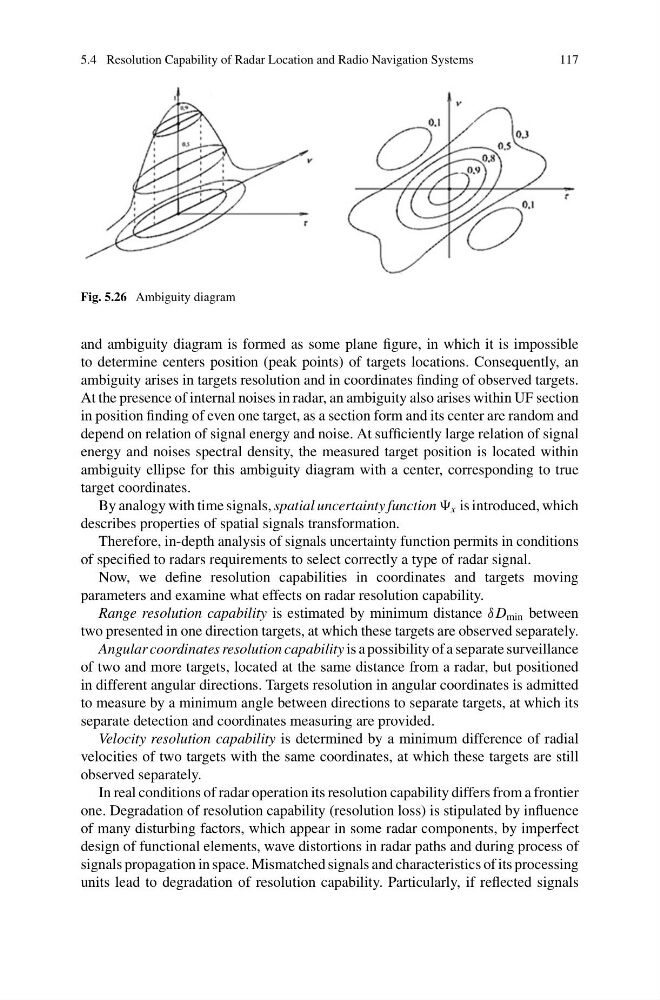
Fig. 5.26 Ambiguity diagram
and ambiguity diagram is formed as some plane figure, in which it is impossible
to determine centers position (peak points) of targets locations. Consequently, an
ambiguity arises in targets resolution and in coordinates finding of observed targets.
At the presence of internal noises in radar, an ambiguity also arises within UF section
in position finding of even one target, as a section form and its center are random and
depend on relation of signal energy and noise. At sufficiently large relation of signal
energy and noises spectral density, the measured target position is located within
ambiguity ellipse for this ambiguity diagram with a center, corresponding to true
target coordinates.
By analogy with time signals, spatial uncertainty function x is introduced, which
describes properties of spatial signals transformation.
Therefore, in-depth analysis of signals uncertainty function permits in conditions
of specified to radars requirements to select correctly a type of radar signal.
Now, we define resolution capabilities in coordinates and targets moving
parameters and examine what effects on radar resolution capability.
Range resolution capability is estimated by minimum distance δ D min between
two presented in one direction targets, at which these targets are observed separately.
Angular coordinates resolution capability is a possibility of a separate surveillance
of two and more targets, located at the same distance from a radar, but positioned
in different angular directions. Targets resolution in angular coordinates is admitted
to measure by a minimum angle between directions to separate targets, at which its
separate detection and coordinates measuring are provided.
Velocity resolution capability is determined by a minimum difference of radial
velocities of two targets with the same coordinates, at which these targets are still
observed separately.
In real conditions of radar operation its resolution capability differs from a frontier
one. Degradation of resolution capability (resolution loss) is stipulated by influence
of many disturbing factors, which appear in some radar components, by imperfect
design of functional elements, wave distortions in radar paths and during process of
signals propagation in space. Mismatched signals and characteristics of its processing
units lead to degradation of resolution capability. Particularly, if reflected signals
117
Fig. 5.26 Ambiguity diagram
and ambiguity diagram is formed as some plane figure, in which it is impossible
to determine centers position (peak points) of targets locations. Consequently, an
ambiguity arises in targets resolution and in coordinates finding of observed targets.
At the presence of internal noises in radar, an ambiguity also arises within UF section
in position finding of even one target, as a section form and its center are random and
depend on relation of signal energy and noise. At sufficiently large relation of signal
energy and noises spectral density, the measured target position is located within
ambiguity ellipse for this ambiguity diagram with a center, corresponding to true
target coordinates.
By analogy with time signals, spatial uncertainty function x is introduced, which
describes properties of spatial signals transformation.
Therefore, in-depth analysis of signals uncertainty function permits in conditions
of specified to radars requirements to select correctly a type of radar signal.
Now, we define resolution capabilities in coordinates and targets moving
parameters and examine what effects on radar resolution capability.
Range resolution capability is estimated by minimum distance δ D min between
two presented in one direction targets, at which these targets are observed separately.
Angular coordinates resolution capability is a possibility of a separate surveillance
of two and more targets, located at the same distance from a radar, but positioned
in different angular directions. Targets resolution in angular coordinates is admitted
to measure by a minimum angle between directions to separate targets, at which its
separate detection and coordinates measuring are provided.
Velocity resolution capability is determined by a minimum difference of radial
velocities of two targets with the same coordinates, at which these targets are still
observed separately.
In real conditions of radar operation its resolution capability differs from a frontier
one. Degradation of resolution capability (resolution loss) is stipulated by influence
of many disturbing factors, which appear in some radar components, by imperfect
design of functional elements, wave distortions in radar paths and during process of
signals propagation in space. Mismatched signals and characteristics of its processing
units lead to degradation of resolution capability. Particularly, if reflected signals