

110
5 Performance Characteristics of Radar Location …
Fig. 5.21 Side-looking
(lateral) radar scan
method of stacked beam patterns, realized in some ground-based radars and representing a combination of a single-beam sequential scan in horizontal plane with
multi-beam instantaneous scan in vertical plane.
Radar scan is characterized by the following parameters:
Radar surveillance zone—space area, within limits of which illumination, receiving
and processing of reflected signals is conducted, including targets detection with
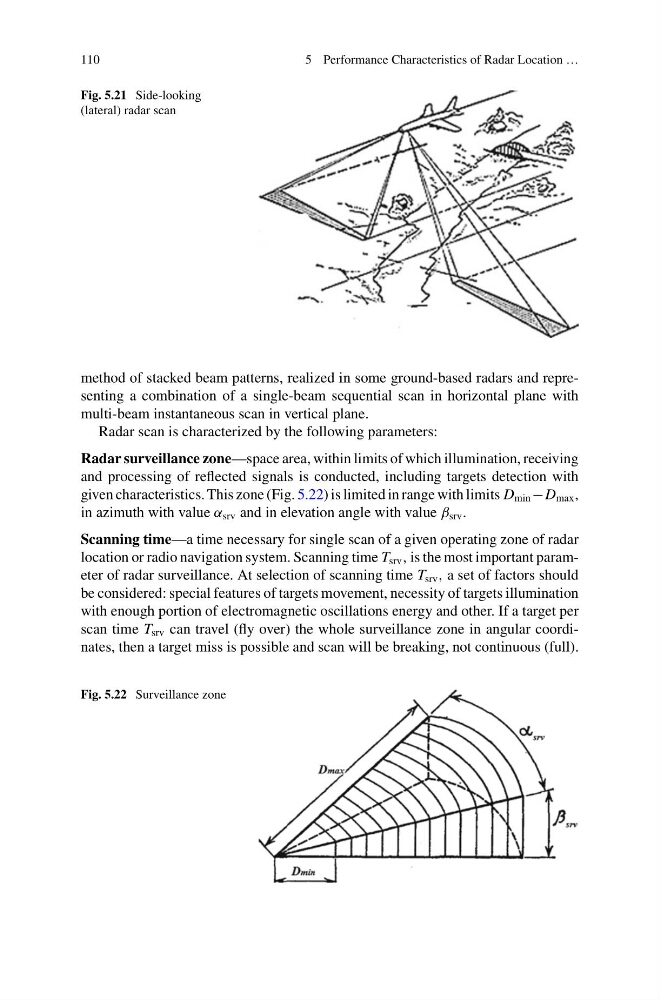
given characteristics. This zone (Fig. 5.22) is limited in range with limits D min −D max ,
in azimuth with value α srv and in elevation angle with value β srv .
Scanning time—a time necessary for single scan of a given operating zone of radar
location or radio navigation system. Scanning time T srv , is the most important parameter of radar surveillance. At selection of scanning time T srv , a set of factors should
be considered: special features of targets movement, necessity of targets illumination
with enough portion of electromagnetic oscillations energy and other. If a target per
scan time T srv can travel (fly over) the whole surveillance zone in angular coordinates, then a target miss is possible and scan will be breaking, not continuous (full).
Fig. 5.22 Surveillance zone
5 Performance Characteristics of Radar Location …
Fig. 5.21 Side-looking
(lateral) radar scan
method of stacked beam patterns, realized in some ground-based radars and representing a combination of a single-beam sequential scan in horizontal plane with
multi-beam instantaneous scan in vertical plane.
Radar scan is characterized by the following parameters:
Radar surveillance zone—space area, within limits of which illumination, receiving
and processing of reflected signals is conducted, including targets detection with
given characteristics. This zone (Fig. 5.22) is limited in range with limits D min −D max ,
in azimuth with value α srv and in elevation angle with value β srv .
Scanning time—a time necessary for single scan of a given operating zone of radar
location or radio navigation system. Scanning time T srv , is the most important parameter of radar surveillance. At selection of scanning time T srv , a set of factors should
be considered: special features of targets movement, necessity of targets illumination
with enough portion of electromagnetic oscillations energy and other. If a target per
scan time T srv can travel (fly over) the whole surveillance zone in angular coordinates, then a target miss is possible and scan will be breaking, not continuous (full).
Fig. 5.22 Surveillance zone