

5.3 Operating Space of Radar Location and Radio Navigation Systems
109
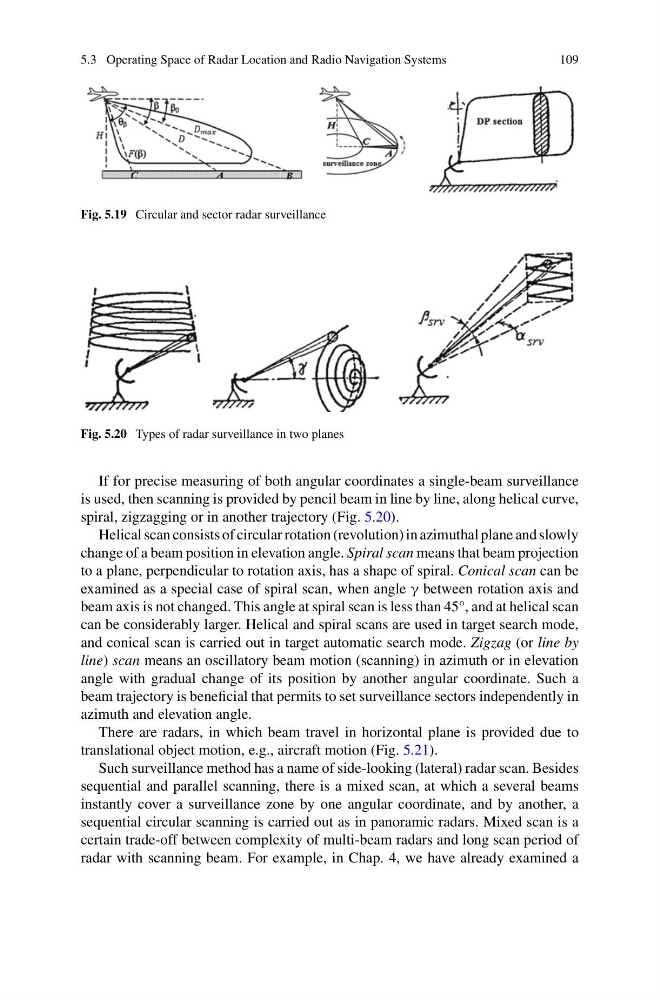
Fig. 5.19 Circular and sector radar surveillance
Fig. 5.20 Types of radar surveillance in two planes
If for precise measuring of both angular coordinates a single-beam surveillance
is used, then scanning is provided by pencil beam in line by line, along helical curve,
spiral, zigzagging or in another trajectory (Fig. 5.20).
Helical scan consists of circular rotation (revolution) in azimuthal plane and slowly
change of a beam position in elevation angle. Spiral scan means that beam projection
to a plane, perpendicular to rotation axis, has a shape of spiral. Conical scan can be
examined as a special case of spiral scan, when angle γ between rotation axis and
beam axis is not changed. This angle at spiral scan is less than 45°, and at helical scan
can be considerably larger. Helical and spiral scans are used in target search mode,
and conical scan is carried out in target automatic search mode. Zigzag (or line by
line) scan means an oscillatory beam motion (scanning) in azimuth or in elevation
angle with gradual change of its position by another angular coordinate. Such a
beam trajectory is beneficial that permits to set surveillance sectors independently in
azimuth and elevation angle.
There are radars, in which beam travel in horizontal plane is provided due to
translational object motion, e.g., aircraft motion (Fig. 5.21).
Such surveillance method has a name of side-looking (lateral) radar scan. Besides
sequential and parallel scanning, there is a mixed scan, at which a several beams
instantly cover a surveillance zone by one angular coordinate, and by another, a
sequential circular scanning is carried out as in panoramic radars. Mixed scan is a
certain trade-off between complexity of multi-beam radars and long scan period of
radar with scanning beam. For example, in Chap. 4, we have already examined a
109
Fig. 5.19 Circular and sector radar surveillance
Fig. 5.20 Types of radar surveillance in two planes
If for precise measuring of both angular coordinates a single-beam surveillance
is used, then scanning is provided by pencil beam in line by line, along helical curve,
spiral, zigzagging or in another trajectory (Fig. 5.20).
Helical scan consists of circular rotation (revolution) in azimuthal plane and slowly
change of a beam position in elevation angle. Spiral scan means that beam projection
to a plane, perpendicular to rotation axis, has a shape of spiral. Conical scan can be
examined as a special case of spiral scan, when angle γ between rotation axis and
beam axis is not changed. This angle at spiral scan is less than 45°, and at helical scan
can be considerably larger. Helical and spiral scans are used in target search mode,
and conical scan is carried out in target automatic search mode. Zigzag (or line by
line) scan means an oscillatory beam motion (scanning) in azimuth or in elevation
angle with gradual change of its position by another angular coordinate. Such a
beam trajectory is beneficial that permits to set surveillance sectors independently in
azimuth and elevation angle.
There are radars, in which beam travel in horizontal plane is provided due to
translational object motion, e.g., aircraft motion (Fig. 5.21).
Such surveillance method has a name of side-looking (lateral) radar scan. Besides
sequential and parallel scanning, there is a mixed scan, at which a several beams
instantly cover a surveillance zone by one angular coordinate, and by another, a
sequential circular scanning is carried out as in panoramic radars. Mixed scan is a
certain trade-off between complexity of multi-beam radars and long scan period of
radar with scanning beam. For example, in Chap. 4, we have already examined a