

u ¼
K s
2
À
c 0
γ À 1
:
ð2:68Þ
Hence, we deduce that both u and c are constant on the positive characteristic and
these characteristics are straight lines with slopes dependent on the particular value
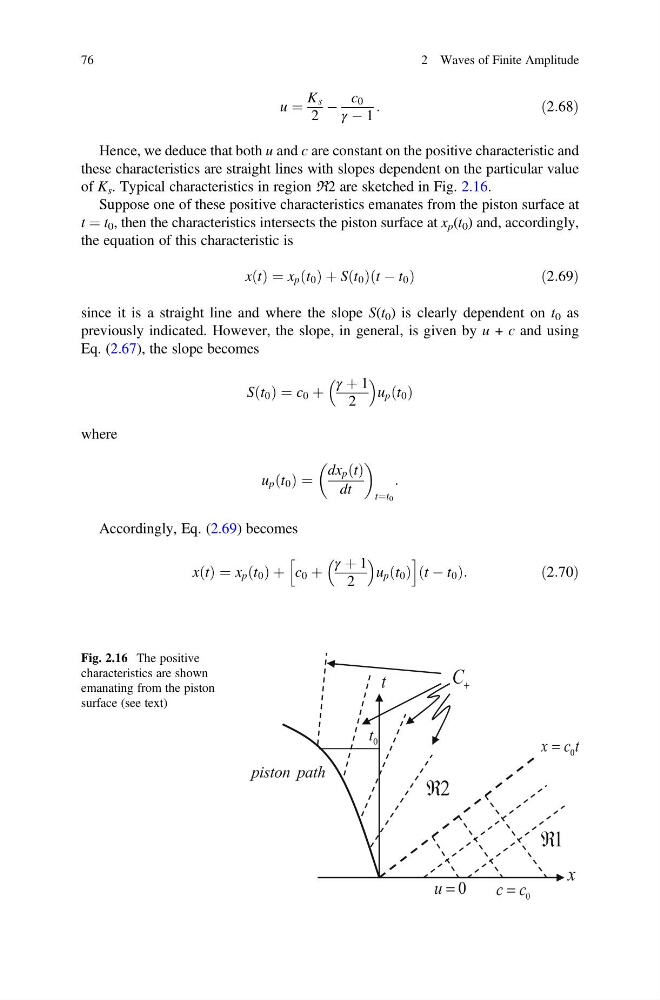
of K s . Typical characteristics in region ℜ2 are sketched in Fig. 2.16.
Suppose one of these positive characteristics emanates from the piston surface at
t ¼ t 0 , then the characteristics intersects the piston surface at x p (t 0 ) and, accordingly,
the equation of this characteristic is
x t
ð Þ ¼ x p t 0
ð Þ þ S t 0
ð Þ t À t 0
ð
Þ
ð2:69Þ
since it is a straight line and where the slope S(t 0 ) is clearly dependent on t 0 as
previously indicated. However, the slope, in general, is given by u + c and using
Eq. (2.67), the slope becomes
S t 0
ð Þ ¼ c 0 þ
γ þ 1
2
u p t 0
ð Þ
where
u p t 0
ð Þ ¼
dx p t
ð Þ
dt
t¼t 0
:
Accordingly, Eq. (2.69) becomes
x t
ð Þ ¼ x p t 0
ð Þ þ c 0 þ
γ þ 1
2
u p t 0
ð Þ
h
i
t À t 0
ð
Þ:
ð2:70Þ
Fig. 2.16 The positive
characteristics are shown
emanating from the piston
surface (see text)
76
2 Waves of Finite Amplitude
K s
2
À
c 0
γ À 1
:
ð2:68Þ
Hence, we deduce that both u and c are constant on the positive characteristic and
these characteristics are straight lines with slopes dependent on the particular value
of K s . Typical characteristics in region ℜ2 are sketched in Fig. 2.16.
Suppose one of these positive characteristics emanates from the piston surface at
t ¼ t 0 , then the characteristics intersects the piston surface at x p (t 0 ) and, accordingly,
the equation of this characteristic is
x t
ð Þ ¼ x p t 0
ð Þ þ S t 0
ð Þ t À t 0
ð
Þ
ð2:69Þ
since it is a straight line and where the slope S(t 0 ) is clearly dependent on t 0 as
previously indicated. However, the slope, in general, is given by u + c and using
Eq. (2.67), the slope becomes
S t 0
ð Þ ¼ c 0 þ
γ þ 1
2
u p t 0
ð Þ
where
u p t 0
ð Þ ¼
dx p t
ð Þ
dt
t¼t 0
:
Accordingly, Eq. (2.69) becomes
x t
ð Þ ¼ x p t 0
ð Þ þ c 0 þ
γ þ 1
2
u p t 0
ð Þ
h
i
t À t 0
ð
Þ:
ð2:70Þ
Fig. 2.16 The positive
characteristics are shown
emanating from the piston
surface (see text)
76
2 Waves of Finite Amplitude