

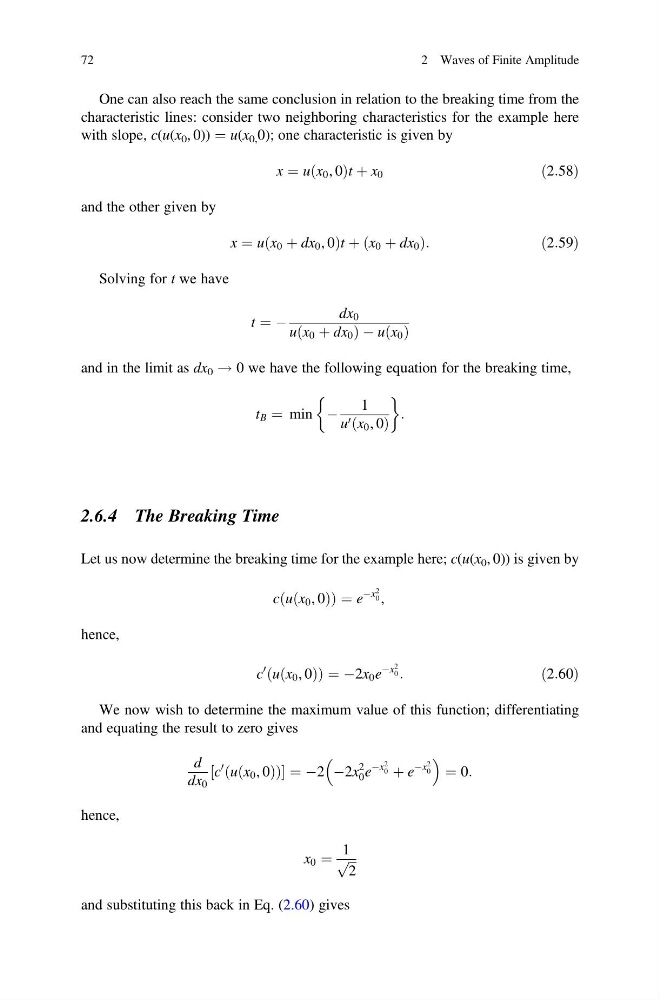
One can also reach the same conclusion in relation to the breaking time from the
characteristic lines: consider two neighboring characteristics for the example here
with slope, c(u(x 0 , 0)) ¼ u(x 0, 0); one characteristic is given by
x ¼ u x 0 , 0
ð
Þt þ x 0
ð2:58Þ
and the other given by
x ¼ u x 0 þ dx 0 , 0
ð
Þ t þ x 0 þ dx 0
ð
Þ :
ð2:59Þ
Solving for t we have
t ¼ À
dx 0
u x 0 þ dx 0
ð
ÞÀu x 0
ð Þ
and in the limit as dx 0 ! 0 we have the following equation for the breaking time,
t B ¼ min À
1
u 0 x 0 , 0
ð
Þ
&
'
:
2.6.4 The Breaking Time
Let us now determine the breaking time for the example here; c(u(x 0 , 0)) is given by
c u x 0 , 0
ð
Þ
ð
Þ¼e
Àx
2
0 ,
hence,
c
0 u x 0 , 0
ð
Þ
ð
Þ¼À 2x 0 e
Àx
2
0 :
ð2:60Þ
We now wish to determine the maximum value of this function; differentiating
and equating the result to zero gives
d
dx 0
c
0 u x 0 , 0
ð
Þ
ð
Þ
½
¼À 2 À2x
2
0 e
Àx
2
0 þ e
Àx
2
0
¼ 0:
hence,
x 0 ¼
1
ffiffi ffi
2
p
and substituting this back in Eq. (2.60) gives
72
2 Waves of Finite Amplitude
characteristic lines: consider two neighboring characteristics for the example here
with slope, c(u(x 0 , 0)) ¼ u(x 0, 0); one characteristic is given by
x ¼ u x 0 , 0
ð
Þt þ x 0
ð2:58Þ
and the other given by
x ¼ u x 0 þ dx 0 , 0
ð
Þ t þ x 0 þ dx 0
ð
Þ :
ð2:59Þ
Solving for t we have
t ¼ À
dx 0
u x 0 þ dx 0
ð
ÞÀu x 0
ð Þ
and in the limit as dx 0 ! 0 we have the following equation for the breaking time,
t B ¼ min À
1
u 0 x 0 , 0
ð
Þ
&
'
:
2.6.4 The Breaking Time
Let us now determine the breaking time for the example here; c(u(x 0 , 0)) is given by
c u x 0 , 0
ð
Þ
ð
Þ¼e
Àx
2
0 ,
hence,
c
0 u x 0 , 0
ð
Þ
ð
Þ¼À 2x 0 e
Àx
2
0 :
ð2:60Þ
We now wish to determine the maximum value of this function; differentiating
and equating the result to zero gives
d
dx 0
c
0 u x 0 , 0
ð
Þ
ð
Þ
½
¼À 2 À2x
2
0 e
Àx
2
0 þ e
Àx
2
0
¼ 0:
hence,
x 0 ¼
1
ffiffi ffi
2
p
and substituting this back in Eq. (2.60) gives
72
2 Waves of Finite Amplitude