

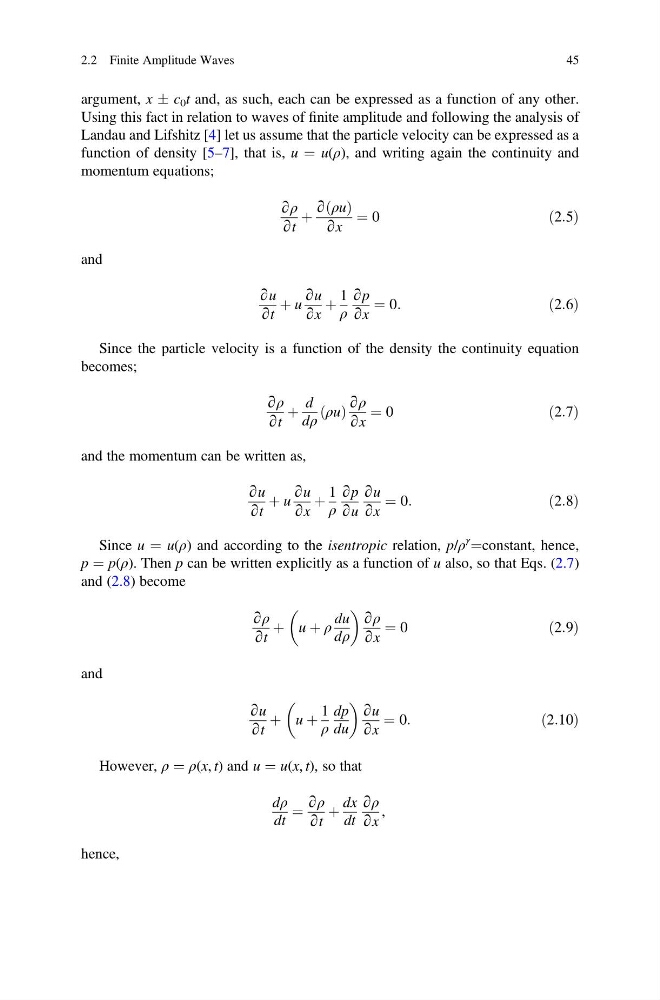
argument, x Æ c 0 t and, as such, each can be expressed as a function of any other.
Using this fact in relation to waves of finite amplitude and following the analysis of
Landau and Lifshitz [4] let us assume that the particle velocity can be expressed as a
function of density [5–7], that is, u ¼ u(ρ), and writing again the continuity and
momentum equations;
∂ρ
∂t
þ
∂ ρu
ð Þ
∂x
¼ 0
ð2:5Þ
and
∂u
∂t
þ u
∂u
∂x
þ
1
ρ
∂p
∂x
¼ 0:
ð2:6Þ
Since the particle velocity is a function of the density the continuity equation
becomes;
∂ρ
∂t
þ
d
dρ
ρu
ð Þ
∂ρ
∂x
¼ 0
ð2:7Þ
and the momentum can be written as,
∂u
∂t
þ u
∂u
∂x
þ
1
ρ
∂p
∂u
∂u
∂x
¼ 0:
ð2:8Þ
Since u ¼ u(ρ) and according to the isentropic relation, p/ρ
γ
¼constant, hence,
p ¼ p(ρ). Then p can be written explicitly as a function of u also, so that Eqs. (2.7)
and (2.8) become
∂ρ
∂t
þ u þ ρ
du
dρ
∂ρ
∂x
¼ 0
ð2:9Þ
and
∂u
∂t
þ u þ
1
ρ
dp
du
∂u
∂x
¼ 0:
ð2:10Þ
However, ρ ¼ ρ(x, t) and u ¼ u(x, t), so that
dρ
dt
¼
∂ρ
∂t
þ
dx
dt
∂ρ
∂x
,
hence,
2.2 Finite Amplitude Waves
45
Using this fact in relation to waves of finite amplitude and following the analysis of
Landau and Lifshitz [4] let us assume that the particle velocity can be expressed as a
function of density [5–7], that is, u ¼ u(ρ), and writing again the continuity and
momentum equations;
∂ρ
∂t
þ
∂ ρu
ð Þ
∂x
¼ 0
ð2:5Þ
and
∂u
∂t
þ u
∂u
∂x
þ
1
ρ
∂p
∂x
¼ 0:
ð2:6Þ
Since the particle velocity is a function of the density the continuity equation
becomes;
∂ρ
∂t
þ
d
dρ
ρu
ð Þ
∂ρ
∂x
¼ 0
ð2:7Þ
and the momentum can be written as,
∂u
∂t
þ u
∂u
∂x
þ
1
ρ
∂p
∂u
∂u
∂x
¼ 0:
ð2:8Þ
Since u ¼ u(ρ) and according to the isentropic relation, p/ρ
γ
¼constant, hence,
p ¼ p(ρ). Then p can be written explicitly as a function of u also, so that Eqs. (2.7)
and (2.8) become
∂ρ
∂t
þ u þ ρ
du
dρ
∂ρ
∂x
¼ 0
ð2:9Þ
and
∂u
∂t
þ u þ
1
ρ
dp
du
∂u
∂x
¼ 0:
ð2:10Þ
However, ρ ¼ ρ(x, t) and u ¼ u(x, t), so that
dρ
dt
¼
∂ρ
∂t
þ
dx
dt
∂ρ
∂x
,
hence,
2.2 Finite Amplitude Waves
45