

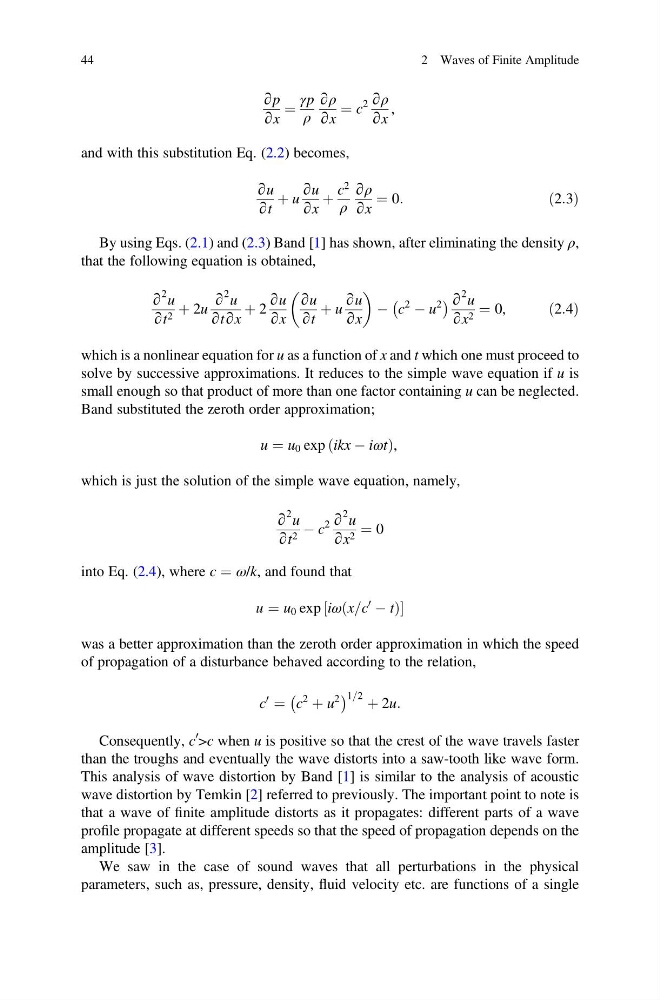
∂p
∂x
¼
γp
ρ
∂ρ
∂x
¼ c
2 ∂ρ
∂x
,
and with this substitution Eq. (2.2) becomes,
∂u
∂t
þ u
∂u
∂x
þ
c
2
ρ
∂ρ
∂x
¼ 0:
ð2:3Þ
By using Eqs. (2.1) and (2.3) Band [1] has shown, after eliminating the density ρ,
that the following equation is obtained,
∂
2 u
∂t 2 þ 2u
∂
2 u
∂t∂x
þ 2
∂u
∂x
∂u
∂t
þ u
∂u
∂x
À c
2
À u
2
À
Á ∂
2 u
∂x 2 ¼ 0,
ð2:4Þ
which is a nonlinear equation for u as a function of x and t which one must proceed to
solve by successive approximations. It reduces to the simple wave equation if u is
small enough so that product of more than one factor containing u can be neglected.
Band substituted the zeroth order approximation;
u ¼ u 0 exp ikx À iωt
ð
Þ ,
which is just the solution of the simple wave equation, namely,
∂
2 u
∂t 2 À c
2 ∂
2 u
∂x 2 ¼ 0
into Eq. (2.4), where c ¼ ω/k, and found that
u ¼ u 0 exp iω x=c
0
À t
ð
Þ
½
was a better approximation than the zeroth order approximation in which the speed
of propagation of a disturbance behaved according to the relation,
c
0
¼ c
2
þ u
2
À
Á 1=2 þ 2u:
Consequently, c
0 >c when u is positive so that the crest of the wave travels faster
than the troughs and eventually the wave distorts into a saw-tooth like wave form.
This analysis of wave distortion by Band [1] is similar to the analysis of acoustic
wave distortion by Temkin [2] referred to previously. The important point to note is
that a wave of finite amplitude distorts as it propagates: different parts of a wave
profile propagate at different speeds so that the speed of propagation depends on the
amplitude [3].
We saw in the case of sound waves that all perturbations in the physical
parameters, such as, pressure, density, fluid velocity etc. are functions of a single
44
2 Waves of Finite Amplitude
∂x
¼
γp
ρ
∂ρ
∂x
¼ c
2 ∂ρ
∂x
,
and with this substitution Eq. (2.2) becomes,
∂u
∂t
þ u
∂u
∂x
þ
c
2
ρ
∂ρ
∂x
¼ 0:
ð2:3Þ
By using Eqs. (2.1) and (2.3) Band [1] has shown, after eliminating the density ρ,
that the following equation is obtained,
∂
2 u
∂t 2 þ 2u
∂
2 u
∂t∂x
þ 2
∂u
∂x
∂u
∂t
þ u
∂u
∂x
À c
2
À u
2
À
Á ∂
2 u
∂x 2 ¼ 0,
ð2:4Þ
which is a nonlinear equation for u as a function of x and t which one must proceed to
solve by successive approximations. It reduces to the simple wave equation if u is
small enough so that product of more than one factor containing u can be neglected.
Band substituted the zeroth order approximation;
u ¼ u 0 exp ikx À iωt
ð
Þ ,
which is just the solution of the simple wave equation, namely,
∂
2 u
∂t 2 À c
2 ∂
2 u
∂x 2 ¼ 0
into Eq. (2.4), where c ¼ ω/k, and found that
u ¼ u 0 exp iω x=c
0
À t
ð
Þ
½
was a better approximation than the zeroth order approximation in which the speed
of propagation of a disturbance behaved according to the relation,
c
0
¼ c
2
þ u
2
À
Á 1=2 þ 2u:
Consequently, c
0 >c when u is positive so that the crest of the wave travels faster
than the troughs and eventually the wave distorts into a saw-tooth like wave form.
This analysis of wave distortion by Band [1] is similar to the analysis of acoustic
wave distortion by Temkin [2] referred to previously. The important point to note is
that a wave of finite amplitude distorts as it propagates: different parts of a wave
profile propagate at different speeds so that the speed of propagation depends on the
amplitude [3].
We saw in the case of sound waves that all perturbations in the physical
parameters, such as, pressure, density, fluid velocity etc. are functions of a single
44
2 Waves of Finite Amplitude