

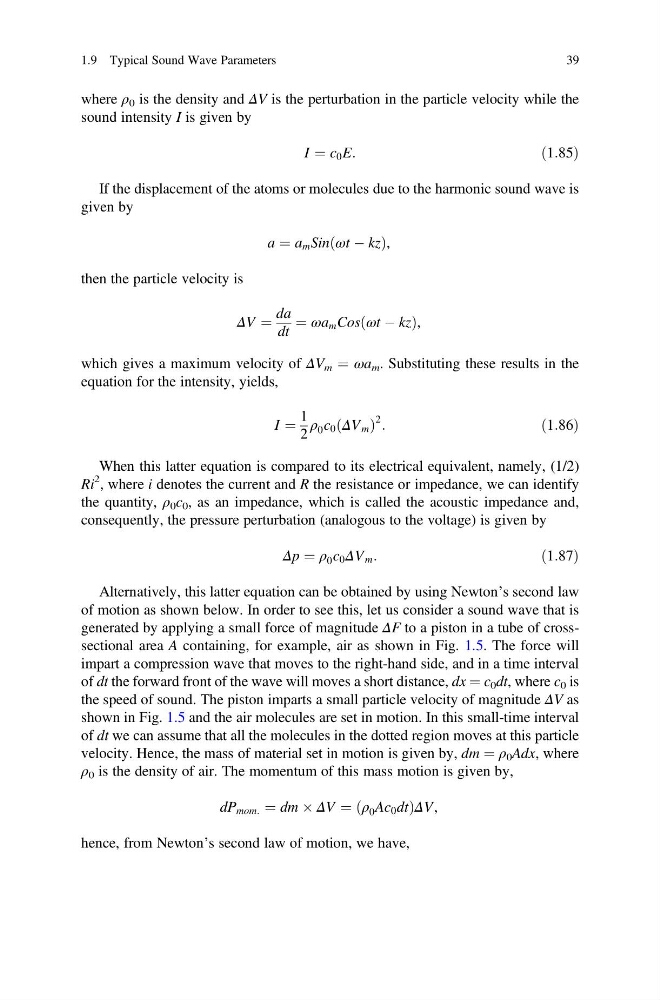
where ρ 0 is the density and ΔV is the perturbation in the particle velocity while the
sound intensity I is given by
I ¼ c 0 E:
ð1:85Þ
If the displacement of the atoms or molecules due to the harmonic sound wave is
given by
a ¼ a m Sin ωt À kz
ð
Þ ,
then the particle velocity is
ΔV ¼
da
dt
¼ ωa m Cos ωt À kz
ð
Þ ,
which gives a maximum velocity of ΔV m ¼ ωa m . Substituting these results in the
equation for the intensity, yields,
I ¼
1
2
ρ 0 c 0 ΔV m
ð
Þ
2 :
ð1:86Þ
When this latter equation is compared to its electrical equivalent, namely, (1/2)
Ri
2 , where i denotes the current and R the resistance or impedance, we can identify
the quantity, ρ 0 c 0 , as an impedance, which is called the acoustic impedance and,
consequently, the pressure perturbation (analogous to the voltage) is given by
Δp ¼ ρ 0 c 0 ΔV m :
ð1:87Þ
Alternatively, this latter equation can be obtained by using Newton’s second law
of motion as shown below. In order to see this, let us consider a sound wave that is
generated by applying a small force of magnitude ΔF to a piston in a tube of crosssectional area A containing, for example, air as shown in Fig. 1.5. The force will
impart a compression wave that moves to the right-hand side, and in a time interval
of dt the forward front of the wave will moves a short distance, dx ¼ c 0 dt, where c 0 is
the speed of sound. The piston imparts a small particle velocity of magnitude ΔV as
shown in Fig. 1.5 and the air molecules are set in motion. In this small-time interval
of dt we can assume that all the molecules in the dotted region moves at this particle
velocity. Hence, the mass of material set in motion is given by, dm ¼ ρ 0 Adx, where
ρ 0 is the density of air. The momentum of this mass motion is given by,
dP mom: ¼ dm  ΔV ¼ ρ 0 Ac 0 dt
ð
Þ ΔV,
hence, from Newton’s second law of motion, we have,
1.9 Typical Sound Wave Parameters
39
sound intensity I is given by
I ¼ c 0 E:
ð1:85Þ
If the displacement of the atoms or molecules due to the harmonic sound wave is
given by
a ¼ a m Sin ωt À kz
ð
Þ ,
then the particle velocity is
ΔV ¼
da
dt
¼ ωa m Cos ωt À kz
ð
Þ ,
which gives a maximum velocity of ΔV m ¼ ωa m . Substituting these results in the
equation for the intensity, yields,
I ¼
1
2
ρ 0 c 0 ΔV m
ð
Þ
2 :
ð1:86Þ
When this latter equation is compared to its electrical equivalent, namely, (1/2)
Ri
2 , where i denotes the current and R the resistance or impedance, we can identify
the quantity, ρ 0 c 0 , as an impedance, which is called the acoustic impedance and,
consequently, the pressure perturbation (analogous to the voltage) is given by
Δp ¼ ρ 0 c 0 ΔV m :
ð1:87Þ
Alternatively, this latter equation can be obtained by using Newton’s second law
of motion as shown below. In order to see this, let us consider a sound wave that is
generated by applying a small force of magnitude ΔF to a piston in a tube of crosssectional area A containing, for example, air as shown in Fig. 1.5. The force will
impart a compression wave that moves to the right-hand side, and in a time interval
of dt the forward front of the wave will moves a short distance, dx ¼ c 0 dt, where c 0 is
the speed of sound. The piston imparts a small particle velocity of magnitude ΔV as
shown in Fig. 1.5 and the air molecules are set in motion. In this small-time interval
of dt we can assume that all the molecules in the dotted region moves at this particle
velocity. Hence, the mass of material set in motion is given by, dm ¼ ρ 0 Adx, where
ρ 0 is the density of air. The momentum of this mass motion is given by,
dP mom: ¼ dm  ΔV ¼ ρ 0 Ac 0 dt
ð
Þ ΔV,
hence, from Newton’s second law of motion, we have,
1.9 Typical Sound Wave Parameters
39