

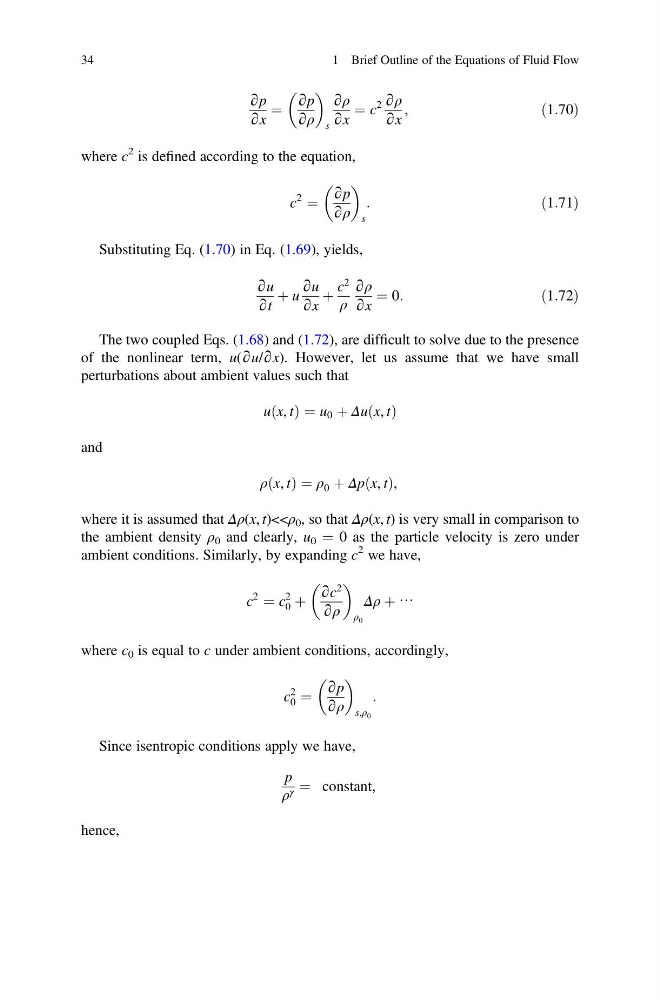
∂p
∂x
¼
∂p
∂ρ
s
∂ρ
∂x
¼ c
2 ∂ρ
∂x
,
ð1:70Þ
where c
2 is defined according to the equation,
c
2
¼
∂p
∂ρ
s
:
ð1:71Þ
Substituting Eq. (1.70) in Eq. (1.69), yields,
∂u
∂t
þ u
∂u
∂x
þ
c
2
ρ
∂ρ
∂x
¼ 0:
ð1:72Þ
The two coupled Eqs. (1.68) and (1.72), are difficult to solve due to the presence
of the nonlinear term, u(∂u/∂x). However, let us assume that we have small
perturbations about ambient values such that
u x, t
ð Þ ¼ u 0 þ Δu x, t
ð Þ
and
ρ x, t
ð Þ ¼ ρ 0 þ Δp x, t
ð Þ,
where it is assumed that Δρ(x, t)<<ρ 0 , so that Δρ(x, t) is very small in comparison to
the ambient density ρ 0 and clearly, u 0 ¼ 0 as the particle velocity is zero under
ambient conditions. Similarly, by expanding c
2 we have,
c
2
¼ c
2
0 þ
∂c
2
∂ρ
ρ 0
Δρ þ ⋯
where c 0 is equal to c under ambient conditions, accordingly,
c
2
0 ¼
∂p
∂ρ
s,ρ 0
:
Since isentropic conditions apply we have,
p
ρ γ ¼ constant,
hence,
34
1 Brief Outline of the Equations of Fluid Flow
∂x
¼
∂p
∂ρ
s
∂ρ
∂x
¼ c
2 ∂ρ
∂x
,
ð1:70Þ
where c
2 is defined according to the equation,
c
2
¼
∂p
∂ρ
s
:
ð1:71Þ
Substituting Eq. (1.70) in Eq. (1.69), yields,
∂u
∂t
þ u
∂u
∂x
þ
c
2
ρ
∂ρ
∂x
¼ 0:
ð1:72Þ
The two coupled Eqs. (1.68) and (1.72), are difficult to solve due to the presence
of the nonlinear term, u(∂u/∂x). However, let us assume that we have small
perturbations about ambient values such that
u x, t
ð Þ ¼ u 0 þ Δu x, t
ð Þ
and
ρ x, t
ð Þ ¼ ρ 0 þ Δp x, t
ð Þ,
where it is assumed that Δρ(x, t)<<ρ 0 , so that Δρ(x, t) is very small in comparison to
the ambient density ρ 0 and clearly, u 0 ¼ 0 as the particle velocity is zero under
ambient conditions. Similarly, by expanding c
2 we have,
c
2
¼ c
2
0 þ
∂c
2
∂ρ
ρ 0
Δρ þ ⋯
where c 0 is equal to c under ambient conditions, accordingly,
c
2
0 ¼
∂p
∂ρ
s,ρ 0
:
Since isentropic conditions apply we have,
p
ρ γ ¼ constant,
hence,
34
1 Brief Outline of the Equations of Fluid Flow