

∂
∂t
1
2
ρu
2
þ
p
γ À 1
þ
1
r 2
∂
∂r
r
2 1
2
ρu
2
þ
γp
γ À 1
u
!
¼ 0
ð1:66bÞ
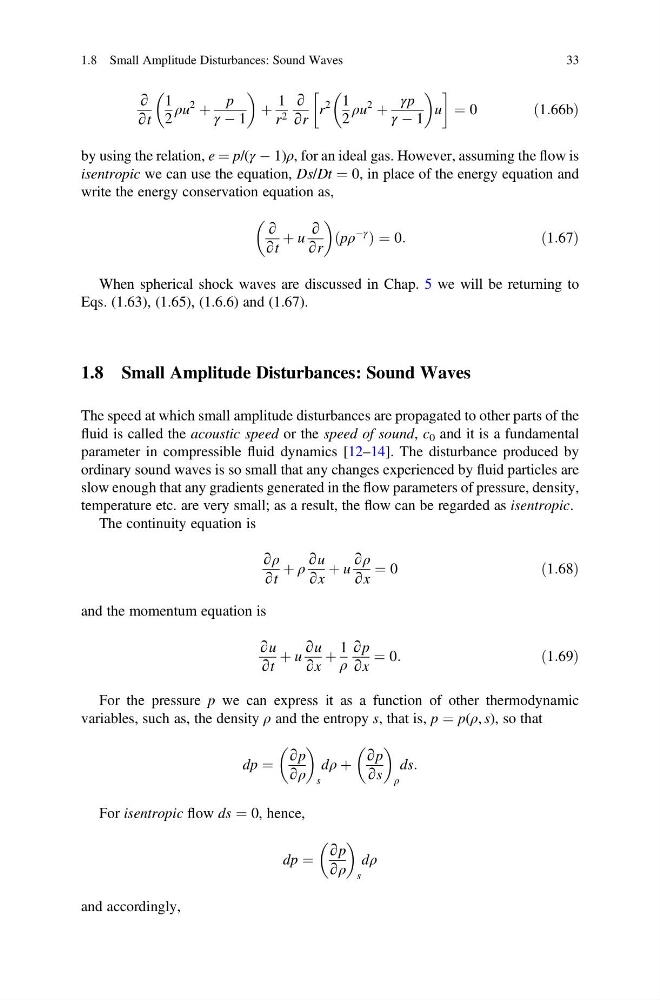
by using the relation, e ¼ p/(γ À 1)ρ, for an ideal gas. However, assuming the flow is
isentropic we can use the equation, Ds/Dt ¼ 0, in place of the energy equation and
write the energy conservation equation as,
∂
∂t
þ u
∂
∂r
pρ
Àγ
ð
Þ¼0:
ð1:67Þ
When spherical shock waves are discussed in Chap. 5 we will be returning to
Eqs. (1.63), (1.65), (1.6.6) and (1.67).
1.8 Small Amplitude Disturbances: Sound Waves
The speed at which small amplitude disturbances are propagated to other parts of the
fluid is called the acoustic speed or the speed of sound, c 0 and it is a fundamental
parameter in compressible fluid dynamics [12–14]. The disturbance produced by
ordinary sound waves is so small that any changes experienced by fluid particles are
slow enough that any gradients generated in the flow parameters of pressure, density,
temperature etc. are very small; as a result, the flow can be regarded as isentropic.
The continuity equation is
∂ρ
∂t
þ ρ
∂u
∂x
þ u
∂ρ
∂x
¼ 0
ð1:68Þ
and the momentum equation is
∂u
∂t
þ u
∂u
∂x
þ
1
ρ
∂p
∂x
¼ 0:
ð1:69Þ
For the pressure p we can express it as a function of other thermodynamic
variables, such as, the density ρ and the entropy s, that is, p ¼ p(ρ, s), so that
dp ¼
∂p
∂ρ
s
dρ þ
∂p
∂s
ρ
ds:
For isentropic flow ds ¼ 0, hence,
dp ¼
∂p
∂ρ
s
dρ
and accordingly,
1.8 Small Amplitude Disturbances: Sound Waves
33
∂t
1
2
ρu
2
þ
p
γ À 1
þ
1
r 2
∂
∂r
r
2 1
2
ρu
2
þ
γp
γ À 1
u
!
¼ 0
ð1:66bÞ
by using the relation, e ¼ p/(γ À 1)ρ, for an ideal gas. However, assuming the flow is
isentropic we can use the equation, Ds/Dt ¼ 0, in place of the energy equation and
write the energy conservation equation as,
∂
∂t
þ u
∂
∂r
pρ
Àγ
ð
Þ¼0:
ð1:67Þ
When spherical shock waves are discussed in Chap. 5 we will be returning to
Eqs. (1.63), (1.65), (1.6.6) and (1.67).
1.8 Small Amplitude Disturbances: Sound Waves
The speed at which small amplitude disturbances are propagated to other parts of the
fluid is called the acoustic speed or the speed of sound, c 0 and it is a fundamental
parameter in compressible fluid dynamics [12–14]. The disturbance produced by
ordinary sound waves is so small that any changes experienced by fluid particles are
slow enough that any gradients generated in the flow parameters of pressure, density,
temperature etc. are very small; as a result, the flow can be regarded as isentropic.
The continuity equation is
∂ρ
∂t
þ ρ
∂u
∂x
þ u
∂ρ
∂x
¼ 0
ð1:68Þ
and the momentum equation is
∂u
∂t
þ u
∂u
∂x
þ
1
ρ
∂p
∂x
¼ 0:
ð1:69Þ
For the pressure p we can express it as a function of other thermodynamic
variables, such as, the density ρ and the entropy s, that is, p ¼ p(ρ, s), so that
dp ¼
∂p
∂ρ
s
dρ þ
∂p
∂s
ρ
ds:
For isentropic flow ds ¼ 0, hence,
dp ¼
∂p
∂ρ
s
dρ
and accordingly,
1.8 Small Amplitude Disturbances: Sound Waves
33