

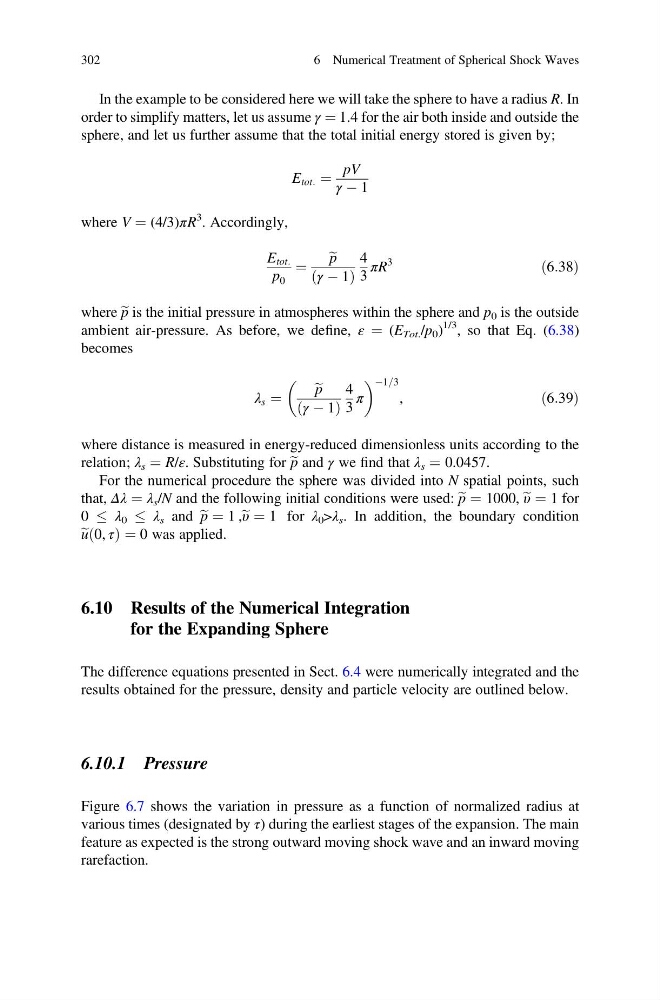
In the example to be considered here we will take the sphere to have a radius R. In
order to simplify matters, let us assume γ ¼ 1.4 for the air both inside and outside the
sphere, and let us further assume that the total initial energy stored is given by;
E tot: ¼
pV
γ À 1
where V ¼ (4/3)πR
3 . Accordingly,
E tot:
p 0
¼
e p
γ À 1
ð
Þ
4
3
πR
3
ð6:38Þ
where e p is the initial pressure in atmospheres within the sphere and p 0 is the outside
ambient air-pressure. As before, we define, ε ¼ (E Tot. /p 0 )
1/3 , so that Eq. (6.38)
becomes
λ s ¼
e p
γ À 1
ð
Þ
4
3
π
À1=3
,
ð6:39Þ
where distance is measured in energy-reduced dimensionless units according to the
relation; λ s ¼ R/ε. Substituting for e p and γ we find that λ s ¼ 0.0457.
For the numerical procedure the sphere was divided into N spatial points, such
that, Δλ ¼ λ s /N and the following initial conditions were used: e p ¼ 1000, e υ ¼ 1 for
0
λ 0
λ s and e p ¼ 1 ,e υ ¼ 1 for λ 0 >λ s . In addition, the boundary condition
e u 0, τ
ð Þ ¼ 0 was applied.
6.10 Results of the Numerical Integration
for the Expanding Sphere
The difference equations presented in Sect. 6.4 were numerically integrated and the
results obtained for the pressure, density and particle velocity are outlined below.
6.10.1 Pressure
Figure 6.7 shows the variation in pressure as a function of normalized radius at
various times (designated by τ) during the earliest stages of the expansion. The main
feature as expected is the strong outward moving shock wave and an inward moving
rarefaction.
302
6 Numerical Treatment of Spherical Shock Waves
order to simplify matters, let us assume γ ¼ 1.4 for the air both inside and outside the
sphere, and let us further assume that the total initial energy stored is given by;
E tot: ¼
pV
γ À 1
where V ¼ (4/3)πR
3 . Accordingly,
E tot:
p 0
¼
e p
γ À 1
ð
Þ
4
3
πR
3
ð6:38Þ
where e p is the initial pressure in atmospheres within the sphere and p 0 is the outside
ambient air-pressure. As before, we define, ε ¼ (E Tot. /p 0 )
1/3 , so that Eq. (6.38)
becomes
λ s ¼
e p
γ À 1
ð
Þ
4
3
π
À1=3
,
ð6:39Þ
where distance is measured in energy-reduced dimensionless units according to the
relation; λ s ¼ R/ε. Substituting for e p and γ we find that λ s ¼ 0.0457.
For the numerical procedure the sphere was divided into N spatial points, such
that, Δλ ¼ λ s /N and the following initial conditions were used: e p ¼ 1000, e υ ¼ 1 for
0
λ 0
λ s and e p ¼ 1 ,e υ ¼ 1 for λ 0 >λ s . In addition, the boundary condition
e u 0, τ
ð Þ ¼ 0 was applied.
6.10 Results of the Numerical Integration
for the Expanding Sphere
The difference equations presented in Sect. 6.4 were numerically integrated and the
results obtained for the pressure, density and particle velocity are outlined below.
6.10.1 Pressure
Figure 6.7 shows the variation in pressure as a function of normalized radius at
various times (designated by τ) during the earliest stages of the expansion. The main
feature as expected is the strong outward moving shock wave and an inward moving
rarefaction.
302
6 Numerical Treatment of Spherical Shock Waves