

ε
3
¼
E 0
p 0
¼
4π
p 0
Z R
0
r
2 1
2
ρu
2
þ
p
γ À 1
dr À
4πR
3
3 γ À 1
ð
Þ
,
ð6:3Þ
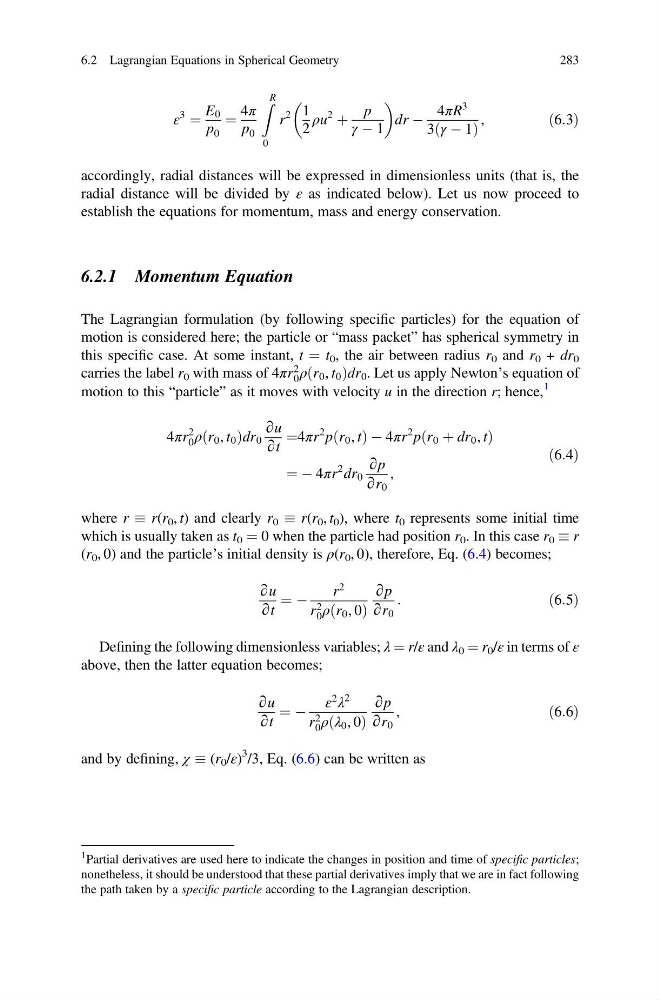
accordingly, radial distances will be expressed in dimensionless units (that is, the
radial distance will be divided by ε as indicated below). Let us now proceed to
establish the equations for momentum, mass and energy conservation.
6.2.1 Momentum Equation
The Lagrangian formulation (by following specific particles) for the equation of
motion is considered here; the particle or “mass packet” has spherical symmetry in
this specific case. At some instant, t ¼ t 0 , the air between radius r 0 and r 0 + dr 0
carries the label r 0 with mass of 4πr
2
0 ρ r 0 , t 0
ð
Þdr 0 . Let us apply Newton’s equation of
motion to this “particle” as it moves with velocity u in the direction r; hence,
1
4πr
2
0 ρ r 0 , t 0
ð
Þdr 0
∂u
∂t
¼4πr
2 p r 0 , t
ð
ÞÀ4πr
2 p r 0 þ dr 0 , t
ð
Þ
¼ À 4πr
2 dr 0
∂p
∂r 0
,
ð6:4Þ
where r r(r 0 , t) and clearly r 0 r(r 0 , t 0 ), where t 0 represents some initial time
which is usually taken as t 0 ¼ 0 when the particle had position r 0 . In this case r 0 r
(r 0 , 0) and the particle’s initial density is ρ(r 0 , 0), therefore, Eq. (6.4) becomes;
∂u
∂t
¼ À
r
2
r 2
0 ρ r 0 , 0
ð
Þ
∂p
∂r 0
:
ð6:5Þ
Defining the following dimensionless variables; λ ¼ r/ε and λ 0 ¼ r 0 /ε in terms of ε
above, then the latter equation becomes;
∂u
∂t
¼ À
ε
2
λ
2
r 2
0 ρ λ 0 , 0
ð
Þ
∂p
∂r 0
,
ð6:6Þ
and by defining, χ (r 0 /ε)
3 /3, Eq. (6.6) can be written as
1 Partial derivatives are used here to indicate the changes in position and time of specific particles;
nonetheless, it should be understood that these partial derivatives imply that we are in fact following
the path taken by a specific particle according to the Lagrangian description.
6.2 Lagrangian Equations in Spherical Geometry
283
3
¼
E 0
p 0
¼
4π
p 0
Z R
0
r
2 1
2
ρu
2
þ
p
γ À 1
dr À
4πR
3
3 γ À 1
ð
Þ
,
ð6:3Þ
accordingly, radial distances will be expressed in dimensionless units (that is, the
radial distance will be divided by ε as indicated below). Let us now proceed to
establish the equations for momentum, mass and energy conservation.
6.2.1 Momentum Equation
The Lagrangian formulation (by following specific particles) for the equation of
motion is considered here; the particle or “mass packet” has spherical symmetry in
this specific case. At some instant, t ¼ t 0 , the air between radius r 0 and r 0 + dr 0
carries the label r 0 with mass of 4πr
2
0 ρ r 0 , t 0
ð
Þdr 0 . Let us apply Newton’s equation of
motion to this “particle” as it moves with velocity u in the direction r; hence,
1
4πr
2
0 ρ r 0 , t 0
ð
Þdr 0
∂u
∂t
¼4πr
2 p r 0 , t
ð
ÞÀ4πr
2 p r 0 þ dr 0 , t
ð
Þ
¼ À 4πr
2 dr 0
∂p
∂r 0
,
ð6:4Þ
where r r(r 0 , t) and clearly r 0 r(r 0 , t 0 ), where t 0 represents some initial time
which is usually taken as t 0 ¼ 0 when the particle had position r 0 . In this case r 0 r
(r 0 , 0) and the particle’s initial density is ρ(r 0 , 0), therefore, Eq. (6.4) becomes;
∂u
∂t
¼ À
r
2
r 2
0 ρ r 0 , 0
ð
Þ
∂p
∂r 0
:
ð6:5Þ
Defining the following dimensionless variables; λ ¼ r/ε and λ 0 ¼ r 0 /ε in terms of ε
above, then the latter equation becomes;
∂u
∂t
¼ À
ε
2
λ
2
r 2
0 ρ λ 0 , 0
ð
Þ
∂p
∂r 0
,
ð6:6Þ
and by defining, χ (r 0 /ε)
3 /3, Eq. (6.6) can be written as
1 Partial derivatives are used here to indicate the changes in position and time of specific particles;
nonetheless, it should be understood that these partial derivatives imply that we are in fact following
the path taken by a specific particle according to the Lagrangian description.
6.2 Lagrangian Equations in Spherical Geometry
283