

the similarity solution and we must resort to numerical techniques to solve the
equations of fluid flow.
In the analysis to follow we will use the Lagrangian form of the equations in
spherical geometry similar to that presented in Chap. 4 in the case of plane shocks; in
addition, artificial viscosity will be introduced to avoid discontinuities.
6.2 Lagrangian Equations in Spherical Geometry
The equations are written in Lagrangian form, that is, in a coordinate system that
moves with the particles so that each particle or infinitesimal cross-section carries a
label as its position changes with time. We will follow the Lagrangian notation of
Zel’dovich and Raizer [1] and in the article by Brode [3].
We have already seen (in Chap. 5) that the total blast energy can be written as
E 0 ¼
Z R
0
1
2
ρu
2
þ
p
γ À 1
4πr
2 dr À
4πR
3
3
p 0
γ À 1
ð6:1Þ
where R is the radius of the shock front. The subtracted term is the internal energy of
the air prior to being engulfed by the shock of radius R. Dividing across by p 0 , the
ambient air pressure ( p 0 ¼ 1.013 Â 10
5 Nm
À2 ), we have
E 0
p 0
¼
4π
p 0
Z R
0
r
2 1
2
ρu
2
þ
p
γ À 1
dr À
4πR
3
3 γ À 1
ð
Þ
:
ð6:2Þ
Noting that the last term in the latter equation has dimensions of length cubed, so
let us define a length ε in terms of the energy E 0 and the ambient pressure p 0 , such
that,
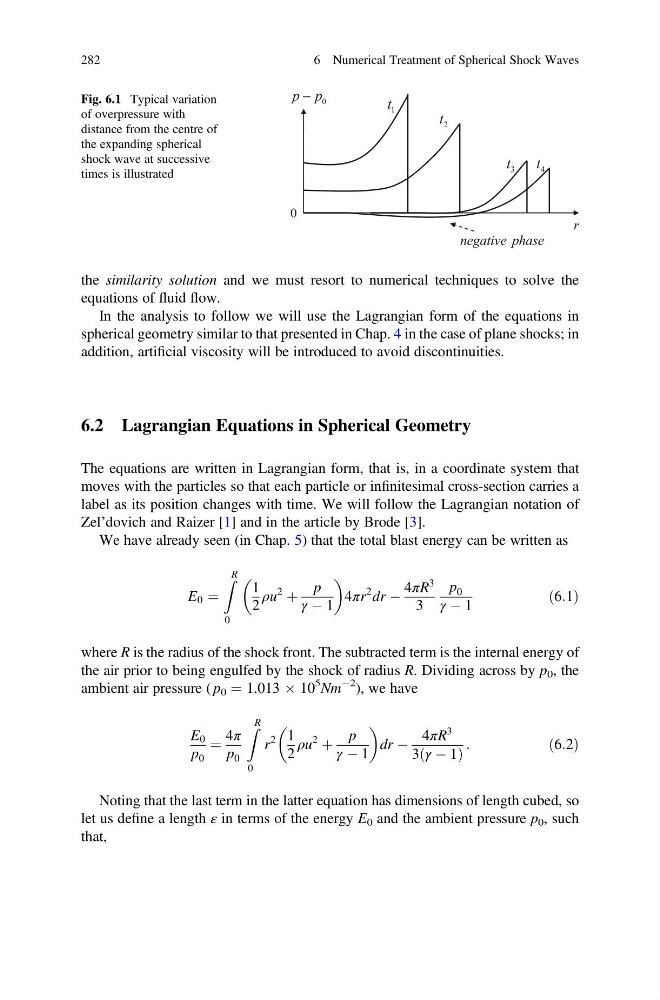
Fig. 6.1 Typical variation
of overpressure with
distance from the centre of
the expanding spherical
shock wave at successive
times is illustrated
282
6 Numerical Treatment of Spherical Shock Waves
equations of fluid flow.
In the analysis to follow we will use the Lagrangian form of the equations in
spherical geometry similar to that presented in Chap. 4 in the case of plane shocks; in
addition, artificial viscosity will be introduced to avoid discontinuities.
6.2 Lagrangian Equations in Spherical Geometry
The equations are written in Lagrangian form, that is, in a coordinate system that
moves with the particles so that each particle or infinitesimal cross-section carries a
label as its position changes with time. We will follow the Lagrangian notation of
Zel’dovich and Raizer [1] and in the article by Brode [3].
We have already seen (in Chap. 5) that the total blast energy can be written as
E 0 ¼
Z R
0
1
2
ρu
2
þ
p
γ À 1
4πr
2 dr À
4πR
3
3
p 0
γ À 1
ð6:1Þ
where R is the radius of the shock front. The subtracted term is the internal energy of
the air prior to being engulfed by the shock of radius R. Dividing across by p 0 , the
ambient air pressure ( p 0 ¼ 1.013 Â 10
5 Nm
À2 ), we have
E 0
p 0
¼
4π
p 0
Z R
0
r
2 1
2
ρu
2
þ
p
γ À 1
dr À
4πR
3
3 γ À 1
ð
Þ
:
ð6:2Þ
Noting that the last term in the latter equation has dimensions of length cubed, so
let us define a length ε in terms of the energy E 0 and the ambient pressure p 0 , such
that,
Fig. 6.1 Typical variation
of overpressure with
distance from the centre of
the expanding spherical
shock wave at successive
times is illustrated
282
6 Numerical Treatment of Spherical Shock Waves