

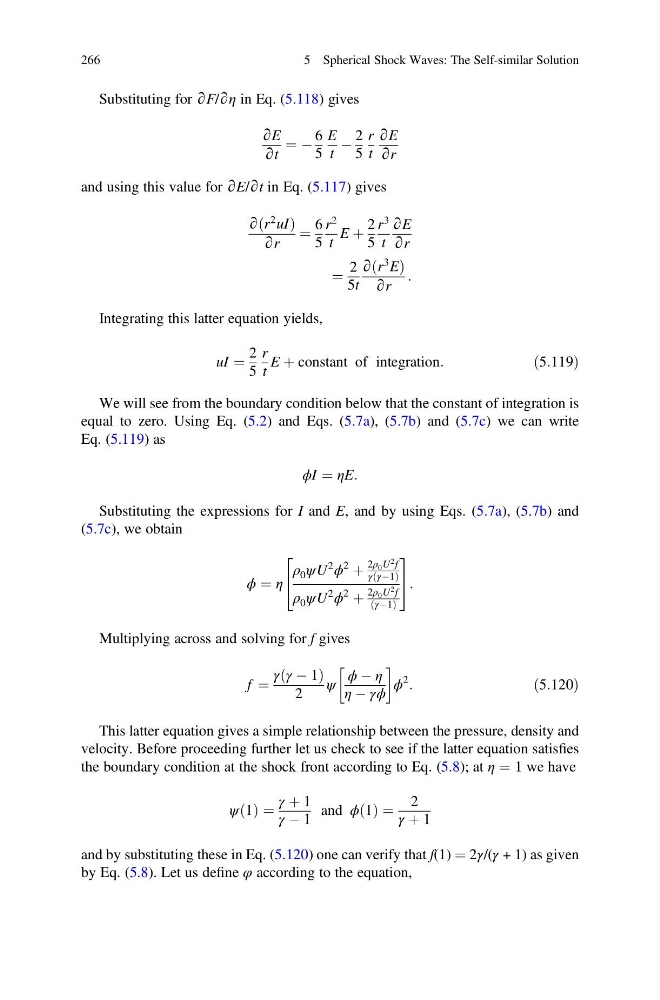
Substituting for ∂F/∂η in Eq. (5.118) gives
∂E
∂t
¼ À
6
5
E
t
À
2
5
r
t
∂E
∂r
and using this value for ∂E/∂t in Eq. (5.117) gives
∂ r
2 uI
ð
Þ
∂r
¼
6
5
r
2
t
E þ
2
5
r
3
t
∂E
∂r
¼
2
5t
∂ r
3 E
ð Þ
∂r
:
Integrating this latter equation yields,
uI ¼
2
5
r
t
E þ constant of integration:
ð5:119Þ
We will see from the boundary condition below that the constant of integration is
equal to zero. Using Eq. (5.2) and Eqs. (5.7a), (5.7b) and (5.7c) we can write
Eq. (5.119) as
ϕI ¼ ηE:
Substituting the expressions for I and E, and by using Eqs. (5.7a), (5.7b) and
(5.7c), we obtain
ϕ ¼ η
ρ 0 ψU
2
ϕ
2
þ
2ρ 0 U
2 f
γ γÀ1
ð
Þ
ρ 0 ψU
2
ϕ
2
þ
2ρ 0 U
2 f
γÀ1
ð
Þ
2
4
3
5 :
Multiplying across and solving for f gives
f ¼
γ γ À 1
ð
Þ
2
ψ
ϕ À η
η À γϕ
!
ϕ
2
:
ð5:120Þ
This latter equation gives a simple relationship between the pressure, density and
velocity. Before proceeding further let us check to see if the latter equation satisfies
the boundary condition at the shock front according to Eq. (5.8); at η ¼ 1 we have
ψ 1
ð Þ ¼
γ þ 1
γ À 1
and ϕ 1
ð Þ ¼
2
γ þ 1
and by substituting these in Eq. (5.120) one can verify that f(1) ¼ 2γ/(γ + 1) as given
by Eq. (5.8). Let us define φ according to the equation,
266
5 Spherical Shock Waves: The Self-similar Solution
∂E
∂t
¼ À
6
5
E
t
À
2
5
r
t
∂E
∂r
and using this value for ∂E/∂t in Eq. (5.117) gives
∂ r
2 uI
ð
Þ
∂r
¼
6
5
r
2
t
E þ
2
5
r
3
t
∂E
∂r
¼
2
5t
∂ r
3 E
ð Þ
∂r
:
Integrating this latter equation yields,
uI ¼
2
5
r
t
E þ constant of integration:
ð5:119Þ
We will see from the boundary condition below that the constant of integration is
equal to zero. Using Eq. (5.2) and Eqs. (5.7a), (5.7b) and (5.7c) we can write
Eq. (5.119) as
ϕI ¼ ηE:
Substituting the expressions for I and E, and by using Eqs. (5.7a), (5.7b) and
(5.7c), we obtain
ϕ ¼ η
ρ 0 ψU
2
ϕ
2
þ
2ρ 0 U
2 f
γ γÀ1
ð
Þ
ρ 0 ψU
2
ϕ
2
þ
2ρ 0 U
2 f
γÀ1
ð
Þ
2
4
3
5 :
Multiplying across and solving for f gives
f ¼
γ γ À 1
ð
Þ
2
ψ
ϕ À η
η À γϕ
!
ϕ
2
:
ð5:120Þ
This latter equation gives a simple relationship between the pressure, density and
velocity. Before proceeding further let us check to see if the latter equation satisfies
the boundary condition at the shock front according to Eq. (5.8); at η ¼ 1 we have
ψ 1
ð Þ ¼
γ þ 1
γ À 1
and ϕ 1
ð Þ ¼
2
γ þ 1
and by substituting these in Eq. (5.120) one can verify that f(1) ¼ 2γ/(γ + 1) as given
by Eq. (5.8). Let us define φ according to the equation,
266
5 Spherical Shock Waves: The Self-similar Solution