

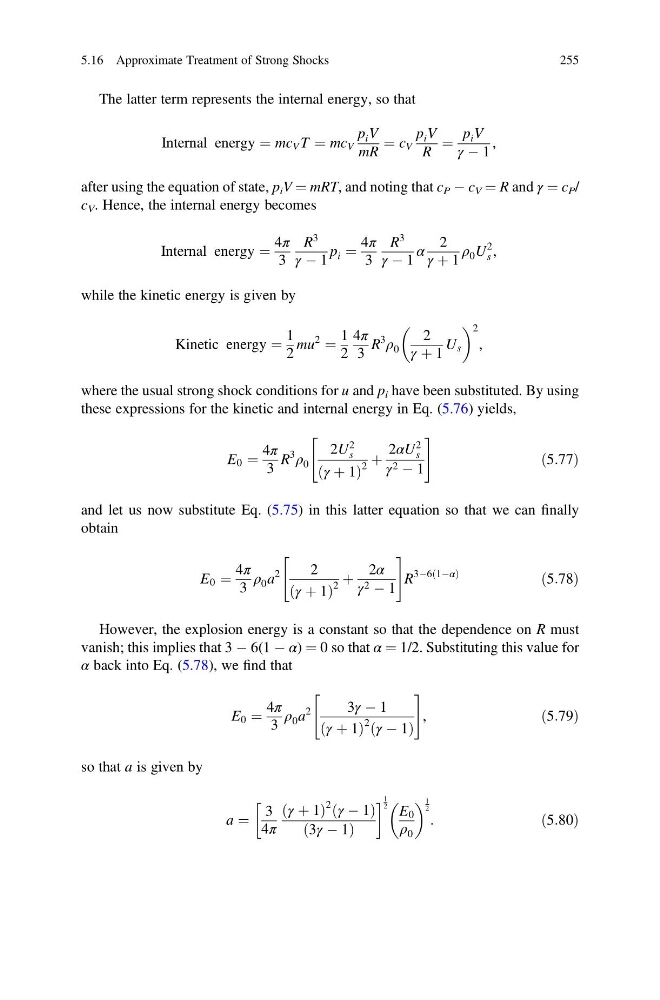
The latter term represents the internal energy, so that
Internal energy ¼ mc V T ¼ mc V
p i V
mR
¼ c V
p i V
R
¼
p i V
γ À 1
,
after using the equation of state, p i V ¼ mRT, and noting that c P À c V ¼ R and γ ¼ c P /
c V . Hence, the internal energy becomes
Internal energy ¼
4π
3
R
3
γ À 1
p i ¼
4π
3
R
3
γ À 1
α
2
γ þ 1
ρ 0 U
2
s ,
while the kinetic energy is given by
Kinetic energy ¼
1
2
mu
2
¼
1
2
4π
3
R
3
ρ 0
2
γ þ 1
U s
2
,
where the usual strong shock conditions for u and p i have been substituted. By using
these expressions for the kinetic and internal energy in Eq. (5.76) yields,
E 0 ¼
4π
3
R
3
ρ 0
2U
2
s
γ þ 1
ð
Þ
2
þ
2αU
2
s
γ 2 À 1
"
#
ð5:77Þ
and let us now substitute Eq. (5.75) in this latter equation so that we can finally
obtain
E 0 ¼
4π
3
ρ 0 a
2
2
γ þ 1
ð
Þ
2
þ
2α
γ 2 À 1
"
#
R
3À6 1Àα
ð
Þ
ð5:78Þ
However, the explosion energy is a constant so that the dependence on R must
vanish; this implies that 3 À 6(1 À α) ¼ 0 so that α ¼ 1/2. Substituting this value for
α back into Eq. (5.78), we find that
E 0 ¼
4π
3
ρ 0 a
2
3γ À 1
γ þ 1
ð
Þ
2 γ À 1
ð
Þ
"
#
,
ð5:79Þ
so that a is given by
a ¼
3
4π
γ þ 1
ð
Þ
2 γ À 1
ð
Þ
3γ À 1
ð
Þ
! 1
2
E 0
ρ 0
1
2 :
ð5:80Þ
5.16 Approximate Treatment of Strong Shocks
255
Internal energy ¼ mc V T ¼ mc V
p i V
mR
¼ c V
p i V
R
¼
p i V
γ À 1
,
after using the equation of state, p i V ¼ mRT, and noting that c P À c V ¼ R and γ ¼ c P /
c V . Hence, the internal energy becomes
Internal energy ¼
4π
3
R
3
γ À 1
p i ¼
4π
3
R
3
γ À 1
α
2
γ þ 1
ρ 0 U
2
s ,
while the kinetic energy is given by
Kinetic energy ¼
1
2
mu
2
¼
1
2
4π
3
R
3
ρ 0
2
γ þ 1
U s
2
,
where the usual strong shock conditions for u and p i have been substituted. By using
these expressions for the kinetic and internal energy in Eq. (5.76) yields,
E 0 ¼
4π
3
R
3
ρ 0
2U
2
s
γ þ 1
ð
Þ
2
þ
2αU
2
s
γ 2 À 1
"
#
ð5:77Þ
and let us now substitute Eq. (5.75) in this latter equation so that we can finally
obtain
E 0 ¼
4π
3
ρ 0 a
2
2
γ þ 1
ð
Þ
2
þ
2α
γ 2 À 1
"
#
R
3À6 1Àα
ð
Þ
ð5:78Þ
However, the explosion energy is a constant so that the dependence on R must
vanish; this implies that 3 À 6(1 À α) ¼ 0 so that α ¼ 1/2. Substituting this value for
α back into Eq. (5.78), we find that
E 0 ¼
4π
3
ρ 0 a
2
3γ À 1
γ þ 1
ð
Þ
2 γ À 1
ð
Þ
"
#
,
ð5:79Þ
so that a is given by
a ¼
3
4π
γ þ 1
ð
Þ
2 γ À 1
ð
Þ
3γ À 1
ð
Þ
! 1
2
E 0
ρ 0
1
2 :
ð5:80Þ
5.16 Approximate Treatment of Strong Shocks
255