

In the following sections we will consider two approximate treatments for strong
shocks; one by Chernyi and the other by Bethe. Both use the unique characteristics
of the point source solution in order to obtain approximate formulae for the
expanding shock wave.
5.16.1 Chernyi’s Approximation
Using the characteristics of the point source solution Chernyi [12], has presented a
simple analysis of the strong explosion and an account of the method as presented in
the text by Zel’dovich and Raizer [13] is outlined below.
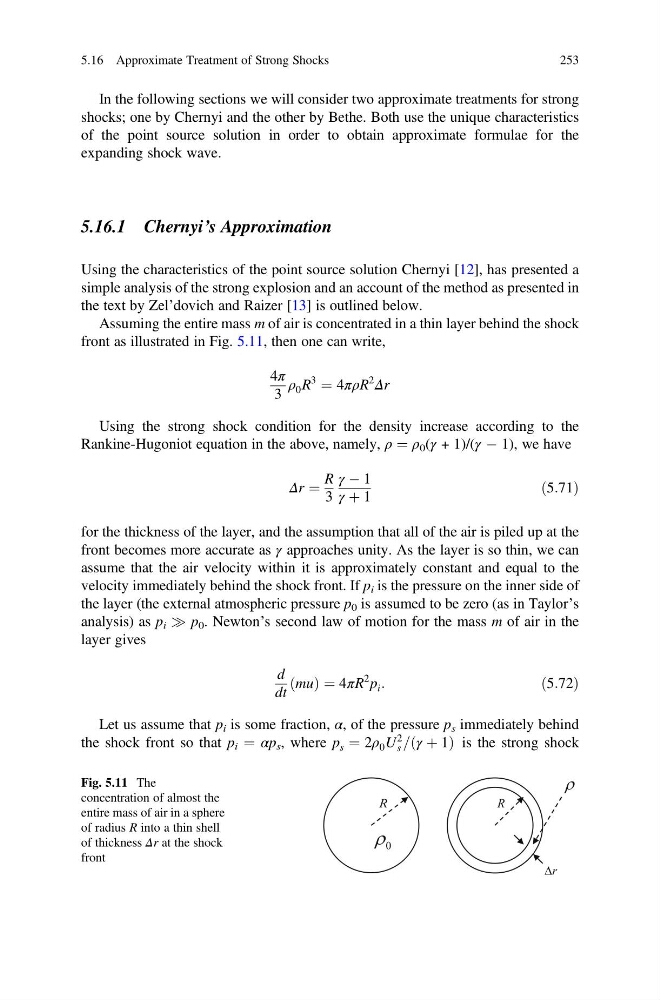
Assuming the entire mass m of air is concentrated in a thin layer behind the shock
front as illustrated in Fig. 5.11, then one can write,
4π
3
ρ 0 R
3
¼ 4πρR
2
Δr
Using the strong shock condition for the density increase according to the
Rankine-Hugoniot equation in the above, namely, ρ ¼ ρ 0 (γ + 1)/(γ À 1), we have
Δr ¼
R
3
γ À 1
γ þ 1
ð5:71Þ
for the thickness of the layer, and the assumption that all of the air is piled up at the
front becomes more accurate as γ approaches unity. As the layer is so thin, we can
assume that the air velocity within it is approximately constant and equal to the
velocity immediately behind the shock front. If p i is the pressure on the inner side of
the layer (the external atmospheric pressure p 0 is assumed to be zero (as in Taylor’s
analysis) as p i ) p 0 . Newton’s second law of motion for the mass m of air in the
layer gives
d
dt
mu
ð Þ ¼ 4πR
2 p i :
ð5:72Þ
Let us assume that p i is some fraction, α, of the pressure p s immediately behind
the shock front so that p i ¼ αp s , where p s ¼ 2ρ 0 U
2
s = γ þ 1
ð
Þ is the strong shock
Fig. 5.11 The
concentration of almost the
entire mass of air in a sphere
of radius R into a thin shell
of thickness Δr at the shock
front
5.16 Approximate Treatment of Strong Shocks
253
shocks; one by Chernyi and the other by Bethe. Both use the unique characteristics
of the point source solution in order to obtain approximate formulae for the
expanding shock wave.
5.16.1 Chernyi’s Approximation
Using the characteristics of the point source solution Chernyi [12], has presented a
simple analysis of the strong explosion and an account of the method as presented in
the text by Zel’dovich and Raizer [13] is outlined below.
Assuming the entire mass m of air is concentrated in a thin layer behind the shock
front as illustrated in Fig. 5.11, then one can write,
4π
3
ρ 0 R
3
¼ 4πρR
2
Δr
Using the strong shock condition for the density increase according to the
Rankine-Hugoniot equation in the above, namely, ρ ¼ ρ 0 (γ + 1)/(γ À 1), we have
Δr ¼
R
3
γ À 1
γ þ 1
ð5:71Þ
for the thickness of the layer, and the assumption that all of the air is piled up at the
front becomes more accurate as γ approaches unity. As the layer is so thin, we can
assume that the air velocity within it is approximately constant and equal to the
velocity immediately behind the shock front. If p i is the pressure on the inner side of
the layer (the external atmospheric pressure p 0 is assumed to be zero (as in Taylor’s
analysis) as p i ) p 0 . Newton’s second law of motion for the mass m of air in the
layer gives
d
dt
mu
ð Þ ¼ 4πR
2 p i :
ð5:72Þ
Let us assume that p i is some fraction, α, of the pressure p s immediately behind
the shock front so that p i ¼ αp s , where p s ¼ 2ρ 0 U
2
s = γ þ 1
ð
Þ is the strong shock
Fig. 5.11 The
concentration of almost the
entire mass of air in a sphere
of radius R into a thin shell
of thickness Δr at the shock
front
5.16 Approximate Treatment of Strong Shocks
253