

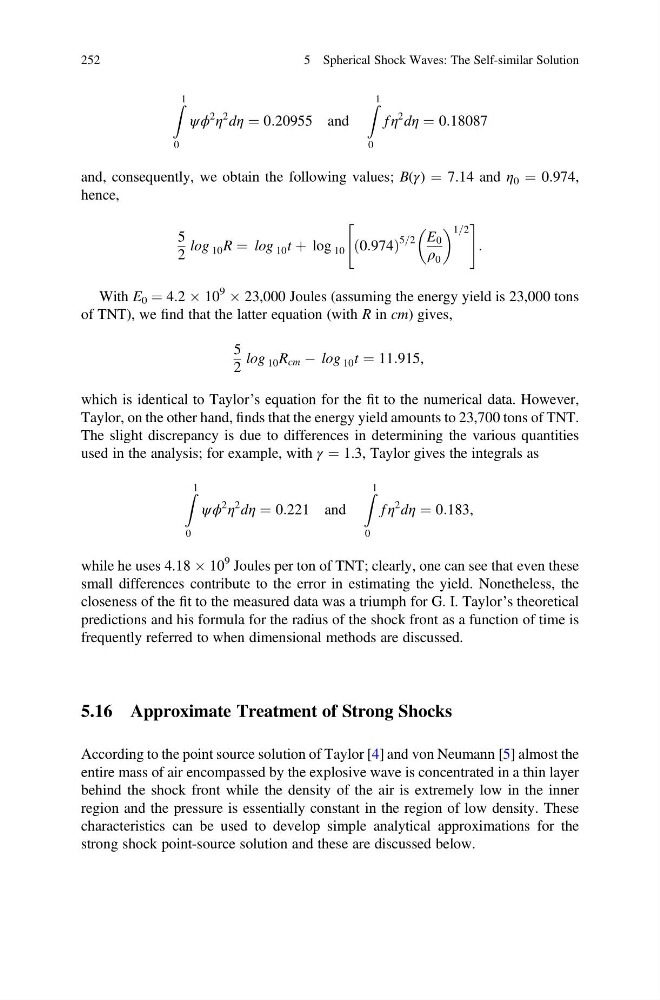
Z 1
0
ψϕ
2
η
2 dη ¼ 0:20955 and
Z 1
0
f η
2 dη ¼ 0:18087
and, consequently, we obtain the following values; B(γ) ¼ 7.14 and η 0 ¼ 0.974,
hence,
5
2
log 10 R ¼ log 10 t þ log 10 0:974
ð
Þ
5=2 E 0
ρ 0
1=2
"
#
:
With E 0 ¼ 4.2 Â 10
9
 23,000 Joules (assuming the energy yield is 23,000 tons
of TNT), we find that the latter equation (with R in cm) gives,
5
2
log 10 R cm À log 10 t ¼ 11:915,
which is identical to Taylor’s equation for the fit to the numerical data. However,
Taylor, on the other hand, finds that the energy yield amounts to 23,700 tons of TNT.
The slight discrepancy is due to differences in determining the various quantities
used in the analysis; for example, with γ ¼ 1.3, Taylor gives the integrals as
Z 1
0
ψϕ
2
η
2 dη ¼ 0:221 and
Z 1
0
f η
2 dη ¼ 0:183,
while he uses 4.18 Â 10
9 Joules per ton of TNT; clearly, one can see that even these
small differences contribute to the error in estimating the yield. Nonetheless, the
closeness of the fit to the measured data was a triumph for G. I. Taylor’s theoretical
predictions and his formula for the radius of the shock front as a function of time is
frequently referred to when dimensional methods are discussed.
5.16 Approximate Treatment of Strong Shocks
According to the point source solution of Taylor [4] and von Neumann [5] almost the
entire mass of air encompassed by the explosive wave is concentrated in a thin layer
behind the shock front while the density of the air is extremely low in the inner
region and the pressure is essentially constant in the region of low density. These
characteristics can be used to develop simple analytical approximations for the
strong shock point-source solution and these are discussed below.
252
5 Spherical Shock Waves: The Self-similar Solution
0
ψϕ
2
η
2 dη ¼ 0:20955 and
Z 1
0
f η
2 dη ¼ 0:18087
and, consequently, we obtain the following values; B(γ) ¼ 7.14 and η 0 ¼ 0.974,
hence,
5
2
log 10 R ¼ log 10 t þ log 10 0:974
ð
Þ
5=2 E 0
ρ 0
1=2
"
#
:
With E 0 ¼ 4.2 Â 10
9
 23,000 Joules (assuming the energy yield is 23,000 tons
of TNT), we find that the latter equation (with R in cm) gives,
5
2
log 10 R cm À log 10 t ¼ 11:915,
which is identical to Taylor’s equation for the fit to the numerical data. However,
Taylor, on the other hand, finds that the energy yield amounts to 23,700 tons of TNT.
The slight discrepancy is due to differences in determining the various quantities
used in the analysis; for example, with γ ¼ 1.3, Taylor gives the integrals as
Z 1
0
ψϕ
2
η
2 dη ¼ 0:221 and
Z 1
0
f η
2 dη ¼ 0:183,
while he uses 4.18 Â 10
9 Joules per ton of TNT; clearly, one can see that even these
small differences contribute to the error in estimating the yield. Nonetheless, the
closeness of the fit to the measured data was a triumph for G. I. Taylor’s theoretical
predictions and his formula for the radius of the shock front as a function of time is
frequently referred to when dimensional methods are discussed.
5.16 Approximate Treatment of Strong Shocks
According to the point source solution of Taylor [4] and von Neumann [5] almost the
entire mass of air encompassed by the explosive wave is concentrated in a thin layer
behind the shock front while the density of the air is extremely low in the inner
region and the pressure is essentially constant in the region of low density. These
characteristics can be used to develop simple analytical approximations for the
strong shock point-source solution and these are discussed below.
252
5 Spherical Shock Waves: The Self-similar Solution