

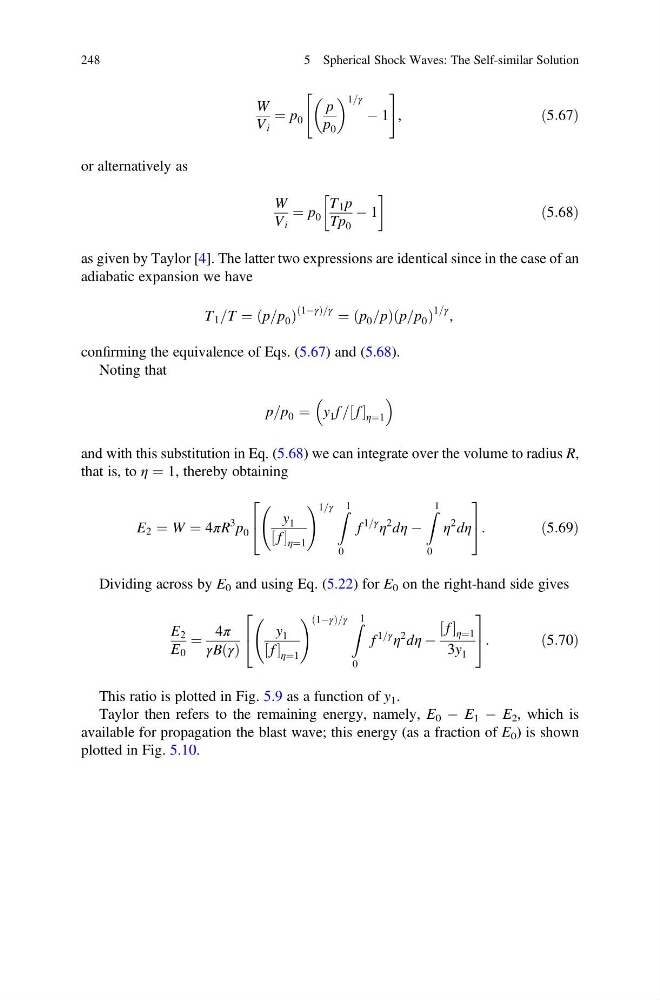
W
V i
¼ p 0
p
p 0
1=γ
À 1
"
#
,
ð5:67Þ
or alternatively as
W
V i
¼ p 0
T 1 p
Tp 0
À 1
!
ð5:68Þ
as given by Taylor [4]. The latter two expressions are identical since in the case of an
adiabatic expansion we have
T 1 =T ¼ p=p 0
ð
Þ
1Àγ
ð
Þ=γ ¼ p 0 =p
ð
Þ p=p 0
ð
Þ
1=γ ,
confirming the equivalence of Eqs. (5.67) and (5.68).
Noting that
p=p 0 ¼ y 1 f = f
½ η¼1
and with this substitution in Eq. (5.68) we can integrate over the volume to radius R,
that is, to η ¼ 1, thereby obtaining
E 2 ¼ W ¼ 4πR
3 p 0
y 1
f
½ η¼1
! 1=γ Z 1
0
f
1=γ
η
2 dη À
Z 1
0
η
2 dη
2
4
3
5 :
ð5:69Þ
Dividing across by E 0 and using Eq. (5.22) for E 0 on the right-hand side gives
E 2
E 0
¼
4π
γB γ
ð Þ
y 1
f
½ η¼1
! 1Àγ
ð
Þ=γ Z 1
0
f
1=γ
η
2 dη À
f
½ η¼1
3y 1
2
4
3
5 :
ð5:70Þ
This ratio is plotted in Fig. 5.9 as a function of y 1 .
Taylor then refers to the remaining energy, namely, E 0 À E 1 À E 2 , which is
available for propagation the blast wave; this energy (as a fraction of E 0 ) is shown
plotted in Fig. 5.10.
248
5 Spherical Shock Waves: The Self-similar Solution
V i
¼ p 0
p
p 0
1=γ
À 1
"
#
,
ð5:67Þ
or alternatively as
W
V i
¼ p 0
T 1 p
Tp 0
À 1
!
ð5:68Þ
as given by Taylor [4]. The latter two expressions are identical since in the case of an
adiabatic expansion we have
T 1 =T ¼ p=p 0
ð
Þ
1Àγ
ð
Þ=γ ¼ p 0 =p
ð
Þ p=p 0
ð
Þ
1=γ ,
confirming the equivalence of Eqs. (5.67) and (5.68).
Noting that
p=p 0 ¼ y 1 f = f
½ η¼1
and with this substitution in Eq. (5.68) we can integrate over the volume to radius R,
that is, to η ¼ 1, thereby obtaining
E 2 ¼ W ¼ 4πR
3 p 0
y 1
f
½ η¼1
! 1=γ Z 1
0
f
1=γ
η
2 dη À
Z 1
0
η
2 dη
2
4
3
5 :
ð5:69Þ
Dividing across by E 0 and using Eq. (5.22) for E 0 on the right-hand side gives
E 2
E 0
¼
4π
γB γ
ð Þ
y 1
f
½ η¼1
! 1Àγ
ð
Þ=γ Z 1
0
f
1=γ
η
2 dη À
f
½ η¼1
3y 1
2
4
3
5 :
ð5:70Þ
This ratio is plotted in Fig. 5.9 as a function of y 1 .
Taylor then refers to the remaining energy, namely, E 0 À E 1 À E 2 , which is
available for propagation the blast wave; this energy (as a fraction of E 0 ) is shown
plotted in Fig. 5.10.
248
5 Spherical Shock Waves: The Self-similar Solution