

after using Eq. (5.22). The maximum pressure occurs at r ¼ R, so that η ¼ 1 and,
hence, [f] η ¼ 1 ¼ 1.166 for γ ¼ 1.4. Hence,
p max : ¼ 0:157R
À3 E 0 :
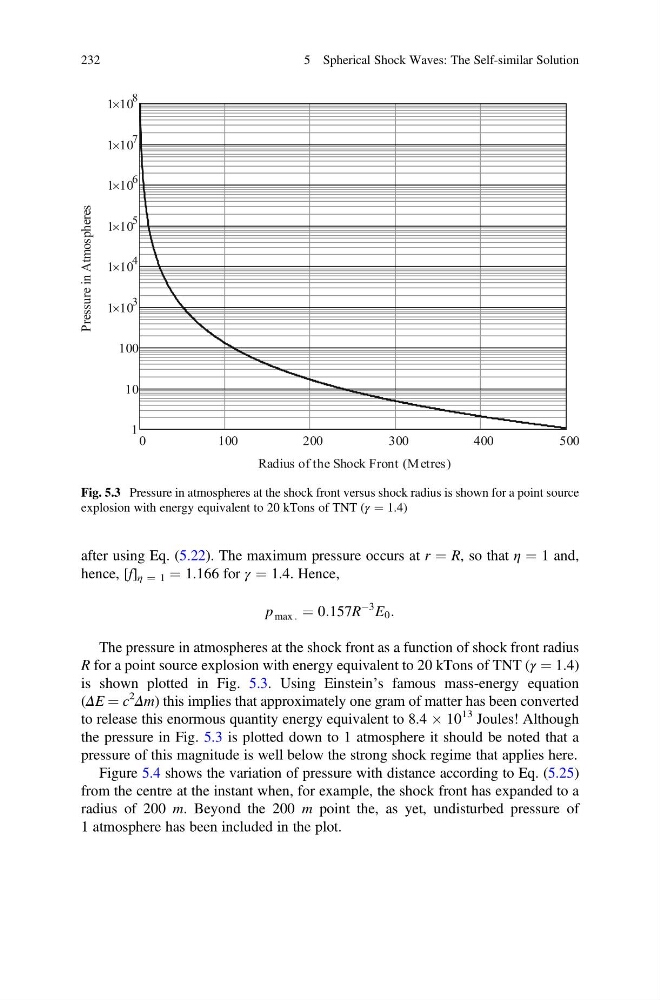
The pressure in atmospheres at the shock front as a function of shock front radius
R for a point source explosion with energy equivalent to 20 kTons of TNT (γ ¼ 1.4)
is shown plotted in Fig. 5.3. Using Einstein’s famous mass-energy equation
(ΔE ¼ c
2
Δm) this implies that approximately one gram of matter has been converted
to release this enormous quantity energy equivalent to 8.4 Â 10
13 Joules! Although
the pressure in Fig. 5.3 is plotted down to 1 atmosphere it should be noted that a
pressure of this magnitude is well below the strong shock regime that applies here.
Figure 5.4 shows the variation of pressure with distance according to Eq. (5.25)
from the centre at the instant when, for example, the shock front has expanded to a
radius of 200 m. Beyond the 200 m point the, as yet, undisturbed pressure of
1 atmosphere has been included in the plot.
Fig. 5.3 Pressure in atmospheres at the shock front versus shock radius is shown for a point source
explosion with energy equivalent to 20 kTons of TNT (γ ¼ 1.4)
232
5 Spherical Shock Waves: The Self-similar Solution
hence, [f] η ¼ 1 ¼ 1.166 for γ ¼ 1.4. Hence,
p max : ¼ 0:157R
À3 E 0 :
The pressure in atmospheres at the shock front as a function of shock front radius
R for a point source explosion with energy equivalent to 20 kTons of TNT (γ ¼ 1.4)
is shown plotted in Fig. 5.3. Using Einstein’s famous mass-energy equation
(ΔE ¼ c
2
Δm) this implies that approximately one gram of matter has been converted
to release this enormous quantity energy equivalent to 8.4 Â 10
13 Joules! Although
the pressure in Fig. 5.3 is plotted down to 1 atmosphere it should be noted that a
pressure of this magnitude is well below the strong shock regime that applies here.
Figure 5.4 shows the variation of pressure with distance according to Eq. (5.25)
from the centre at the instant when, for example, the shock front has expanded to a
radius of 200 m. Beyond the 200 m point the, as yet, undisturbed pressure of
1 atmosphere has been included in the plot.
Fig. 5.3 Pressure in atmospheres at the shock front versus shock radius is shown for a point source
explosion with energy equivalent to 20 kTons of TNT (γ ¼ 1.4)
232
5 Spherical Shock Waves: The Self-similar Solution