

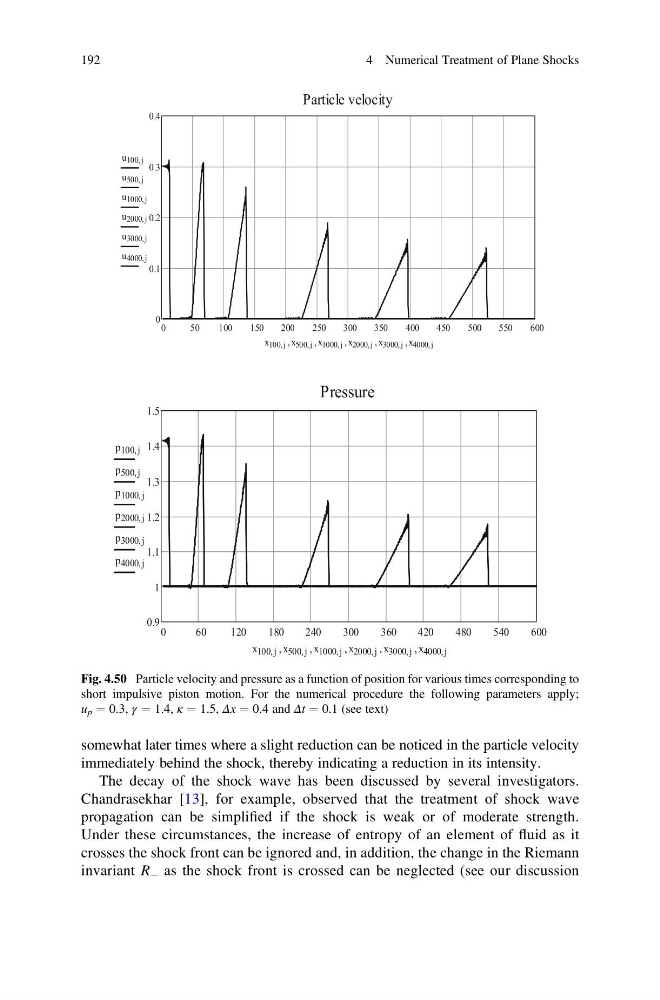
somewhat later times where a slight reduction can be noticed in the particle velocity
immediately behind the shock, thereby indicating a reduction in its intensity.
The decay of the shock wave has been discussed by several investigators.
Chandrasekhar [13], for example, observed that the treatment of shock wave
propagation can be simplified if the shock is weak or of moderate strength.
Under these circumstances, the increase of entropy of an element of fluid as it
crosses the shock front can be ignored and, in addition, the change in the Riemann
invariant R À as the shock front is crossed can be neglected (see our discussion
Fig. 4.50 Particle velocity and pressure as a function of position for various times corresponding to
short impulsive piston motion. For the numerical procedure the following parameters apply;
u p ¼ 0.3, γ ¼ 1.4, κ ¼ 1.5, Δx ¼ 0.4 and Δt ¼ 0.1 (see text)
192
4 Numerical Treatment of Plane Shocks
immediately behind the shock, thereby indicating a reduction in its intensity.
The decay of the shock wave has been discussed by several investigators.
Chandrasekhar [13], for example, observed that the treatment of shock wave
propagation can be simplified if the shock is weak or of moderate strength.
Under these circumstances, the increase of entropy of an element of fluid as it
crosses the shock front can be ignored and, in addition, the change in the Riemann
invariant R À as the shock front is crossed can be neglected (see our discussion
Fig. 4.50 Particle velocity and pressure as a function of position for various times corresponding to
short impulsive piston motion. For the numerical procedure the following parameters apply;
u p ¼ 0.3, γ ¼ 1.4, κ ¼ 1.5, Δx ¼ 0.4 and Δt ¼ 0.1 (see text)
192
4 Numerical Treatment of Plane Shocks