

Alternatively, we found that a shock forms after some finite time when the piston
undergoes uniform acceleration to some finite velocity.
In this section we consider the case where the piston is pushed for only a finite
duration and thereafter the piston motion is arrested. The fluid adjacent to the piston
that was initially set in motion momentarily continues to move and a rarefaction
wave is formed that will eventually overtake the shock and reduce its intensity. This
overtaking takes place since the shock wave moves with subsonic velocity relative to
the air behind it, whereas the head of the rarefaction wave moves at the sonic
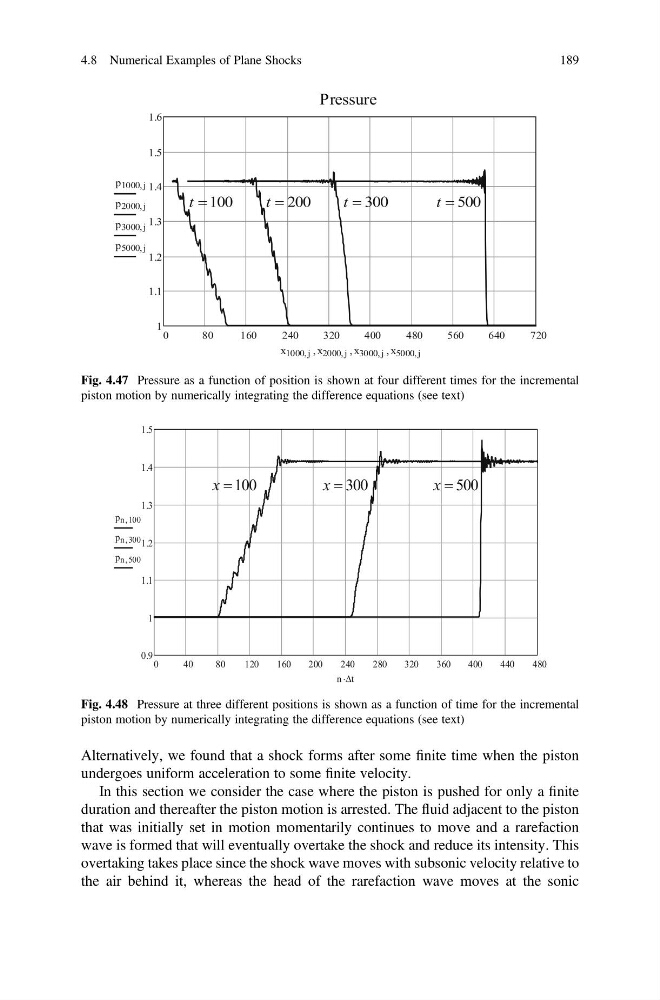
Fig. 4.47 Pressure as a function of position is shown at four different times for the incremental
piston motion by numerically integrating the difference equations (see text)
Fig. 4.48 Pressure at three different positions is shown as a function of time for the incremental
piston motion by numerically integrating the difference equations (see text)
4.8 Numerical Examples of Plane Shocks
189
undergoes uniform acceleration to some finite velocity.
In this section we consider the case where the piston is pushed for only a finite
duration and thereafter the piston motion is arrested. The fluid adjacent to the piston
that was initially set in motion momentarily continues to move and a rarefaction
wave is formed that will eventually overtake the shock and reduce its intensity. This
overtaking takes place since the shock wave moves with subsonic velocity relative to
the air behind it, whereas the head of the rarefaction wave moves at the sonic
Fig. 4.47 Pressure as a function of position is shown at four different times for the incremental
piston motion by numerically integrating the difference equations (see text)
Fig. 4.48 Pressure at three different positions is shown as a function of time for the incremental
piston motion by numerically integrating the difference equations (see text)
4.8 Numerical Examples of Plane Shocks
189