

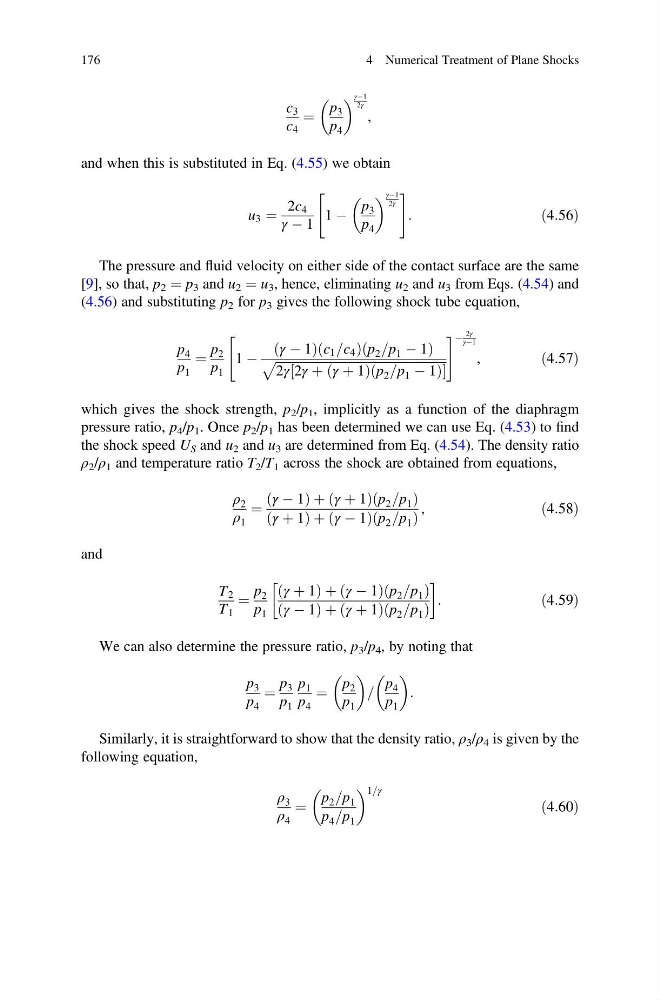
c 3
c 4
¼
p 3
p 4
γÀ1
2γ
,
and when this is substituted in Eq. (4.55) we obtain
u 3 ¼
2c 4
γ À 1
1 À
p 3
p 4
γÀ1
2γ
"
#
:
ð4:56Þ
The pressure and fluid velocity on either side of the contact surface are the same
[9], so that, p 2 ¼ p 3 and u 2 ¼ u 3 , hence, eliminating u 2 and u 3 from Eqs. (4.54) and
(4.56) and substituting p 2 for p 3 gives the following shock tube equation,
p 4
p 1
¼
p 2
p 1
1 À
γ À 1
ð
Þ c 1 =c 4
ð
Þ p 2 =p 1 À 1
ð
Þ
ffiffiffiffiffiffiffiffiffiffiffiffiffiffiffiffiffiffiffiffiffiffiffiffiffiffiffiffiffiffiffiffiffiffiffiffiffiffiffiffiffiffiffiffiffiffiffiffiffiffiffiffiffiffiffi
2γ 2γ þ γ þ 1
ð
Þ p 2 =p 1 À 1
ð
Þ
½
p
"
# À
2γ
γÀ1
,
ð4:57Þ
which gives the shock strength, p 2 /p 1 , implicitly as a function of the diaphragm
pressure ratio, p 4 /p 1 . Once p 2 /p 1 has been determined we can use Eq. (4.53) to find
the shock speed U S and u 2 and u 3 are determined from Eq. (4.54). The density ratio
ρ 2 /ρ 1 and temperature ratio T 2 /T 1 across the shock are obtained from equations,
ρ 2
ρ 1
¼
γ À 1
ð
Þþ γ þ 1
ð
Þ p 2 =p 1
ð
Þ
γ þ 1
ð
Þþ γ À 1
ð
Þ p 2 =p 1
ð
Þ
,
ð4:58Þ
and
T 2
T 1
¼
p 2
p 1
γ þ 1
ð
Þþ γ À 1
ð
Þ p 2 =p 1
ð
Þ
γ À 1
ð
Þþ γ þ 1
ð
Þ p 2 =p 1
ð
Þ
!
:
ð4:59Þ
We can also determine the pressure ratio, p 3 /p 4 , by noting that
p 3
p 4
¼
p 3
p 1
p 1
p 4
¼
p 2
p 1
=
p 4
p 1
:
Similarly, it is straightforward to show that the density ratio, ρ 3 /ρ 4 is given by the
following equation,
ρ 3
ρ 4
¼
p 2 =p 1
p 4 =p 1
1=γ
ð4:60Þ
176
4 Numerical Treatment of Plane Shocks
c 4
¼
p 3
p 4
γÀ1
2γ
,
and when this is substituted in Eq. (4.55) we obtain
u 3 ¼
2c 4
γ À 1
1 À
p 3
p 4
γÀ1
2γ
"
#
:
ð4:56Þ
The pressure and fluid velocity on either side of the contact surface are the same
[9], so that, p 2 ¼ p 3 and u 2 ¼ u 3 , hence, eliminating u 2 and u 3 from Eqs. (4.54) and
(4.56) and substituting p 2 for p 3 gives the following shock tube equation,
p 4
p 1
¼
p 2
p 1
1 À
γ À 1
ð
Þ c 1 =c 4
ð
Þ p 2 =p 1 À 1
ð
Þ
ffiffiffiffiffiffiffiffiffiffiffiffiffiffiffiffiffiffiffiffiffiffiffiffiffiffiffiffiffiffiffiffiffiffiffiffiffiffiffiffiffiffiffiffiffiffiffiffiffiffiffiffiffiffiffi
2γ 2γ þ γ þ 1
ð
Þ p 2 =p 1 À 1
ð
Þ
½
p
"
# À
2γ
γÀ1
,
ð4:57Þ
which gives the shock strength, p 2 /p 1 , implicitly as a function of the diaphragm
pressure ratio, p 4 /p 1 . Once p 2 /p 1 has been determined we can use Eq. (4.53) to find
the shock speed U S and u 2 and u 3 are determined from Eq. (4.54). The density ratio
ρ 2 /ρ 1 and temperature ratio T 2 /T 1 across the shock are obtained from equations,
ρ 2
ρ 1
¼
γ À 1
ð
Þþ γ þ 1
ð
Þ p 2 =p 1
ð
Þ
γ þ 1
ð
Þþ γ À 1
ð
Þ p 2 =p 1
ð
Þ
,
ð4:58Þ
and
T 2
T 1
¼
p 2
p 1
γ þ 1
ð
Þþ γ À 1
ð
Þ p 2 =p 1
ð
Þ
γ À 1
ð
Þþ γ þ 1
ð
Þ p 2 =p 1
ð
Þ
!
:
ð4:59Þ
We can also determine the pressure ratio, p 3 /p 4 , by noting that
p 3
p 4
¼
p 3
p 1
p 1
p 4
¼
p 2
p 1
=
p 4
p 1
:
Similarly, it is straightforward to show that the density ratio, ρ 3 /ρ 4 is given by the
following equation,
ρ 3
ρ 4
¼
p 2 =p 1
p 4 =p 1
1=γ
ð4:60Þ
176
4 Numerical Treatment of Plane Shocks