

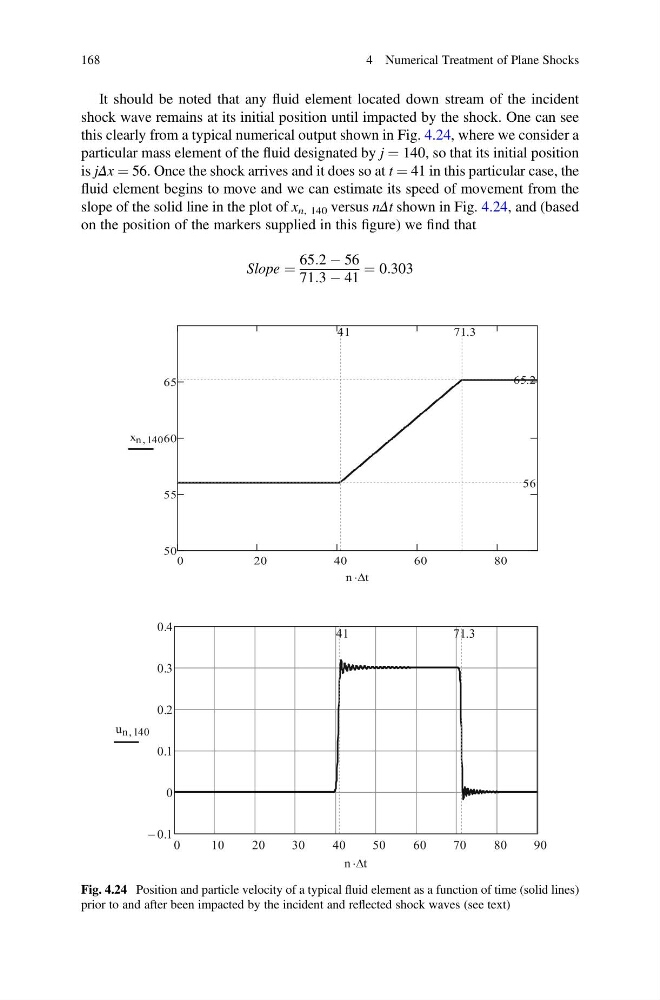
It should be noted that any fluid element located down stream of the incident
shock wave remains at its initial position until impacted by the shock. One can see
this clearly from a typical numerical output shown in Fig. 4.24, where we consider a
particular mass element of the fluid designated by j ¼ 140, so that its initial position
is jΔx ¼ 56. Once the shock arrives and it does so at t ¼ 41 in this particular case, the
fluid element begins to move and we can estimate its speed of movement from the
slope of the solid line in the plot of x n, 140 versus nΔt shown in Fig. 4.24, and (based
on the position of the markers supplied in this figure) we find that
Slope ¼
65:2 À 56
71:3 À 41
¼ 0:303
Fig. 4.24 Position and particle velocity of a typical fluid element as a function of time (solid lines)
prior to and after been impacted by the incident and reflected shock waves (see text)
168
4 Numerical Treatment of Plane Shocks
shock wave remains at its initial position until impacted by the shock. One can see
this clearly from a typical numerical output shown in Fig. 4.24, where we consider a
particular mass element of the fluid designated by j ¼ 140, so that its initial position
is jΔx ¼ 56. Once the shock arrives and it does so at t ¼ 41 in this particular case, the
fluid element begins to move and we can estimate its speed of movement from the
slope of the solid line in the plot of x n, 140 versus nΔt shown in Fig. 4.24, and (based
on the position of the markers supplied in this figure) we find that
Slope ¼
65:2 À 56
71:3 À 41
¼ 0:303
Fig. 4.24 Position and particle velocity of a typical fluid element as a function of time (solid lines)
prior to and after been impacted by the incident and reflected shock waves (see text)
168
4 Numerical Treatment of Plane Shocks