

4.5 The Numerical Procedure
A brief outline of the numerical procedure using the finite difference representation
of the differential equations is presented here. Much more detail on finite difference
equations can be found in texts dealing specifically with numerical methods [4, 5]
and the interested reader is directed to the literature on this subject and a good
starting point is the excellent text by Anderson [4]. Anderson derives a number of
different forms of the finite difference expressions and goes on to discuss the order of
accuracy of the finite difference quotients obtained. Furthermore, he describes two
general approaches; an explicit approach and an implicit approach as well as the
stability requirement for the solution of the difference equations involved. Similarly,
Ramshaw [6] provides an excellent account of finite-difference approximations and
numerical stability requirements.
4.5.1 The Differential Equations for Plane Wave Motion: A
Summary
In order to carry out the numerical procedure let us recall the previous equations for
plane wave motion; they are re-written here (with x 0 simply replaced by x) and with
artificial viscosity included,
∂υ
∂t
¼
1
ρ x, 0
ð Þ
∂u
∂x
,
Continuity
ð
Þ
ρ x, 0
ð Þ
∂u
∂t
¼ À
∂
∂x
p þ q
ð
Þ,
Momentum
ð
Þ
and
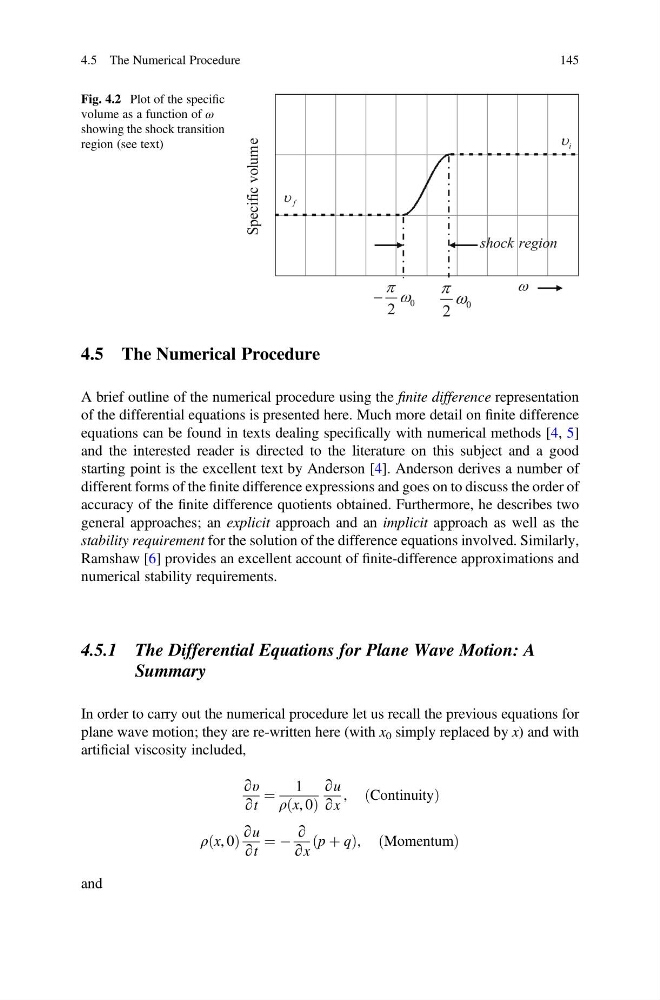
Fig. 4.2 Plot of the specific
volume as a function of ω
showing the shock transition
region (see text)
4.5 The Numerical Procedure
145
A brief outline of the numerical procedure using the finite difference representation
of the differential equations is presented here. Much more detail on finite difference
equations can be found in texts dealing specifically with numerical methods [4, 5]
and the interested reader is directed to the literature on this subject and a good
starting point is the excellent text by Anderson [4]. Anderson derives a number of
different forms of the finite difference expressions and goes on to discuss the order of
accuracy of the finite difference quotients obtained. Furthermore, he describes two
general approaches; an explicit approach and an implicit approach as well as the
stability requirement for the solution of the difference equations involved. Similarly,
Ramshaw [6] provides an excellent account of finite-difference approximations and
numerical stability requirements.
4.5.1 The Differential Equations for Plane Wave Motion: A
Summary
In order to carry out the numerical procedure let us recall the previous equations for
plane wave motion; they are re-written here (with x 0 simply replaced by x) and with
artificial viscosity included,
∂υ
∂t
¼
1
ρ x, 0
ð Þ
∂u
∂x
,
Continuity
ð
Þ
ρ x, 0
ð Þ
∂u
∂t
¼ À
∂
∂x
p þ q
ð
Þ,
Momentum
ð
Þ
and
Fig. 4.2 Plot of the specific
volume as a function of ω
showing the shock transition
region (see text)
4.5 The Numerical Procedure
145