

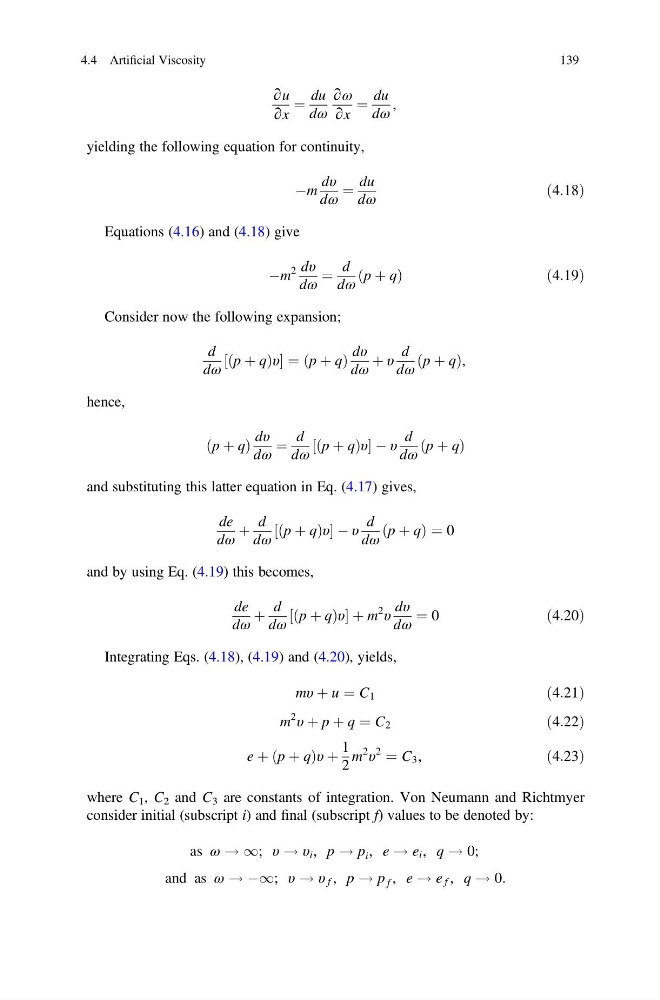
∂u
∂x
¼
du
dω
∂ω
∂x
¼
du
dω
,
yielding the following equation for continuity,
Àm
dυ
dω
¼
du
dω
ð4:18Þ
Equations (4.16) and (4.18) give
Àm
2 dυ
dω
¼
d
dω
p þ q
ð
Þ
ð4:19Þ
Consider now the following expansion;
d
dω
p þ q
ð
Þυ
½
¼ p þ q
ð
Þ
dυ
dω
þ υ
d
dω
p þ q
ð
Þ,
hence,
p þ q
ð
Þ
dυ
dω
¼
d
dω
p þ q
ð
Þυ
½
Àυ
d
dω
p þ q
ð
Þ
and substituting this latter equation in Eq. (4.17) gives,
de
dω
þ
d
dω
p þ q
ð
Þυ
½
Àυ
d
dω
p þ q
ð
Þ¼0
and by using Eq. (4.19) this becomes,
de
dω
þ
d
dω
p þ q
ð
Þυ
½
þm
2
υ
dυ
dω
¼ 0
ð4:20Þ
Integrating Eqs. (4.18), (4.19) and (4.20), yields,
mυ þ u ¼ C 1
ð4:21Þ
m
2
υ þ p þ q ¼ C 2
ð4:22Þ
e þ p þ q
ð
Þυ þ
1
2
m
2
υ
2
¼ C 3 ,
ð4:23Þ
where C 1 , C 2 and C 3 are constants of integration. Von Neumann and Richtmyer
consider initial (subscript i) and final (subscript f) values to be denoted by:
as ω ! 1; υ ! υ i , p ! p i , e ! e i , q ! 0;
and as ω ! À1; υ ! υ f , p ! p f , e ! e f , q ! 0:
4.4 Artificial Viscosity
139
∂x
¼
du
dω
∂ω
∂x
¼
du
dω
,
yielding the following equation for continuity,
Àm
dυ
dω
¼
du
dω
ð4:18Þ
Equations (4.16) and (4.18) give
Àm
2 dυ
dω
¼
d
dω
p þ q
ð
Þ
ð4:19Þ
Consider now the following expansion;
d
dω
p þ q
ð
Þυ
½
¼ p þ q
ð
Þ
dυ
dω
þ υ
d
dω
p þ q
ð
Þ,
hence,
p þ q
ð
Þ
dυ
dω
¼
d
dω
p þ q
ð
Þυ
½
Àυ
d
dω
p þ q
ð
Þ
and substituting this latter equation in Eq. (4.17) gives,
de
dω
þ
d
dω
p þ q
ð
Þυ
½
Àυ
d
dω
p þ q
ð
Þ¼0
and by using Eq. (4.19) this becomes,
de
dω
þ
d
dω
p þ q
ð
Þυ
½
þm
2
υ
dυ
dω
¼ 0
ð4:20Þ
Integrating Eqs. (4.18), (4.19) and (4.20), yields,
mυ þ u ¼ C 1
ð4:21Þ
m
2
υ þ p þ q ¼ C 2
ð4:22Þ
e þ p þ q
ð
Þυ þ
1
2
m
2
υ
2
¼ C 3 ,
ð4:23Þ
where C 1 , C 2 and C 3 are constants of integration. Von Neumann and Richtmyer
consider initial (subscript i) and final (subscript f) values to be denoted by:
as ω ! 1; υ ! υ i , p ! p i , e ! e i , q ! 0;
and as ω ! À1; υ ! υ f , p ! p f , e ! e f , q ! 0:
4.4 Artificial Viscosity
139