

ω u
ð Þ ¼
8μ
3 γ þ 1
ð
Þρ 0 U s
U s À u 1
u 1
ln
2u 1 À 2u
u 1
À
U s
u 1
ln
2u
u 1
!
ð3:71Þ
Let us consider a propagating shock in air (γ ¼ 1.4), and let us assume the
following parameters for the ambient pressure p 0 and density ρ 0 ahead of the shock
wave; p 0 ¼ 1.01 Â 10
5
Nm
À2 , ρ 0 ¼ 1.25kgm
À3 . With a Mach number of 1.5 and with
a coefficient of viscosity of μ ¼ 2 Â 10
À5 Nm
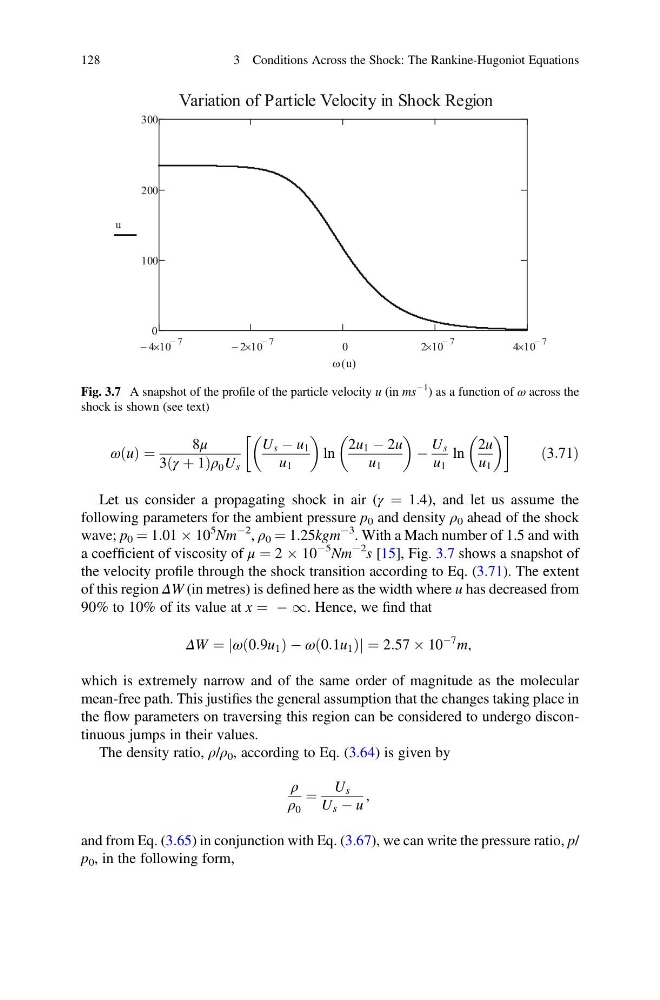
À2 s [15], Fig. 3.7 shows a snapshot of
the velocity profile through the shock transition according to Eq. (3.71). The extent
of this region ΔW (in metres) is defined here as the width where u has decreased from
90% to 10% of its value at x ¼ À 1. Hence, we find that
ΔW ¼ ω 0:9u 1
ð
ÞÀω 0:1u 1
ð
Þ
j
j ¼ 2:57 Â 10
À7 m,
which is extremely narrow and of the same order of magnitude as the molecular
mean-free path. This justifies the general assumption that the changes taking place in
the flow parameters on traversing this region can be considered to undergo discontinuous jumps in their values.
The density ratio, ρ/ρ 0 , according to Eq. (3.64) is given by
ρ
ρ 0
¼
U s
U s À u
,
and from Eq. (3.65) in conjunction with Eq. (3.67), we can write the pressure ratio, p/
p 0 , in the following form,
Fig. 3.7 A snapshot of the profile of the particle velocity u (in ms
À1
) as a function of ω across the
shock is shown (see text)
128
3 Conditions Across the Shock: The Rankine-Hugoniot Equations
ð Þ ¼
8μ
3 γ þ 1
ð
Þρ 0 U s
U s À u 1
u 1
ln
2u 1 À 2u
u 1
À
U s
u 1
ln
2u
u 1
!
ð3:71Þ
Let us consider a propagating shock in air (γ ¼ 1.4), and let us assume the
following parameters for the ambient pressure p 0 and density ρ 0 ahead of the shock
wave; p 0 ¼ 1.01 Â 10
5
Nm
À2 , ρ 0 ¼ 1.25kgm
À3 . With a Mach number of 1.5 and with
a coefficient of viscosity of μ ¼ 2 Â 10
À5 Nm
À2 s [15], Fig. 3.7 shows a snapshot of
the velocity profile through the shock transition according to Eq. (3.71). The extent
of this region ΔW (in metres) is defined here as the width where u has decreased from
90% to 10% of its value at x ¼ À 1. Hence, we find that
ΔW ¼ ω 0:9u 1
ð
ÞÀω 0:1u 1
ð
Þ
j
j ¼ 2:57 Â 10
À7 m,
which is extremely narrow and of the same order of magnitude as the molecular
mean-free path. This justifies the general assumption that the changes taking place in
the flow parameters on traversing this region can be considered to undergo discontinuous jumps in their values.
The density ratio, ρ/ρ 0 , according to Eq. (3.64) is given by
ρ
ρ 0
¼
U s
U s À u
,
and from Eq. (3.65) in conjunction with Eq. (3.67), we can write the pressure ratio, p/
p 0 , in the following form,
Fig. 3.7 A snapshot of the profile of the particle velocity u (in ms
À1
) as a function of ω across the
shock is shown (see text)
128
3 Conditions Across the Shock: The Rankine-Hugoniot Equations