

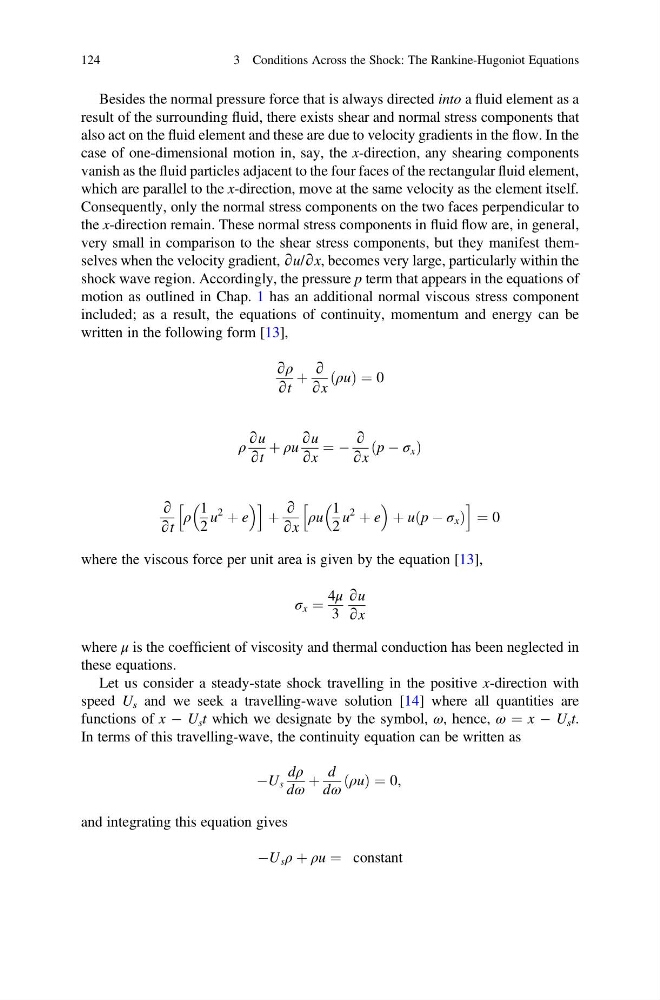
Besides the normal pressure force that is always directed into a fluid element as a
result of the surrounding fluid, there exists shear and normal stress components that
also act on the fluid element and these are due to velocity gradients in the flow. In the
case of one-dimensional motion in, say, the x-direction, any shearing components
vanish as the fluid particles adjacent to the four faces of the rectangular fluid element,
which are parallel to the x-direction, move at the same velocity as the element itself.
Consequently, only the normal stress components on the two faces perpendicular to
the x-direction remain. These normal stress components in fluid flow are, in general,
very small in comparison to the shear stress components, but they manifest themselves when the velocity gradient, ∂u/∂x, becomes very large, particularly within the
shock wave region. Accordingly, the pressure p term that appears in the equations of
motion as outlined in Chap. 1 has an additional normal viscous stress component
included; as a result, the equations of continuity, momentum and energy can be
written in the following form [13],
∂ρ
∂t
þ
∂
∂x
ρu
ð Þ ¼ 0
ρ
∂u
∂t
þ ρu
∂u
∂x
¼ À
∂
∂x
p À σ x
ð
Þ
∂
∂t
ρ
1
2
u
2
þ e
h
i
þ
∂
∂x
ρu
1
2
u
2
þ e
þ u p À σ x
ð
Þ
h
i
¼ 0
where the viscous force per unit area is given by the equation [13],
σ x ¼
4μ
3
∂u
∂x
where μ is the coefficient of viscosity and thermal conduction has been neglected in
these equations.
Let us consider a steady-state shock travelling in the positive x-direction with
speed U s and we seek a travelling-wave solution [14] where all quantities are
functions of x À U s t which we designate by the symbol, ω, hence, ω ¼ x À U s t.
In terms of this travelling-wave, the continuity equation can be written as
ÀU s
dρ
dω
þ
d
dω
ρu
ð Þ ¼ 0,
and integrating this equation gives
ÀU s ρ þ ρu ¼ constant
124
3 Conditions Across the Shock: The Rankine-Hugoniot Equations
result of the surrounding fluid, there exists shear and normal stress components that
also act on the fluid element and these are due to velocity gradients in the flow. In the
case of one-dimensional motion in, say, the x-direction, any shearing components
vanish as the fluid particles adjacent to the four faces of the rectangular fluid element,
which are parallel to the x-direction, move at the same velocity as the element itself.
Consequently, only the normal stress components on the two faces perpendicular to
the x-direction remain. These normal stress components in fluid flow are, in general,
very small in comparison to the shear stress components, but they manifest themselves when the velocity gradient, ∂u/∂x, becomes very large, particularly within the
shock wave region. Accordingly, the pressure p term that appears in the equations of
motion as outlined in Chap. 1 has an additional normal viscous stress component
included; as a result, the equations of continuity, momentum and energy can be
written in the following form [13],
∂ρ
∂t
þ
∂
∂x
ρu
ð Þ ¼ 0
ρ
∂u
∂t
þ ρu
∂u
∂x
¼ À
∂
∂x
p À σ x
ð
Þ
∂
∂t
ρ
1
2
u
2
þ e
h
i
þ
∂
∂x
ρu
1
2
u
2
þ e
þ u p À σ x
ð
Þ
h
i
¼ 0
where the viscous force per unit area is given by the equation [13],
σ x ¼
4μ
3
∂u
∂x
where μ is the coefficient of viscosity and thermal conduction has been neglected in
these equations.
Let us consider a steady-state shock travelling in the positive x-direction with
speed U s and we seek a travelling-wave solution [14] where all quantities are
functions of x À U s t which we designate by the symbol, ω, hence, ω ¼ x À U s t.
In terms of this travelling-wave, the continuity equation can be written as
ÀU s
dρ
dω
þ
d
dω
ρu
ð Þ ¼ 0,
and integrating this equation gives
ÀU s ρ þ ρu ¼ constant
124
3 Conditions Across the Shock: The Rankine-Hugoniot Equations