

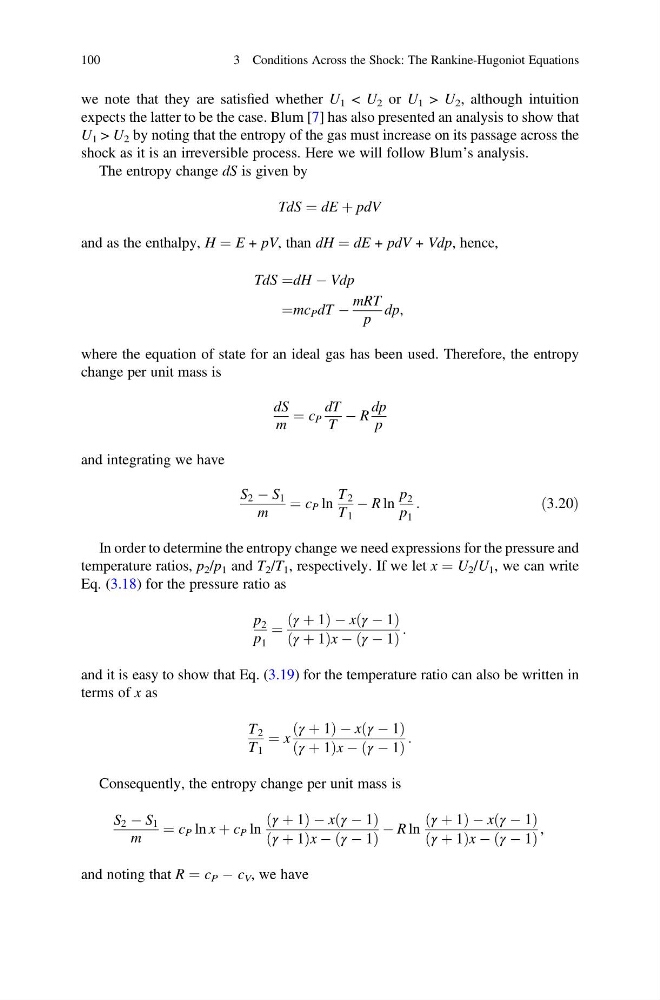
we note that they are satisfied whether U 1 < U 2 or U 1 > U 2 , although intuition
expects the latter to be the case. Blum [7] has also presented an analysis to show that
U 1 > U 2 by noting that the entropy of the gas must increase on its passage across the
shock as it is an irreversible process. Here we will follow Blum’s analysis.
The entropy change dS is given by
TdS ¼ dE þ pdV
and as the enthalpy, H ¼ E + pV, than dH ¼ dE + pdV + Vdp, hence,
TdS ¼dH À Vdp
¼mc P dT À
mRT
p
dp,
where the equation of state for an ideal gas has been used. Therefore, the entropy
change per unit mass is
dS
m
¼ c P
dT
T
À R
dp
p
and integrating we have
S 2 À S 1
m
¼ c P ln
T 2
T 1
À R ln
p 2
p 1
:
ð3:20Þ
In order to determine the entropy change we need expressions for the pressure and
temperature ratios, p 2 /p 1 and T 2 /T 1 , respectively. If we let x ¼ U 2 /U 1 , we can write
Eq. (3.18) for the pressure ratio as
p 2
p 1
¼
γ þ 1
ð
ÞÀx γ À 1
ð
Þ
γ þ 1
ð
Þx À γ À 1
ð
Þ
:
and it is easy to show that Eq. (3.19) for the temperature ratio can also be written in
terms of x as
T 2
T 1
¼ x
γ þ 1
ð
ÞÀx γ À 1
ð
Þ
γ þ 1
ð
Þx À γ À 1
ð
Þ
:
Consequently, the entropy change per unit mass is
S 2 À S 1
m
¼ c P ln x þ c P ln
γ þ 1
ð
ÞÀx γ À 1
ð
Þ
γ þ 1
ð
Þx À γ À 1
ð
Þ
À R ln
γ þ 1
ð
ÞÀx γ À 1
ð
Þ
γ þ 1
ð
Þx À γ À 1
ð
Þ
,
and noting that R ¼ c P À c V , we have
100
3 Conditions Across the Shock: The Rankine-Hugoniot Equations
expects the latter to be the case. Blum [7] has also presented an analysis to show that
U 1 > U 2 by noting that the entropy of the gas must increase on its passage across the
shock as it is an irreversible process. Here we will follow Blum’s analysis.
The entropy change dS is given by
TdS ¼ dE þ pdV
and as the enthalpy, H ¼ E + pV, than dH ¼ dE + pdV + Vdp, hence,
TdS ¼dH À Vdp
¼mc P dT À
mRT
p
dp,
where the equation of state for an ideal gas has been used. Therefore, the entropy
change per unit mass is
dS
m
¼ c P
dT
T
À R
dp
p
and integrating we have
S 2 À S 1
m
¼ c P ln
T 2
T 1
À R ln
p 2
p 1
:
ð3:20Þ
In order to determine the entropy change we need expressions for the pressure and
temperature ratios, p 2 /p 1 and T 2 /T 1 , respectively. If we let x ¼ U 2 /U 1 , we can write
Eq. (3.18) for the pressure ratio as
p 2
p 1
¼
γ þ 1
ð
ÞÀx γ À 1
ð
Þ
γ þ 1
ð
Þx À γ À 1
ð
Þ
:
and it is easy to show that Eq. (3.19) for the temperature ratio can also be written in
terms of x as
T 2
T 1
¼ x
γ þ 1
ð
ÞÀx γ À 1
ð
Þ
γ þ 1
ð
Þx À γ À 1
ð
Þ
:
Consequently, the entropy change per unit mass is
S 2 À S 1
m
¼ c P ln x þ c P ln
γ þ 1
ð
ÞÀx γ À 1
ð
Þ
γ þ 1
ð
Þx À γ À 1
ð
Þ
À R ln
γ þ 1
ð
ÞÀx γ À 1
ð
Þ
γ þ 1
ð
Þx À γ À 1
ð
Þ
,
and noting that R ¼ c P À c V , we have
100
3 Conditions Across the Shock: The Rankine-Hugoniot Equations