

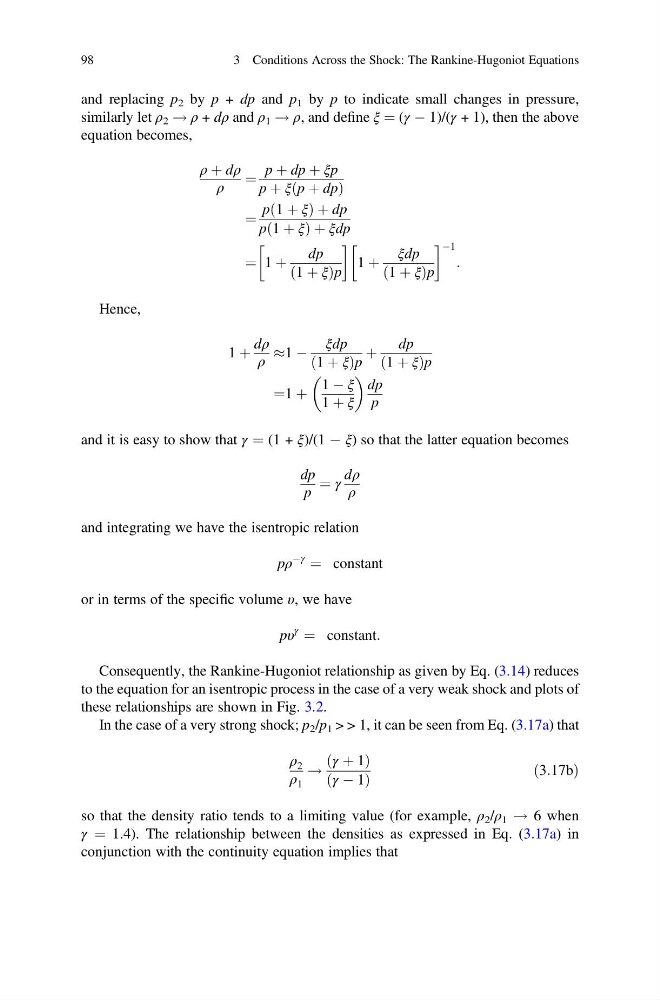
and replacing p 2 by p + dp and p 1 by p to indicate small changes in pressure,
similarly let ρ 2 ! ρ + dρ and ρ 1 ! ρ, and define ξ ¼ (γ À 1)/(γ + 1), then the above
equation becomes,
ρ þ dρ
ρ
¼
p þ dp þ ξp
p þ ξ p þ dp
ð
Þ
¼
p 1 þ ξ
ð
Þþdp
p 1 þ ξ
ð
Þþξdp
¼ 1 þ
dp
1 þ ξ
ð
Þp
!
1 þ
ξdp
1 þ ξ
ð
Þp
! À1
:
Hence,
1 þ
dρ
ρ
%1 À
ξdp
1 þ ξ
ð
Þp
þ
dp
1 þ ξ
ð
Þp
¼1 þ
1 À ξ
1 þ ξ
dp
p
and it is easy to show that γ ¼ (1 + ξ)/(1 À ξ) so that the latter equation becomes
dp
p
¼ γ
dρ
ρ
and integrating we have the isentropic relation
pρ
Àγ
¼ constant
or in terms of the specific volume υ, we have
pυ
γ
¼ constant:
Consequently, the Rankine-Hugoniot relationship as given by Eq. (3.14) reduces
to the equation for an isentropic process in the case of a very weak shock and plots of
these relationships are shown in Fig. 3.2.
In the case of a very strong shock; p 2 /p 1 > > 1, it can be seen from Eq. (3.17a) that
ρ 2
ρ 1
!
γ þ 1
ð
Þ
γ À 1
ð
Þ
ð3:17bÞ
so that the density ratio tends to a limiting value (for example, ρ 2 /ρ 1 ! 6 when
γ ¼ 1.4). The relationship between the densities as expressed in Eq. (3.17a) in
conjunction with the continuity equation implies that
98
3 Conditions Across the Shock: The Rankine-Hugoniot Equations
similarly let ρ 2 ! ρ + dρ and ρ 1 ! ρ, and define ξ ¼ (γ À 1)/(γ + 1), then the above
equation becomes,
ρ þ dρ
ρ
¼
p þ dp þ ξp
p þ ξ p þ dp
ð
Þ
¼
p 1 þ ξ
ð
Þþdp
p 1 þ ξ
ð
Þþξdp
¼ 1 þ
dp
1 þ ξ
ð
Þp
!
1 þ
ξdp
1 þ ξ
ð
Þp
! À1
:
Hence,
1 þ
dρ
ρ
%1 À
ξdp
1 þ ξ
ð
Þp
þ
dp
1 þ ξ
ð
Þp
¼1 þ
1 À ξ
1 þ ξ
dp
p
and it is easy to show that γ ¼ (1 + ξ)/(1 À ξ) so that the latter equation becomes
dp
p
¼ γ
dρ
ρ
and integrating we have the isentropic relation
pρ
Àγ
¼ constant
or in terms of the specific volume υ, we have
pυ
γ
¼ constant:
Consequently, the Rankine-Hugoniot relationship as given by Eq. (3.14) reduces
to the equation for an isentropic process in the case of a very weak shock and plots of
these relationships are shown in Fig. 3.2.
In the case of a very strong shock; p 2 /p 1 > > 1, it can be seen from Eq. (3.17a) that
ρ 2
ρ 1
!
γ þ 1
ð
Þ
γ À 1
ð
Þ
ð3:17bÞ
so that the density ratio tends to a limiting value (for example, ρ 2 /ρ 1 ! 6 when
γ ¼ 1.4). The relationship between the densities as expressed in Eq. (3.17a) in
conjunction with the continuity equation implies that
98
3 Conditions Across the Shock: The Rankine-Hugoniot Equations