

78
N. Engel et al.
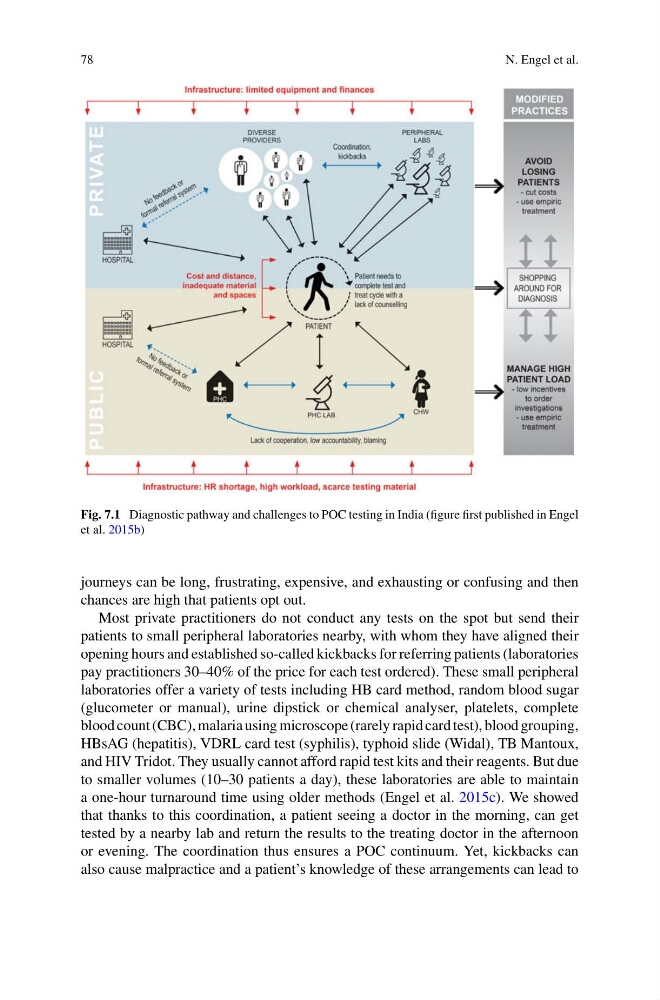
Fig. 7.1 Diagnostic pathway and challenges to POC testing in India (figure first published in Engel
et al. 2015b)
journeys can be long, frustrating, expensive, and exhausting or confusing and then
chances are high that patients opt out.
Most private practitioners do not conduct any tests on the spot but send their
patients to small peripheral laboratories nearby, with whom they have aligned their
opening hours and established so-called kickbacks for referring patients (laboratories
pay practitioners 30–40% of the price for each test ordered). These small peripheral
laboratories offer a variety of tests including HB card method, random blood sugar
(glucometer or manual), urine dipstick or chemical analyser, platelets, complete
blood count (CBC), malaria using microscope (rarely rapid card test), blood grouping,
HBsAG (hepatitis), VDRL card test (syphilis), typhoid slide (Widal), TB Mantoux,
and HIV Tridot. They usually cannot afford rapid test kits and their reagents. But due
to smaller volumes (10–30 patients a day), these laboratories are able to maintain
a one-hour turnaround time using older methods (Engel et al. 2015c). We showed
that thanks to this coordination, a patient seeing a doctor in the morning, can get
tested by a nearby lab and return the results to the treating doctor in the afternoon
or evening. The coordination thus ensures a POC continuum. Yet, kickbacks can
also cause malpractice and a patient’s knowledge of these arrangements can lead to
N. Engel et al.
Fig. 7.1 Diagnostic pathway and challenges to POC testing in India (figure first published in Engel
et al. 2015b)
journeys can be long, frustrating, expensive, and exhausting or confusing and then
chances are high that patients opt out.
Most private practitioners do not conduct any tests on the spot but send their
patients to small peripheral laboratories nearby, with whom they have aligned their
opening hours and established so-called kickbacks for referring patients (laboratories
pay practitioners 30–40% of the price for each test ordered). These small peripheral
laboratories offer a variety of tests including HB card method, random blood sugar
(glucometer or manual), urine dipstick or chemical analyser, platelets, complete
blood count (CBC), malaria using microscope (rarely rapid card test), blood grouping,
HBsAG (hepatitis), VDRL card test (syphilis), typhoid slide (Widal), TB Mantoux,
and HIV Tridot. They usually cannot afford rapid test kits and their reagents. But due
to smaller volumes (10–30 patients a day), these laboratories are able to maintain
a one-hour turnaround time using older methods (Engel et al. 2015c). We showed
that thanks to this coordination, a patient seeing a doctor in the morning, can get
tested by a nearby lab and return the results to the treating doctor in the afternoon
or evening. The coordination thus ensures a POC continuum. Yet, kickbacks can
also cause malpractice and a patient’s knowledge of these arrangements can lead to