

2 Do No Digital Harm: Mitigating Technology Risks …
19
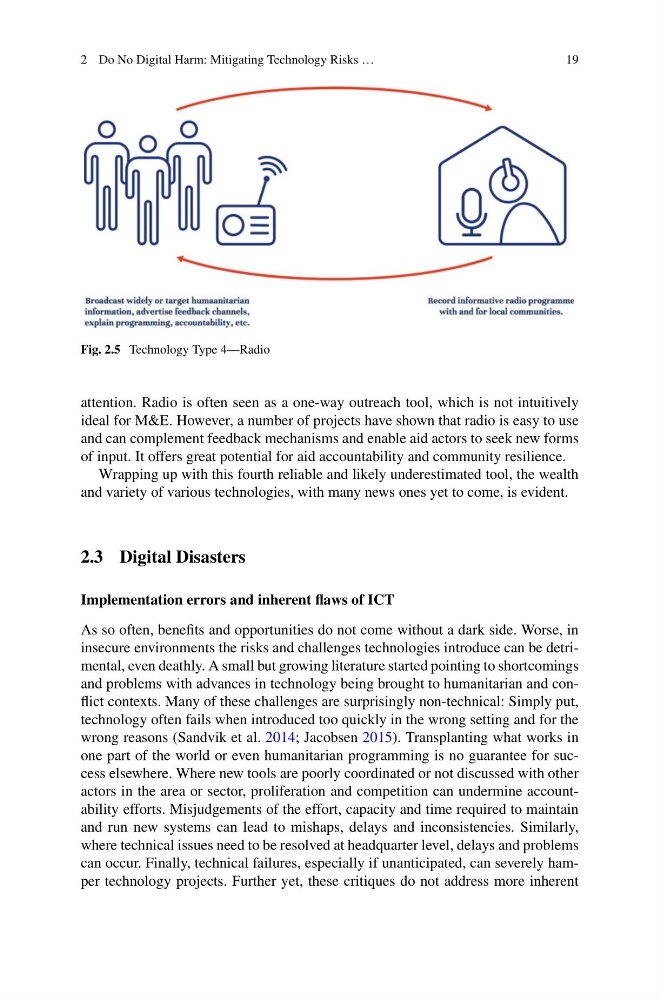
Fig. 2.5 Technology Type 4—Radio
attention. Radio is often seen as a one-way outreach tool, which is not intuitively
ideal for M&E. However, a number of projects have shown that radio is easy to use
and can complement feedback mechanisms and enable aid actors to seek new forms
of input. It offers great potential for aid accountability and community resilience.
Wrapping up with this fourth reliable and likely underestimated tool, the wealth
and variety of various technologies, with many news ones yet to come, is evident.
2.3 Digital Disasters
Implementation errors and inherent flaws of ICT
As so often, benefits and opportunities do not come without a dark side. Worse, in
insecure environments the risks and challenges technologies introduce can be detrimental, even deathly. A small but growing literature started pointing to shortcomings
and problems with advances in technology being brought to humanitarian and conflict contexts. Many of these challenges are surprisingly non-technical: Simply put,
technology often fails when introduced too quickly in the wrong setting and for the
wrong reasons (Sandvik et al. 2014; Jacobsen 2015). Transplanting what works in
one part of the world or even humanitarian programming is no guarantee for success elsewhere. Where new tools are poorly coordinated or not discussed with other
actors in the area or sector, proliferation and competition can undermine accountability efforts. Misjudgements of the effort, capacity and time required to maintain
and run new systems can lead to mishaps, delays and inconsistencies. Similarly,
where technical issues need to be resolved at headquarter level, delays and problems
can occur. Finally, technical failures, especially if unanticipated, can severely hamper technology projects. Further yet, these critiques do not address more inherent
19
Fig. 2.5 Technology Type 4—Radio
attention. Radio is often seen as a one-way outreach tool, which is not intuitively
ideal for M&E. However, a number of projects have shown that radio is easy to use
and can complement feedback mechanisms and enable aid actors to seek new forms
of input. It offers great potential for aid accountability and community resilience.
Wrapping up with this fourth reliable and likely underestimated tool, the wealth
and variety of various technologies, with many news ones yet to come, is evident.
2.3 Digital Disasters
Implementation errors and inherent flaws of ICT
As so often, benefits and opportunities do not come without a dark side. Worse, in
insecure environments the risks and challenges technologies introduce can be detrimental, even deathly. A small but growing literature started pointing to shortcomings
and problems with advances in technology being brought to humanitarian and conflict contexts. Many of these challenges are surprisingly non-technical: Simply put,
technology often fails when introduced too quickly in the wrong setting and for the
wrong reasons (Sandvik et al. 2014; Jacobsen 2015). Transplanting what works in
one part of the world or even humanitarian programming is no guarantee for success elsewhere. Where new tools are poorly coordinated or not discussed with other
actors in the area or sector, proliferation and competition can undermine accountability efforts. Misjudgements of the effort, capacity and time required to maintain
and run new systems can lead to mishaps, delays and inconsistencies. Similarly,
where technical issues need to be resolved at headquarter level, delays and problems
can occur. Finally, technical failures, especially if unanticipated, can severely hamper technology projects. Further yet, these critiques do not address more inherent