

2 Do No Digital Harm: Mitigating Technology Risks …
15
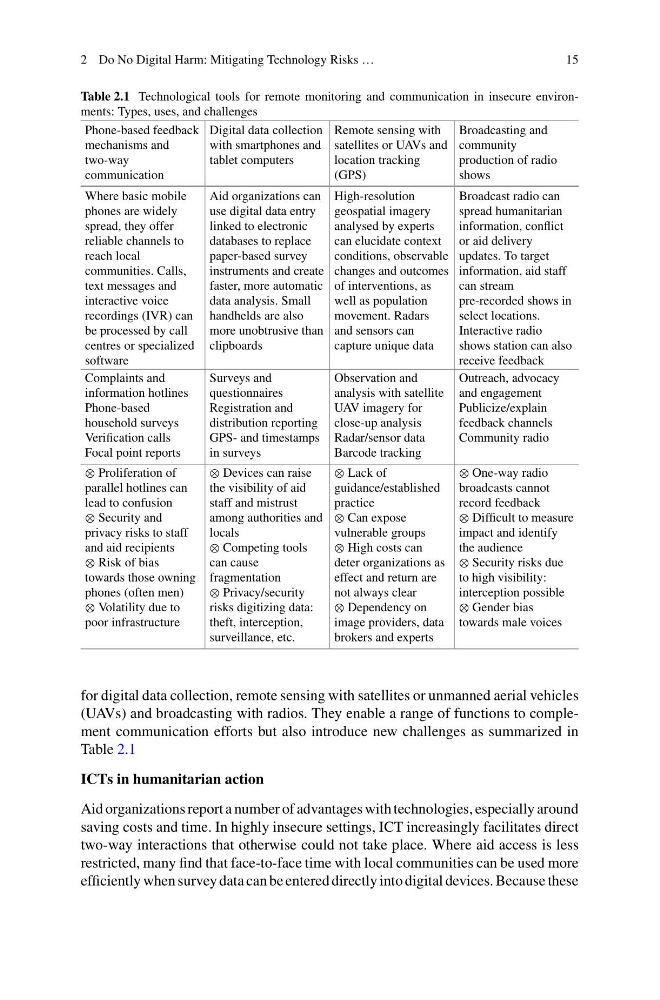
Table 2.1 Technological tools for remote monitoring and communication in insecure environments: Types, uses, and challenges
Phone-based feedback
mechanisms and
two-way
communication
Digital data collection
with smartphones and
tablet computers
Remote sensing with
satellites or UAVs and
location tracking
(GPS)
Broadcasting and
community
production of radio
shows
Where basic mobile
phones are widely
spread, they offer
reliable channels to
reach local
communities. Calls,
text messages and
interactive voice
recordings (IVR) can
be processed by call
centres or specialized
software
Aid organizations can
use digital data entry
linked to electronic
databases to replace
paper-based survey
instruments and create
faster, more automatic
data analysis. Small
handhelds are also
more unobtrusive than
clipboards
High-resolution
geospatial imagery
analysed by experts
can elucidate context
conditions, observable
changes and outcomes
of interventions, as
well as population
movement. Radars
and sensors can
capture unique data
Broadcast radio can
spread humanitarian
information, conflict
or aid delivery
updates. To target
information, aid staff
can stream
pre-recorded shows in
select locations.
Interactive radio
shows station can also
receive feedback
Complaints and
information hotlines
Phone-based
household surveys
Verification calls
Focal point reports
Surveys and
questionnaires
Registration and
distribution reporting
GPS- and timestamps
in surveys
Observation and
analysis with satellite
UAV imagery for
close-up analysis
Radar/sensor data
Barcode tracking
Outreach, advocacy
and engagement
Publicize/explain
feedback channels
Community radio
⊗ Proliferation of
parallel hotlines can
lead to confusion
⊗ Security and
privacy risks to staff
and aid recipients
⊗ Risk of bias
towards those owning
phones (often men)
⊗ Volatility due to
poor infrastructure
⊗ Devices can raise
the visibility of aid
staff and mistrust
among authorities and
locals
⊗ Competing tools
can cause
fragmentation
⊗ Privacy/security
risks digitizing data:
theft, interception,
surveillance, etc.
⊗ Lack of
guidance/established
practice
⊗ Can expose
vulnerable groups
⊗ High costs can
deter organizations as
effect and return are
not always clear
⊗ Dependency on
image providers, data
brokers and experts
⊗ One-way radio
broadcasts cannot
record feedback
⊗ Difficult to measure
impact and identify
the audience
⊗ Security risks due
to high visibility:
interception possible
⊗ Gender bias
towards male voices
for digital data collection, remote sensing with satellites or unmanned aerial vehicles
(UAVs) and broadcasting with radios. They enable a range of functions to complement communication efforts but also introduce new challenges as summarized in
Table 2.1
ICTs in humanitarian action
Aid organizations report a number of advantages with technologies, especially around
saving costs and time. In highly insecure settings, ICT increasingly facilitates direct
two-way interactions that otherwise could not take place. Where aid access is less
restricted, many find that face-to-face time with local communities can be used more
efficiently when survey data can be entered directly into digital devices. Because these
15
Table 2.1 Technological tools for remote monitoring and communication in insecure environments: Types, uses, and challenges
Phone-based feedback
mechanisms and
two-way
communication
Digital data collection
with smartphones and
tablet computers
Remote sensing with
satellites or UAVs and
location tracking
(GPS)
Broadcasting and
community
production of radio
shows
Where basic mobile
phones are widely
spread, they offer
reliable channels to
reach local
communities. Calls,
text messages and
interactive voice
recordings (IVR) can
be processed by call
centres or specialized
software
Aid organizations can
use digital data entry
linked to electronic
databases to replace
paper-based survey
instruments and create
faster, more automatic
data analysis. Small
handhelds are also
more unobtrusive than
clipboards
High-resolution
geospatial imagery
analysed by experts
can elucidate context
conditions, observable
changes and outcomes
of interventions, as
well as population
movement. Radars
and sensors can
capture unique data
Broadcast radio can
spread humanitarian
information, conflict
or aid delivery
updates. To target
information, aid staff
can stream
pre-recorded shows in
select locations.
Interactive radio
shows station can also
receive feedback
Complaints and
information hotlines
Phone-based
household surveys
Verification calls
Focal point reports
Surveys and
questionnaires
Registration and
distribution reporting
GPS- and timestamps
in surveys
Observation and
analysis with satellite
UAV imagery for
close-up analysis
Radar/sensor data
Barcode tracking
Outreach, advocacy
and engagement
Publicize/explain
feedback channels
Community radio
⊗ Proliferation of
parallel hotlines can
lead to confusion
⊗ Security and
privacy risks to staff
and aid recipients
⊗ Risk of bias
towards those owning
phones (often men)
⊗ Volatility due to
poor infrastructure
⊗ Devices can raise
the visibility of aid
staff and mistrust
among authorities and
locals
⊗ Competing tools
can cause
fragmentation
⊗ Privacy/security
risks digitizing data:
theft, interception,
surveillance, etc.
⊗ Lack of
guidance/established
practice
⊗ Can expose
vulnerable groups
⊗ High costs can
deter organizations as
effect and return are
not always clear
⊗ Dependency on
image providers, data
brokers and experts
⊗ One-way radio
broadcasts cannot
record feedback
⊗ Difficult to measure
impact and identify
the audience
⊗ Security risks due
to high visibility:
interception possible
⊗ Gender bias
towards male voices
for digital data collection, remote sensing with satellites or unmanned aerial vehicles
(UAVs) and broadcasting with radios. They enable a range of functions to complement communication efforts but also introduce new challenges as summarized in
Table 2.1
ICTs in humanitarian action
Aid organizations report a number of advantages with technologies, especially around
saving costs and time. In highly insecure settings, ICT increasingly facilitates direct
two-way interactions that otherwise could not take place. Where aid access is less
restricted, many find that face-to-face time with local communities can be used more
efficiently when survey data can be entered directly into digital devices. Because these