

218
M. J. C. van den Homberg et al.
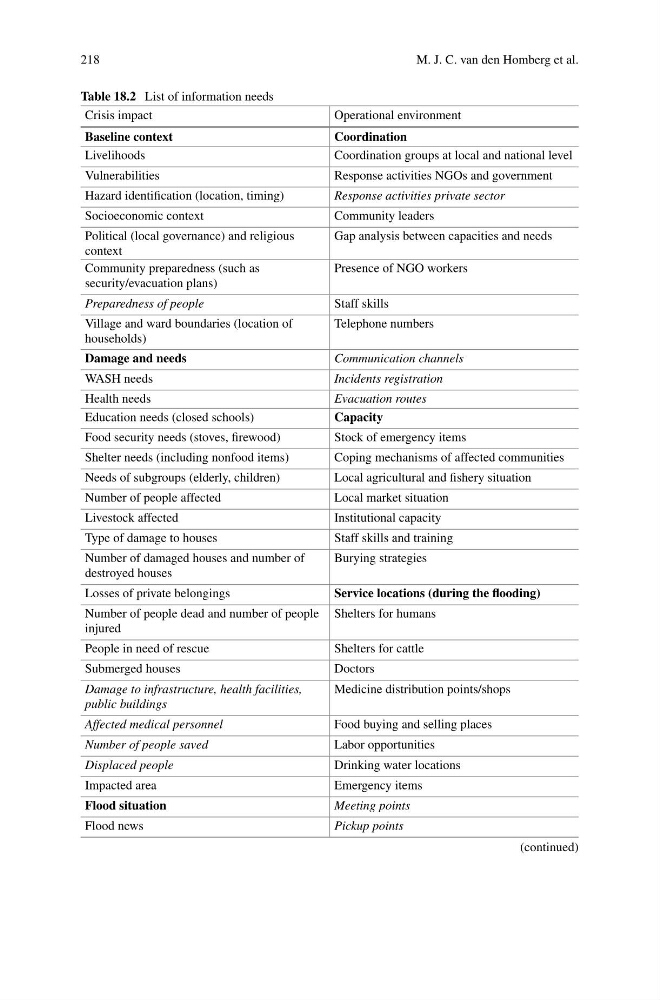
Table 18.2 List of information needs
Crisis impact
Operational environment
Baseline context
Coordination
Livelihoods
Coordination groups at local and national level
Vulnerabilities
Response activities NGOs and government
Hazard identification (location, timing)
Response activities private sector
Socioeconomic context
Community leaders
Political (local governance) and religious
context
Gap analysis between capacities and needs
Community preparedness (such as
security/evacuation plans)
Presence of NGO workers
Preparedness of people
Staff skills
Village and ward boundaries (location of
households)
Telephone numbers
Damage and needs
Communication channels
WASH needs
Incidents registration
Health needs
Evacuation routes
Education needs (closed schools)
Capacity
Food security needs (stoves, firewood)
Stock of emergency items
Shelter needs (including nonfood items)
Coping mechanisms of affected communities
Needs of subgroups (elderly, children)
Local agricultural and fishery situation
Number of people affected
Local market situation
Livestock affected
Institutional capacity
Type of damage to houses
Staff skills and training
Number of damaged houses and number of
destroyed houses
Burying strategies
Losses of private belongings
Service locations (during the flooding)
Number of people dead and number of people
injured
Shelters for humans
People in need of rescue
Shelters for cattle
Submerged houses
Doctors
Damage to infrastructure, health facilities,
public buildings
Medicine distribution points/shops
Affected medical personnel
Food buying and selling places
Number of people saved
Labor opportunities
Displaced people
Drinking water locations
Impacted area
Emergency items
Flood situation
Meeting points
Flood news
Pickup points
(continued)
M. J. C. van den Homberg et al.
Table 18.2 List of information needs
Crisis impact
Operational environment
Baseline context
Coordination
Livelihoods
Coordination groups at local and national level
Vulnerabilities
Response activities NGOs and government
Hazard identification (location, timing)
Response activities private sector
Socioeconomic context
Community leaders
Political (local governance) and religious
context
Gap analysis between capacities and needs
Community preparedness (such as
security/evacuation plans)
Presence of NGO workers
Preparedness of people
Staff skills
Village and ward boundaries (location of
households)
Telephone numbers
Damage and needs
Communication channels
WASH needs
Incidents registration
Health needs
Evacuation routes
Education needs (closed schools)
Capacity
Food security needs (stoves, firewood)
Stock of emergency items
Shelter needs (including nonfood items)
Coping mechanisms of affected communities
Needs of subgroups (elderly, children)
Local agricultural and fishery situation
Number of people affected
Local market situation
Livestock affected
Institutional capacity
Type of damage to houses
Staff skills and training
Number of damaged houses and number of
destroyed houses
Burying strategies
Losses of private belongings
Service locations (during the flooding)
Number of people dead and number of people
injured
Shelters for humans
People in need of rescue
Shelters for cattle
Submerged houses
Doctors
Damage to infrastructure, health facilities,
public buildings
Medicine distribution points/shops
Affected medical personnel
Food buying and selling places
Number of people saved
Labor opportunities
Displaced people
Drinking water locations
Impacted area
Emergency items
Flood situation
Meeting points
Flood news
Pickup points
(continued)