

216
M. J. C. van den Homberg et al.
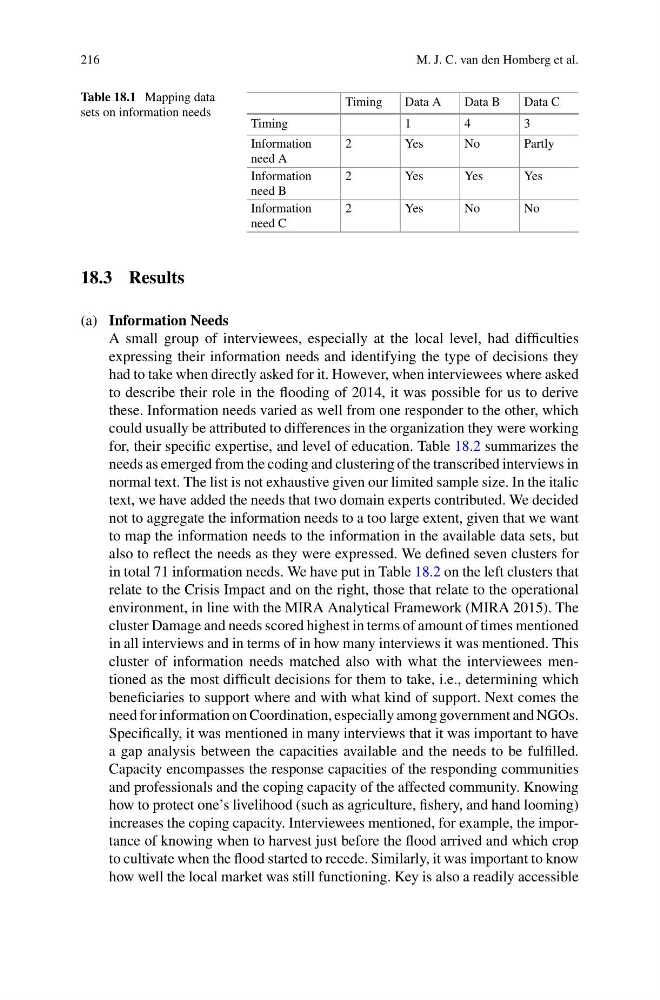
Table 18.1 Mapping data
sets on information needs
Timing
Data A
Data B
Data C
Timing
1
4
3
Information
need A
2
Yes
No
Partly
Information
need B
2
Yes
Yes
Yes
Information
need C
2
Yes
No
No
18.3 Results
(a) Information Needs
A small group of interviewees, especially at the local level, had difficulties
expressing their information needs and identifying the type of decisions they
had to take when directly asked for it. However, when interviewees where asked
to describe their role in the flooding of 2014, it was possible for us to derive
these. Information needs varied as well from one responder to the other, which
could usually be attributed to differences in the organization they were working
for, their specific expertise, and level of education. Table 18.2 summarizes the
needs as emerged from the coding and clustering of the transcribed interviews in
normal text. The list is not exhaustive given our limited sample size. In the italic
text, we have added the needs that two domain experts contributed. We decided
not to aggregate the information needs to a too large extent, given that we want
to map the information needs to the information in the available data sets, but
also to reflect the needs as they were expressed. We defined seven clusters for
in total 71 information needs. We have put in Table 18.2 on the left clusters that
relate to the Crisis Impact and on the right, those that relate to the operational
environment, in line with the MIRA Analytical Framework (MIRA 2015). The
cluster Damage and needs scored highest in terms of amount of times mentioned
in all interviews and in terms of in how many interviews it was mentioned. This
cluster of information needs matched also with what the interviewees mentioned as the most difficult decisions for them to take, i.e., determining which
beneficiaries to support where and with what kind of support. Next comes the
need for information on Coordination, especially among government and NGOs.
Specifically, it was mentioned in many interviews that it was important to have
a gap analysis between the capacities available and the needs to be fulfilled.
Capacity encompasses the response capacities of the responding communities
and professionals and the coping capacity of the affected community. Knowing
how to protect one’s livelihood (such as agriculture, fishery, and hand looming)
increases the coping capacity. Interviewees mentioned, for example, the importance of knowing when to harvest just before the flood arrived and which crop
to cultivate when the flood started to recede. Similarly, it was important to know
how well the local market was still functioning. Key is also a readily accessible
M. J. C. van den Homberg et al.
Table 18.1 Mapping data
sets on information needs
Timing
Data A
Data B
Data C
Timing
1
4
3
Information
need A
2
Yes
No
Partly
Information
need B
2
Yes
Yes
Yes
Information
need C
2
Yes
No
No
18.3 Results
(a) Information Needs
A small group of interviewees, especially at the local level, had difficulties
expressing their information needs and identifying the type of decisions they
had to take when directly asked for it. However, when interviewees where asked
to describe their role in the flooding of 2014, it was possible for us to derive
these. Information needs varied as well from one responder to the other, which
could usually be attributed to differences in the organization they were working
for, their specific expertise, and level of education. Table 18.2 summarizes the
needs as emerged from the coding and clustering of the transcribed interviews in
normal text. The list is not exhaustive given our limited sample size. In the italic
text, we have added the needs that two domain experts contributed. We decided
not to aggregate the information needs to a too large extent, given that we want
to map the information needs to the information in the available data sets, but
also to reflect the needs as they were expressed. We defined seven clusters for
in total 71 information needs. We have put in Table 18.2 on the left clusters that
relate to the Crisis Impact and on the right, those that relate to the operational
environment, in line with the MIRA Analytical Framework (MIRA 2015). The
cluster Damage and needs scored highest in terms of amount of times mentioned
in all interviews and in terms of in how many interviews it was mentioned. This
cluster of information needs matched also with what the interviewees mentioned as the most difficult decisions for them to take, i.e., determining which
beneficiaries to support where and with what kind of support. Next comes the
need for information on Coordination, especially among government and NGOs.
Specifically, it was mentioned in many interviews that it was important to have
a gap analysis between the capacities available and the needs to be fulfilled.
Capacity encompasses the response capacities of the responding communities
and professionals and the coping capacity of the affected community. Knowing
how to protect one’s livelihood (such as agriculture, fishery, and hand looming)
increases the coping capacity. Interviewees mentioned, for example, the importance of knowing when to harvest just before the flood arrived and which crop
to cultivate when the flood started to recede. Similarly, it was important to know
how well the local market was still functioning. Key is also a readily accessible