

16 Highlights and Lessons from the Implementation of an Early …
189
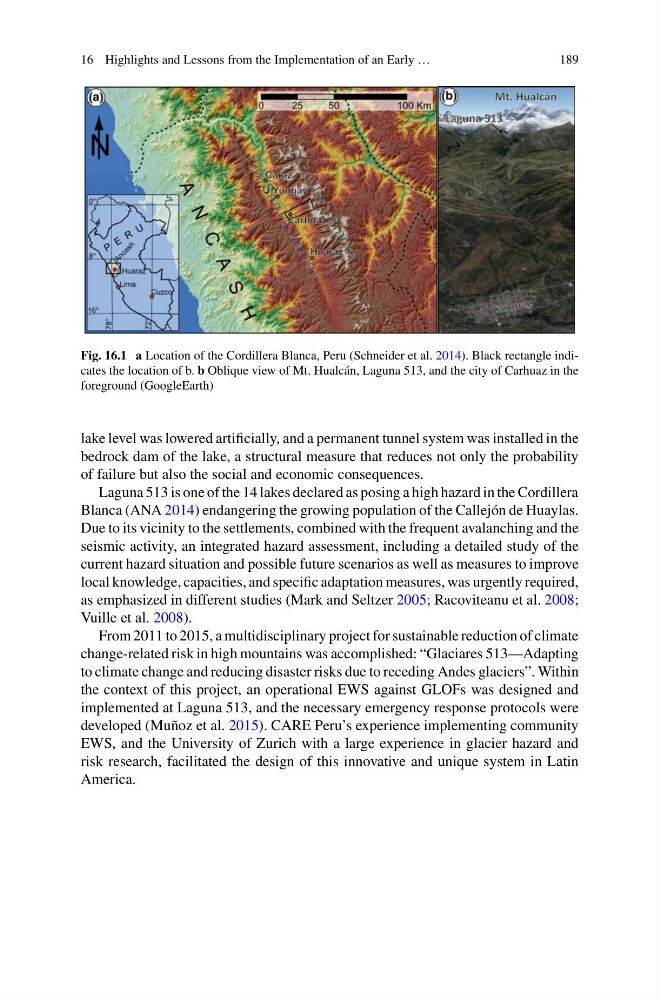
Fig. 16.1 a Location of the Cordillera Blanca, Peru (Schneider et al. 2014). Black rectangle indicates the location of b. b Oblique view of Mt. Hualcán, Laguna 513, and the city of Carhuaz in the
foreground (GoogleEarth)
lake level was lowered artificially, and a permanent tunnel system was installed in the
bedrock dam of the lake, a structural measure that reduces not only the probability
of failure but also the social and economic consequences.
Laguna 513 is one of the 14 lakes declared as posing a high hazard in the Cordillera
Blanca (ANA 2014) endangering the growing population of the Callejón de Huaylas.
Due to its vicinity to the settlements, combined with the frequent avalanching and the
seismic activity, an integrated hazard assessment, including a detailed study of the
current hazard situation and possible future scenarios as well as measures to improve
local knowledge, capacities, and specific adaptation measures, was urgently required,
as emphasized in different studies (Mark and Seltzer 2005; Racoviteanu et al. 2008;
Vuille et al. 2008).
From 2011 to 2015, a multidisciplinary project for sustainable reduction of climate
change-related risk in high mountains was accomplished: “Glaciares 513—Adapting
to climate change and reducing disaster risks due to receding Andes glaciers”. Within
the context of this project, an operational EWS against GLOFs was designed and
implemented at Laguna 513, and the necessary emergency response protocols were
developed (Muñoz et al. 2015). CARE Peru’s experience implementing community
EWS, and the University of Zurich with a large experience in glacier hazard and
risk research, facilitated the design of this innovative and unique system in Latin
America.
189
Fig. 16.1 a Location of the Cordillera Blanca, Peru (Schneider et al. 2014). Black rectangle indicates the location of b. b Oblique view of Mt. Hualcán, Laguna 513, and the city of Carhuaz in the
foreground (GoogleEarth)
lake level was lowered artificially, and a permanent tunnel system was installed in the
bedrock dam of the lake, a structural measure that reduces not only the probability
of failure but also the social and economic consequences.
Laguna 513 is one of the 14 lakes declared as posing a high hazard in the Cordillera
Blanca (ANA 2014) endangering the growing population of the Callejón de Huaylas.
Due to its vicinity to the settlements, combined with the frequent avalanching and the
seismic activity, an integrated hazard assessment, including a detailed study of the
current hazard situation and possible future scenarios as well as measures to improve
local knowledge, capacities, and specific adaptation measures, was urgently required,
as emphasized in different studies (Mark and Seltzer 2005; Racoviteanu et al. 2008;
Vuille et al. 2008).
From 2011 to 2015, a multidisciplinary project for sustainable reduction of climate
change-related risk in high mountains was accomplished: “Glaciares 513—Adapting
to climate change and reducing disaster risks due to receding Andes glaciers”. Within
the context of this project, an operational EWS against GLOFs was designed and
implemented at Laguna 513, and the necessary emergency response protocols were
developed (Muñoz et al. 2015). CARE Peru’s experience implementing community
EWS, and the University of Zurich with a large experience in glacier hazard and
risk research, facilitated the design of this innovative and unique system in Latin
America.