

Elements of Quantum Theory
89
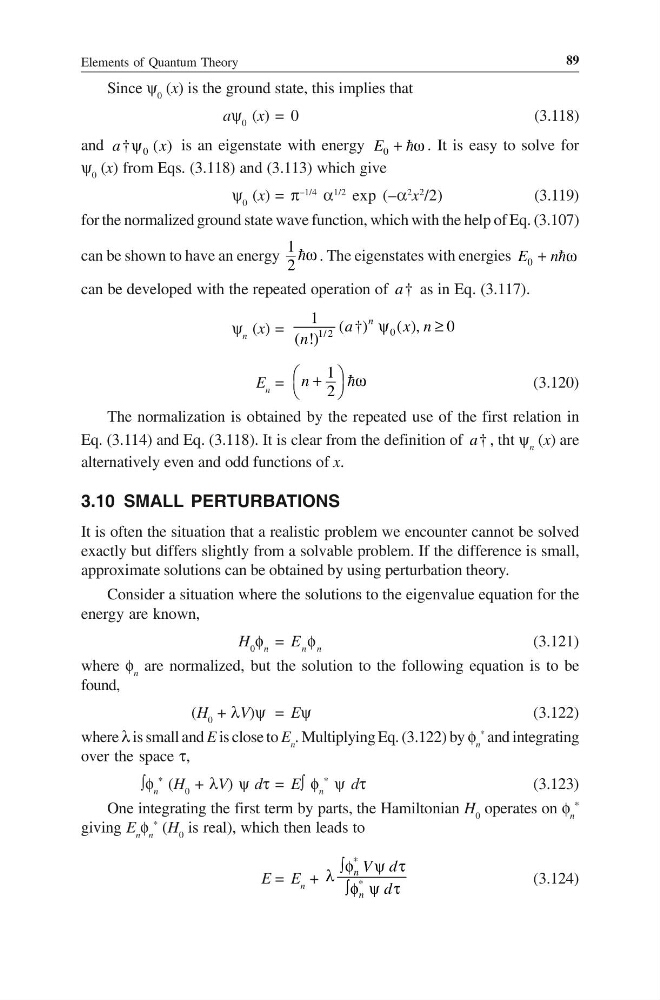
Since ψ 0 (x) is the ground state, this implies that
aψ 0 (x) = 0
(3.118)
and
0
† ( )
a
x
ψ
is an eigenstate with energy 0
E + ω
. It is easy to solve for
ψ 0 (x) from Eqs. (3.118) and (3.113) which give
ψ 0 (x) = π
–1/4
α
1/2
exp (–α
2
x
2
/2)
(3.119)
for the normalized ground state wave function, which with the help of Eq. (3.107)
can be shown to have an energy
1
2
ω
. The eigenstates with energies 0
E n
+ ω
can be developed with the repeated operation of †
a as in Eq. (3.117).
ψ n (x) =
0
1/ 2
1 ( †)
( ),
0
( !)
n
a
x n
n
ψ
≥
E n =
1
2
n
+
ω
(3.120)
The normalization is obtained by the repeated use of the first relation in
Eq. (3.114) and Eq. (3.118). It is clear from the definition of †
a , tht ψ n (x) are
alternatively even and odd functions of x.
3.10 SMALL PERTURBATIONS
It is often the situation that a realistic problem we encounter cannot be solved
exactly but differs slightly from a solvable problem. If the difference is small,
approximate solutions can be obtained by using perturbation theory.
Consider a situation where the solutions to the eigenvalue equation for the
energy are known,
H 0 φ n = E n φ n
(3.121)
where φ n are normalized, but the solution to the following equation is to be
found,
(H 0 + λV)ψ = Eψ
(3.122)
where λ is small and E is close to E n . Multiplying Eq. (3.122) by φ n
*
and integrating
over the space τ,
∫φ n
*
(H 0 + λV) ψ dτ = E∫ φ n
*
ψ dτ
(3.123)
One integrating the first term by parts, the Hamiltonian H 0 operates on φ n
*
giving E n φ n
*
(H 0 is real), which then leads to
E = E n +
*
*
∫ φ ψ τ
λ ∫ φ ψ τ
n
n
V d
d
(3.124)
89
Since ψ 0 (x) is the ground state, this implies that
aψ 0 (x) = 0
(3.118)
and
0
† ( )
a
x
ψ
is an eigenstate with energy 0
E + ω
. It is easy to solve for
ψ 0 (x) from Eqs. (3.118) and (3.113) which give
ψ 0 (x) = π
–1/4
α
1/2
exp (–α
2
x
2
/2)
(3.119)
for the normalized ground state wave function, which with the help of Eq. (3.107)
can be shown to have an energy
1
2
ω
. The eigenstates with energies 0
E n
+ ω
can be developed with the repeated operation of †
a as in Eq. (3.117).
ψ n (x) =
0
1/ 2
1 ( †)
( ),
0
( !)
n
a
x n
n
ψ
≥
E n =
1
2
n
+
ω
(3.120)
The normalization is obtained by the repeated use of the first relation in
Eq. (3.114) and Eq. (3.118). It is clear from the definition of †
a , tht ψ n (x) are
alternatively even and odd functions of x.
3.10 SMALL PERTURBATIONS
It is often the situation that a realistic problem we encounter cannot be solved
exactly but differs slightly from a solvable problem. If the difference is small,
approximate solutions can be obtained by using perturbation theory.
Consider a situation where the solutions to the eigenvalue equation for the
energy are known,
H 0 φ n = E n φ n
(3.121)
where φ n are normalized, but the solution to the following equation is to be
found,
(H 0 + λV)ψ = Eψ
(3.122)
where λ is small and E is close to E n . Multiplying Eq. (3.122) by φ n
*
and integrating
over the space τ,
∫φ n
*
(H 0 + λV) ψ dτ = E∫ φ n
*
ψ dτ
(3.123)
One integrating the first term by parts, the Hamiltonian H 0 operates on φ n
*
giving E n φ n
*
(H 0 is real), which then leads to
E = E n +
*
*
∫ φ ψ τ
λ ∫ φ ψ τ
n
n
V d
d
(3.124)