

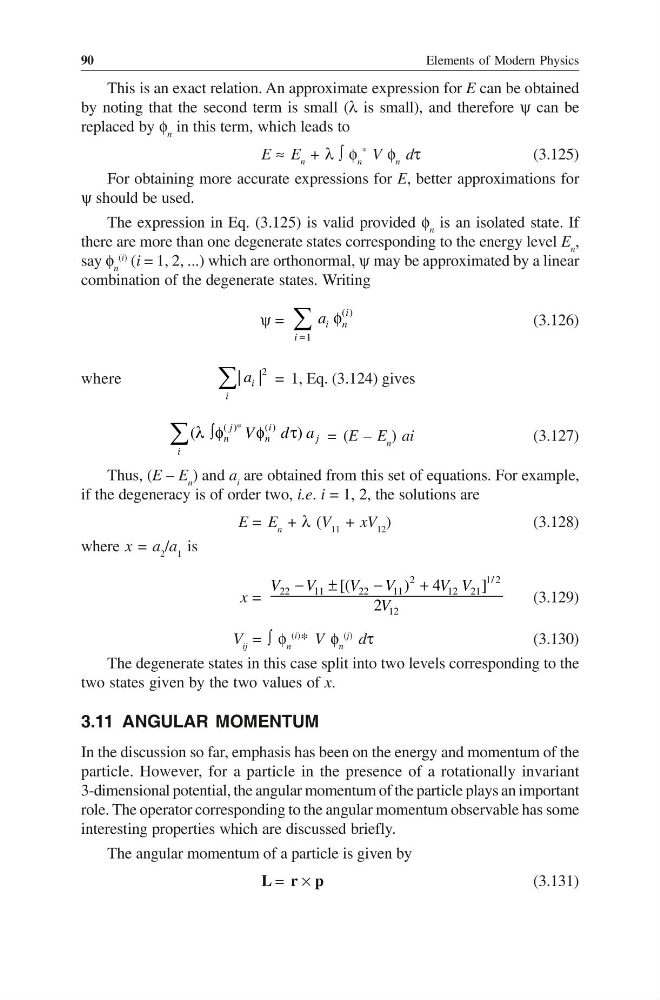
Elements of Modern Physics
90
This is an exact relation. An approximate expression for E can be obtained
by noting that the second term is small (λ is small), and therefore ψ can be
replaced by φ n in this term, which leads to
E ≈ E n + λ ∫ φ n
*
V φ n dτ
(3.125)
For obtaining more accurate expressions for E, better approximations for
ψ should be used.
The expression in Eq. (3.125) is valid provided φ n is an isolated state. If
there are more than one degenerate states corresponding to the energy level E n ,
say φ n
(i)
(i = 1, 2, ...) which are orthonormal, ψ may be approximated by a linear
combination of the degenerate states. Writing
ψ =
( )
1
i
i n
i
a
=
φ
∑
(3.126)
where
2
| |
i
i
a
∑ = 1, Eq. (3.124) gives
( )*
( )
(
)
λ ∫ φ
φ
τ
∑
j
i
n
n
j
i
V
d a = (E – E n ) ai
(3.127)
Thus, (E – E n ) and a i are obtained from this set of equations. For example,
if the degeneracy is of order two, i.e. i = 1, 2, the solutions are
E = E n + λ (V 11 + xV 12 )
(3.128)
where x = a 2 /a 1 is
x =
2
1 / 2
22
11
22
11
12 21
12
[(
) 4
]
2
V
V
V
V
V V
V
−
±
−
+
(3.129)
V ij = ∫ φ n
(i)
* V φ n
(j)
dτ
(3.130)
The degenerate states in this case split into two levels corresponding to the
two states given by the two values of x.
3.11 ANGULAR MOMENTUM
In the discussion so far, emphasis has been on the energy and momentum of the
particle. However, for a particle in the presence of a rotationally invariant
3-dimensional potential, the angular momentum of the particle plays an important
role. The operator corresponding to the angular momentum observable has some
interesting properties which are discussed briefly.
The angular momentum of a particle is given by
L = r × p
(3.131)
90
This is an exact relation. An approximate expression for E can be obtained
by noting that the second term is small (λ is small), and therefore ψ can be
replaced by φ n in this term, which leads to
E ≈ E n + λ ∫ φ n
*
V φ n dτ
(3.125)
For obtaining more accurate expressions for E, better approximations for
ψ should be used.
The expression in Eq. (3.125) is valid provided φ n is an isolated state. If
there are more than one degenerate states corresponding to the energy level E n ,
say φ n
(i)
(i = 1, 2, ...) which are orthonormal, ψ may be approximated by a linear
combination of the degenerate states. Writing
ψ =
( )
1
i
i n
i
a
=
φ
∑
(3.126)
where
2
| |
i
i
a
∑ = 1, Eq. (3.124) gives
( )*
( )
(
)
λ ∫ φ
φ
τ
∑
j
i
n
n
j
i
V
d a = (E – E n ) ai
(3.127)
Thus, (E – E n ) and a i are obtained from this set of equations. For example,
if the degeneracy is of order two, i.e. i = 1, 2, the solutions are
E = E n + λ (V 11 + xV 12 )
(3.128)
where x = a 2 /a 1 is
x =
2
1 / 2
22
11
22
11
12 21
12
[(
) 4
]
2
V
V
V
V
V V
V
−
±
−
+
(3.129)
V ij = ∫ φ n
(i)
* V φ n
(j)
dτ
(3.130)
The degenerate states in this case split into two levels corresponding to the
two states given by the two values of x.
3.11 ANGULAR MOMENTUM
In the discussion so far, emphasis has been on the energy and momentum of the
particle. However, for a particle in the presence of a rotationally invariant
3-dimensional potential, the angular momentum of the particle plays an important
role. The operator corresponding to the angular momentum observable has some
interesting properties which are discussed briefly.
The angular momentum of a particle is given by
L = r × p
(3.131)