

Elements of Quantum Theory
87
A quantum well laser is a laser diode in which the active region of the
device is so narrow that quantum confinement occurs. The wavelength of the
light emitted by a quantum well laser is determined by the width of the active
region rather than just the bandgap of the material from which it is constructed.
This means that much shorter wavelengths can be obtained from quantum well
lasers than from conventional laser diodes using a particular semiconductor
material. The efficiency of a quantum well laser is also greater than a conventional
laser diode.
(Source : Wikipedia)
3.9 SIMPLE HARMONIC OSCILLATOR
A problem of considerable importance is that of the simple harmonic oscillator.
For most oscillating systems, it can be used as the first approximation.
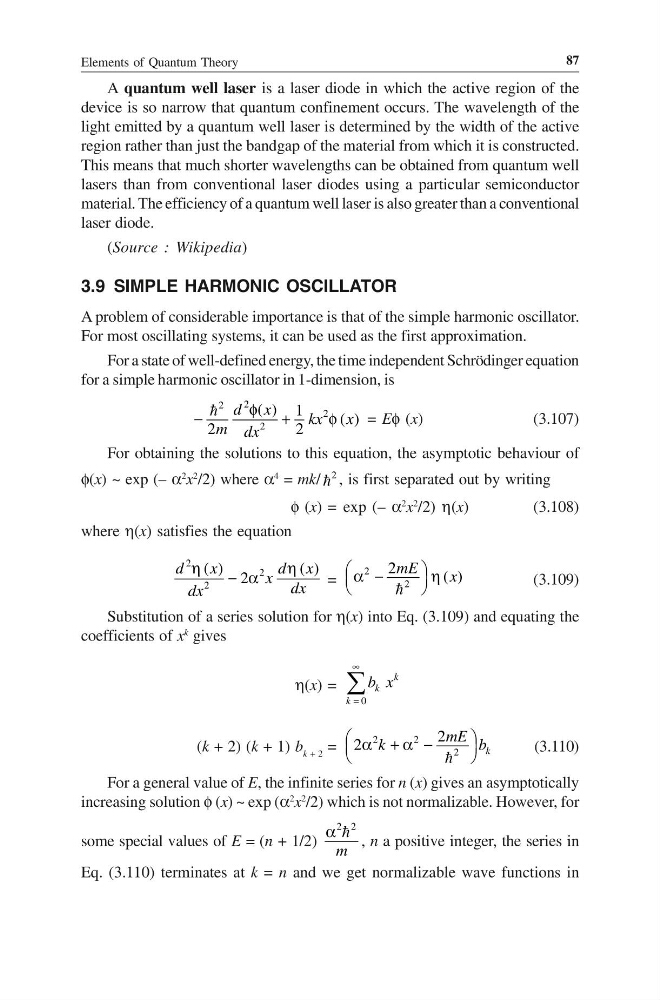
For a state of well-defined energy, the time independent Schrödinger equation
for a simple harmonic oscillator in 1-dimension, is
2
2
2
2
( ) 1
( )
2
2
d x
kx
x
m dx
φ
−
+
φ
= Eφ (x)
(3.107)
For obtaining the solutions to this equation, the asymptotic behaviour of
φ(x) ~ exp (– α
2
x
2
/2) where α
4
= mk/
2
, is first separated out by writing
φ (x) = exp (– α
2
x
2
/2) η(x)
(3.108)
where η(x) satisfies the equation
2
2
2
( )
( )
2
d
x
d x
x dx
dx
η
η
− α
=
2
2
2
( )
mE
x
α −
η
(3.109)
Substitution of a series solution for η(x) into Eq. (3.109) and equating the
coefficients of x
k
gives
η(x) =
0
k
k
k
b x
∞
=
∑
(k + 2) (k + 1) b k + 2 =
2
2
2
2
2
k
mE
k
b
α + α −
(3.110)
For a general value of E, the infinite series for n (x) gives an asymptotically
increasing solution φ (x) ~ exp (α
2
x
2
/2) which is not normalizable. However, for
some special values of E = (n + 1/2)
2 2
m
α , n a positive integer, the series in
Eq. (3.110) terminates at k = n and we get normalizable wave functions in
87
A quantum well laser is a laser diode in which the active region of the
device is so narrow that quantum confinement occurs. The wavelength of the
light emitted by a quantum well laser is determined by the width of the active
region rather than just the bandgap of the material from which it is constructed.
This means that much shorter wavelengths can be obtained from quantum well
lasers than from conventional laser diodes using a particular semiconductor
material. The efficiency of a quantum well laser is also greater than a conventional
laser diode.
(Source : Wikipedia)
3.9 SIMPLE HARMONIC OSCILLATOR
A problem of considerable importance is that of the simple harmonic oscillator.
For most oscillating systems, it can be used as the first approximation.
For a state of well-defined energy, the time independent Schrödinger equation
for a simple harmonic oscillator in 1-dimension, is
2
2
2
2
( ) 1
( )
2
2
d x
kx
x
m dx
φ
−
+
φ
= Eφ (x)
(3.107)
For obtaining the solutions to this equation, the asymptotic behaviour of
φ(x) ~ exp (– α
2
x
2
/2) where α
4
= mk/
2
, is first separated out by writing
φ (x) = exp (– α
2
x
2
/2) η(x)
(3.108)
where η(x) satisfies the equation
2
2
2
( )
( )
2
d
x
d x
x dx
dx
η
η
− α
=
2
2
2
( )
mE
x
α −
η
(3.109)
Substitution of a series solution for η(x) into Eq. (3.109) and equating the
coefficients of x
k
gives
η(x) =
0
k
k
k
b x
∞
=
∑
(k + 2) (k + 1) b k + 2 =
2
2
2
2
2
k
mE
k
b
α + α −
(3.110)
For a general value of E, the infinite series for n (x) gives an asymptotically
increasing solution φ (x) ~ exp (α
2
x
2
/2) which is not normalizable. However, for
some special values of E = (n + 1/2)
2 2
m
α , n a positive integer, the series in
Eq. (3.110) terminates at k = n and we get normalizable wave functions in