

Elements of Modern Physics
44
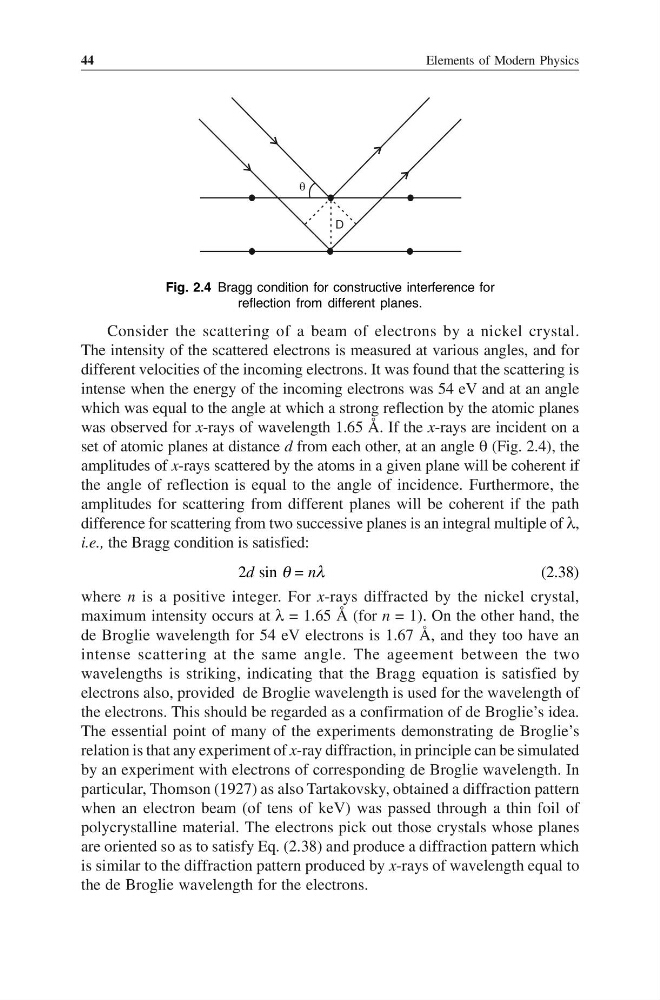
Fig. 2.4 Bragg condition for constructive interference for
reflection from different planes.
Consider the scattering of a beam of electrons by a nickel crystal.
The intensity of the scattered electrons is measured at various angles, and for
different velocities of the incoming electrons. It was found that the scattering is
intense when the energy of the incoming electrons was 54 eV and at an angle
which was equal to the angle at which a strong reflection by the atomic planes
was observed for x-rays of wavelength 1.65 Å. If the x-rays are incident on a
set of atomic planes at distance d from each other, at an angle θ (Fig. 2.4), the
amplitudes of x-rays scattered by the atoms in a given plane will be coherent if
the angle of reflection is equal to the angle of incidence. Furthermore, the
amplitudes for scattering from different planes will be coherent if the path
difference for scattering from two successive planes is an integral multiple of λ,
i.e., the Bragg condition is satisfied:
2d sin θ = nλ
(2.38)
where n is a positive integer. For x-rays diffracted by the nickel crystal,
maximum intensity occurs at λ = 1.65 Å (for n = 1). On the other hand, the
de Broglie wavelength for 54 eV electrons is 1.67 Å, and they too have an
intense scattering at the same angle. The ageement between the two
wavelengths is striking, indicating that the Bragg equation is satisfied by
electrons also, provided de Broglie wavelength is used for the wavelength of
the electrons. This should be regarded as a confirmation of de Broglie’s idea.
The essential point of many of the experiments demonstrating de Broglie’s
relation is that any experiment of x-ray diffraction, in principle can be simulated
by an experiment with electrons of corresponding de Broglie wavelength. In
particular, Thomson (1927) as also Tartakovsky, obtained a diffraction pattern
when an electron beam (of tens of keV) was passed through a thin foil of
polycrystalline material. The electrons pick out those crystals whose planes
are oriented so as to satisfy Eq. (2.38) and produce a diffraction pattern which
is similar to the diffraction pattern produced by x-rays of wavelength equal to
the de Broglie wavelength for the electrons.
44
Fig. 2.4 Bragg condition for constructive interference for
reflection from different planes.
Consider the scattering of a beam of electrons by a nickel crystal.
The intensity of the scattered electrons is measured at various angles, and for
different velocities of the incoming electrons. It was found that the scattering is
intense when the energy of the incoming electrons was 54 eV and at an angle
which was equal to the angle at which a strong reflection by the atomic planes
was observed for x-rays of wavelength 1.65 Å. If the x-rays are incident on a
set of atomic planes at distance d from each other, at an angle θ (Fig. 2.4), the
amplitudes of x-rays scattered by the atoms in a given plane will be coherent if
the angle of reflection is equal to the angle of incidence. Furthermore, the
amplitudes for scattering from different planes will be coherent if the path
difference for scattering from two successive planes is an integral multiple of λ,
i.e., the Bragg condition is satisfied:
2d sin θ = nλ
(2.38)
where n is a positive integer. For x-rays diffracted by the nickel crystal,
maximum intensity occurs at λ = 1.65 Å (for n = 1). On the other hand, the
de Broglie wavelength for 54 eV electrons is 1.67 Å, and they too have an
intense scattering at the same angle. The ageement between the two
wavelengths is striking, indicating that the Bragg equation is satisfied by
electrons also, provided de Broglie wavelength is used for the wavelength of
the electrons. This should be regarded as a confirmation of de Broglie’s idea.
The essential point of many of the experiments demonstrating de Broglie’s
relation is that any experiment of x-ray diffraction, in principle can be simulated
by an experiment with electrons of corresponding de Broglie wavelength. In
particular, Thomson (1927) as also Tartakovsky, obtained a diffraction pattern
when an electron beam (of tens of keV) was passed through a thin foil of
polycrystalline material. The electrons pick out those crystals whose planes
are oriented so as to satisfy Eq. (2.38) and produce a diffraction pattern which
is similar to the diffraction pattern produced by x-rays of wavelength equal to
the de Broglie wavelength for the electrons.