

Introduction to Quantum Ideas
43
0
sin
tan
/
cos
θ
φ = ν ν −
θ
2
0
cot ( / 2)
1
/
θ
= + ν
h
mc
(2.36)
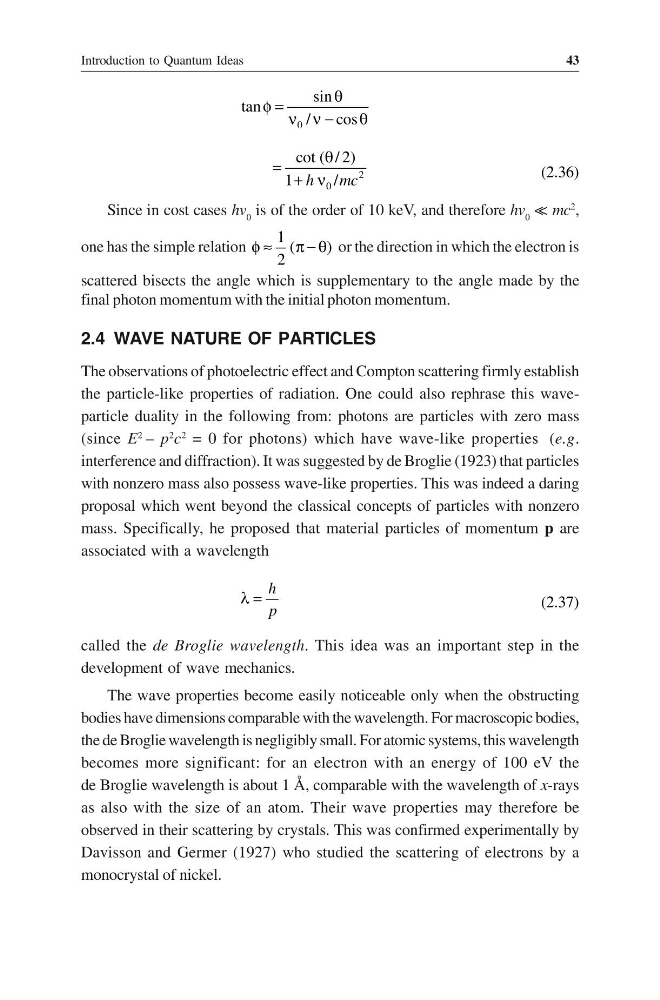
Since in cost cases hv 0 is of the order of 10 keV, and therefore hv 0 << mc
2
,
one has the simple relation
1 (
)
2
φ ≈ π − θ or the direction in which the electron is
scattered bisects the angle which is supplementary to the angle made by the
final photon momentum with the initial photon momentum.
2.4 WAVE NATURE OF PARTICLES
The observations of photoelectric effect and Compton scattering firmly establish
the particle-like properties of radiation. One could also rephrase this waveparticle duality in the following from: photons are particles with zero mass
(since E
2
– p
2
c
2
= 0 for photons) which have wave-like properties (e.g.
interference and diffraction). It was suggested by de Broglie (1923) that particles
with nonzero mass also possess wave-like properties. This was indeed a daring
proposal which went beyond the classical concepts of particles with nonzero
mass. Specifically, he proposed that material particles of momentum p are
associated with a wavelength
h
p
λ =
(2.37)
called the de Broglie wavelength. This idea was an important step in the
development of wave mechanics.
The wave properties become easily noticeable only when the obstructing
bodies have dimensions comparable with the wavelength. For macroscopic bodies,
the de Broglie wavelength is negligibly small. For atomic systems, this wavelength
becomes more significant: for an electron with an energy of 100 eV the
de Broglie wavelength is about 1 Å, comparable with the wavelength of x-rays
as also with the size of an atom. Their wave properties may therefore be
observed in their scattering by crystals. This was confirmed experimentally by
Davisson and Germer (1927) who studied the scattering of electrons by a
monocrystal of nickel.
43
0
sin
tan
/
cos
θ
φ = ν ν −
θ
2
0
cot ( / 2)
1
/
θ
= + ν
h
mc
(2.36)
Since in cost cases hv 0 is of the order of 10 keV, and therefore hv 0 << mc
2
,
one has the simple relation
1 (
)
2
φ ≈ π − θ or the direction in which the electron is
scattered bisects the angle which is supplementary to the angle made by the
final photon momentum with the initial photon momentum.
2.4 WAVE NATURE OF PARTICLES
The observations of photoelectric effect and Compton scattering firmly establish
the particle-like properties of radiation. One could also rephrase this waveparticle duality in the following from: photons are particles with zero mass
(since E
2
– p
2
c
2
= 0 for photons) which have wave-like properties (e.g.
interference and diffraction). It was suggested by de Broglie (1923) that particles
with nonzero mass also possess wave-like properties. This was indeed a daring
proposal which went beyond the classical concepts of particles with nonzero
mass. Specifically, he proposed that material particles of momentum p are
associated with a wavelength
h
p
λ =
(2.37)
called the de Broglie wavelength. This idea was an important step in the
development of wave mechanics.
The wave properties become easily noticeable only when the obstructing
bodies have dimensions comparable with the wavelength. For macroscopic bodies,
the de Broglie wavelength is negligibly small. For atomic systems, this wavelength
becomes more significant: for an electron with an energy of 100 eV the
de Broglie wavelength is about 1 Å, comparable with the wavelength of x-rays
as also with the size of an atom. Their wave properties may therefore be
observed in their scattering by crystals. This was confirmed experimentally by
Davisson and Germer (1927) who studied the scattering of electrons by a
monocrystal of nickel.