

General Relativity and Cosmology
417
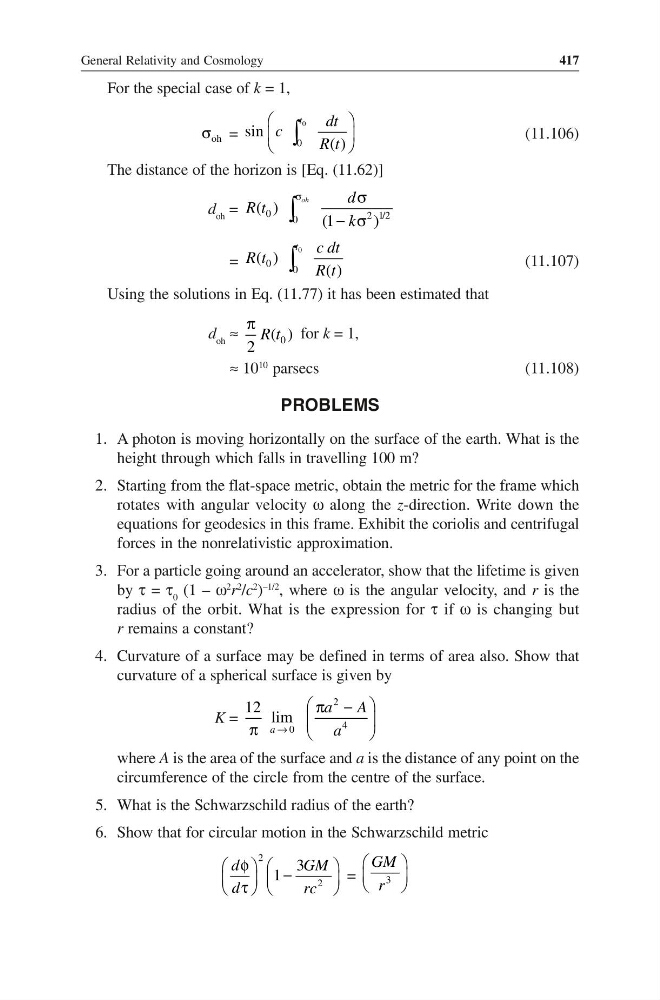
For the special case of k = 1,
oh
σ =
0
0
sin
( )
t
dt
c
R t
∫
(11.106)
The distance of the horizon is [Eq. (11.62)]
d oh =
0
2 1/2
0
( )
(1
)
oh
d
R t
k
σ
σ
− σ
∫
=
0
0
0
( )
( )
t
c dt
R t
R t
∫
(11.107)
Using the solutions in Eq. (11.77) it has been estimated that
d oh ≈
0
( )
2
R t
π
for k = 1,
≈ 10
10
parsecs
(11.108)
PROBLEMS
1. A photon is moving horizontally on the surface of the earth. What is the
height through which falls in travelling 100 m?
2. Starting from the flat-space metric, obtain the metric for the frame which
rotates with angular velocity ω along the z-direction. Write down the
equations for geodesics in this frame. Exhibit the coriolis and centrifugal
forces in the nonrelativistic approximation.
3. For a particle going around an accelerator, show that the lifetime is given
by τ = τ 0 (1 – ω
2
r
2
/c
2
)
–1/2
, where ω is the angular velocity, and r is the
radius of the orbit. What is the expression for τ if ω is changing but
r remains a constant?
4. Curvature of a surface may be defined in terms of area also. Show that
curvature of a spherical surface is given by
K =
2
4
0
2 lim
a
a
A
a
→
1
π −
π
where A is the area of the surface and a is the distance of any point on the
circumference of the circle from the centre of the surface.
5. What is the Schwarzschild radius of the earth?
6. Show that for circular motion in the Schwarzschild metric
2
2
3
1
d
G M
d
rc
φ
−
τ
=
3
GM
r
417
For the special case of k = 1,
oh
σ =
0
0
sin
( )
t
dt
c
R t
∫
(11.106)
The distance of the horizon is [Eq. (11.62)]
d oh =
0
2 1/2
0
( )
(1
)
oh
d
R t
k
σ
σ
− σ
∫
=
0
0
0
( )
( )
t
c dt
R t
R t
∫
(11.107)
Using the solutions in Eq. (11.77) it has been estimated that
d oh ≈
0
( )
2
R t
π
for k = 1,
≈ 10
10
parsecs
(11.108)
PROBLEMS
1. A photon is moving horizontally on the surface of the earth. What is the
height through which falls in travelling 100 m?
2. Starting from the flat-space metric, obtain the metric for the frame which
rotates with angular velocity ω along the z-direction. Write down the
equations for geodesics in this frame. Exhibit the coriolis and centrifugal
forces in the nonrelativistic approximation.
3. For a particle going around an accelerator, show that the lifetime is given
by τ = τ 0 (1 – ω
2
r
2
/c
2
)
–1/2
, where ω is the angular velocity, and r is the
radius of the orbit. What is the expression for τ if ω is changing but
r remains a constant?
4. Curvature of a surface may be defined in terms of area also. Show that
curvature of a spherical surface is given by
K =
2
4
0
2 lim
a
a
A
a
→
1
π −
π
where A is the area of the surface and a is the distance of any point on the
circumference of the circle from the centre of the surface.
5. What is the Schwarzschild radius of the earth?
6. Show that for circular motion in the Schwarzschild metric
2
2
3
1
d
G M
d
rc
φ
−
τ
=
3
GM
r