

Elements of Modern Physics
416
Example 3
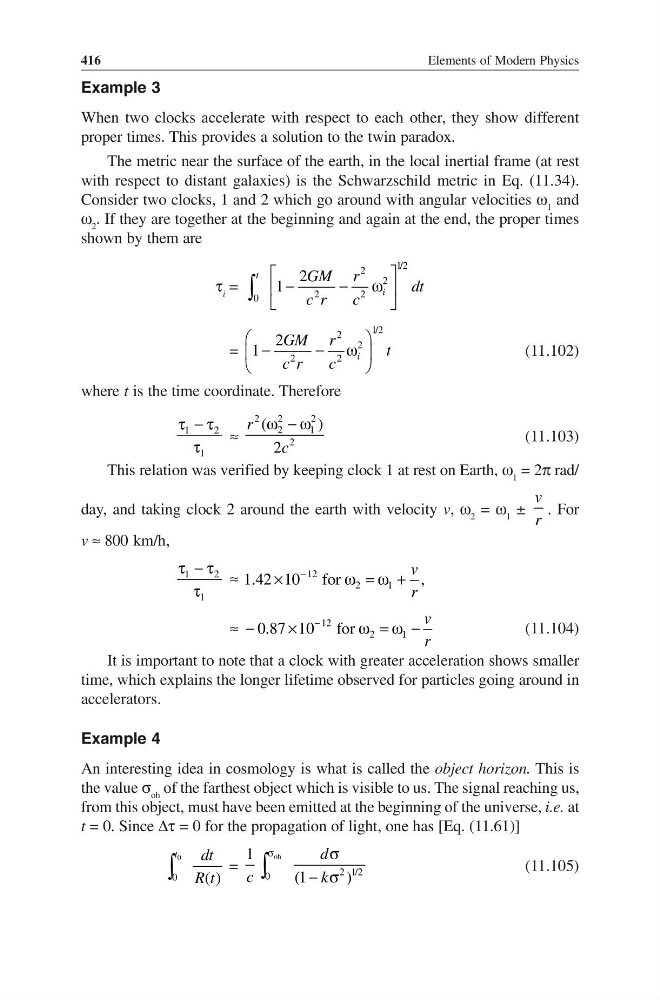
When two clocks accelerate with respect to each other, they show different
proper times. This provides a solution to the twin paradox.
The metric near the surface of the earth, in the local inertial frame (at rest
with respect to distant galaxies) is the Schwarzschild metric in Eq. (11.34).
Consider two clocks, 1 and 2 which go around with angular velocities ω 1 and
ω 2 . If they are together at the beginning and again at the end, the proper times
shown by them are
τ i =
1/2
2
2
2
2
0
2
1
t
i
GM r
dt
c r
c
−
− ω
∫
=
1/2
2
2
2
2
2
1
i
GM r
t
c r
c
−
− ω
(11.102)
where t is the time coordinate. Therefore
1
2
1
τ − τ
τ
≈
2
2
2
2
1
2
(
)
2
r
c
ω − ω
(11.103)
This relation was verified by keeping clock 1 at rest on Earth, ω 1 = 2π rad/
day, and taking clock 2 around the earth with velocity v, ω 2 = ω 1 ±
v
r
. For
v ≈ 800 km/h,
1
2
1
τ − τ
τ
≈
12
2
1
1.42 10 for
,
v
r
−
×
ω =ω +
≈
12
2
1
0.87 10 for
v
r
−
−
×
ω =ω −
(11.104)
It is important to note that a clock with greater acceleration shows smaller
time, which explains the longer lifetime observed for particles going around in
accelerators.
Example 4
An interesting idea in cosmology is what is called the object horizon. This is
the value σ oh of the farthest object which is visible to us. The signal reaching us,
from this object, must have been emitted at the beginning of the universe, i.e. at
t = 0. Since ∆τ = 0 for the propagation of light, one has [Eq. (11.61)]
0
0
( )
t
dt
R t
∫
=
oh
2 1/2
0
1
(1
)
d
c
k
σ
σ
− σ
∫
(11.105)
416
Example 3
When two clocks accelerate with respect to each other, they show different
proper times. This provides a solution to the twin paradox.
The metric near the surface of the earth, in the local inertial frame (at rest
with respect to distant galaxies) is the Schwarzschild metric in Eq. (11.34).
Consider two clocks, 1 and 2 which go around with angular velocities ω 1 and
ω 2 . If they are together at the beginning and again at the end, the proper times
shown by them are
τ i =
1/2
2
2
2
2
0
2
1
t
i
GM r
dt
c r
c
−
− ω
∫
=
1/2
2
2
2
2
2
1
i
GM r
t
c r
c
−
− ω
(11.102)
where t is the time coordinate. Therefore
1
2
1
τ − τ
τ
≈
2
2
2
2
1
2
(
)
2
r
c
ω − ω
(11.103)
This relation was verified by keeping clock 1 at rest on Earth, ω 1 = 2π rad/
day, and taking clock 2 around the earth with velocity v, ω 2 = ω 1 ±
v
r
. For
v ≈ 800 km/h,
1
2
1
τ − τ
τ
≈
12
2
1
1.42 10 for
,
v
r
−
×
ω =ω +
≈
12
2
1
0.87 10 for
v
r
−
−
×
ω =ω −
(11.104)
It is important to note that a clock with greater acceleration shows smaller
time, which explains the longer lifetime observed for particles going around in
accelerators.
Example 4
An interesting idea in cosmology is what is called the object horizon. This is
the value σ oh of the farthest object which is visible to us. The signal reaching us,
from this object, must have been emitted at the beginning of the universe, i.e. at
t = 0. Since ∆τ = 0 for the propagation of light, one has [Eq. (11.61)]
0
0
( )
t
dt
R t
∫
=
oh
2 1/2
0
1
(1
)
d
c
k
σ
σ
− σ
∫
(11.105)