

Elements of Modern Physics
398
is an extremum, where Eq. (11.12) has been used, and s is an arbitrary parameter.
The extremum paths are called geodesics.
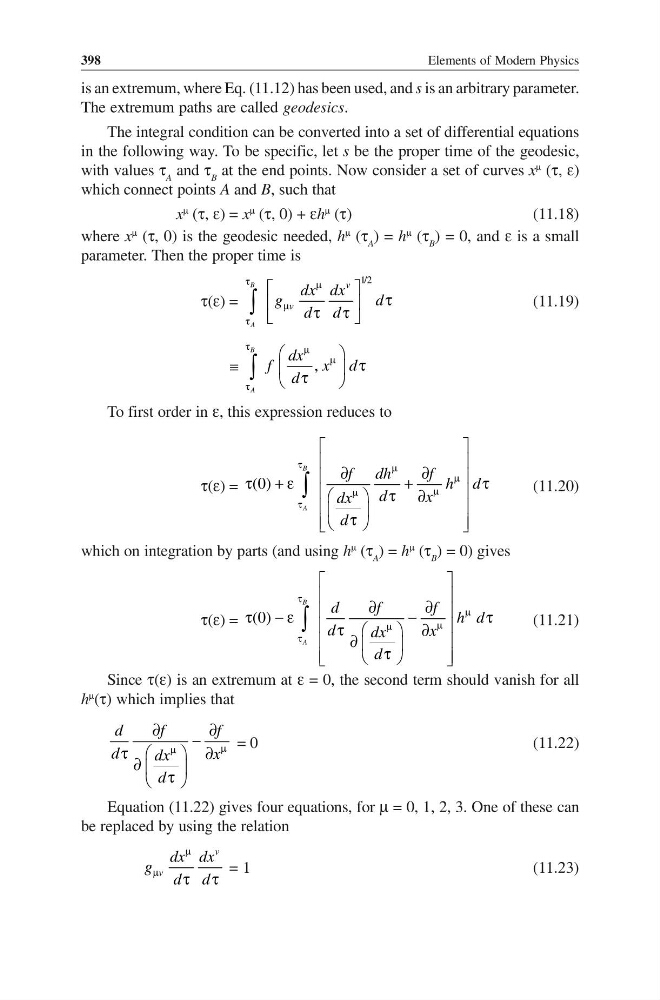
The integral condition can be converted into a set of differential equations
in the following way. To be specific, let s be the proper time of the geodesic,
with values τ A and τ B at the end points. Now consider a set of curves x
µ
(τ, ε)
which connect points A and B, such that
x
µ
(τ, ε) = x
µ
(τ, 0) + εh
µ
(τ)
(11.18)
where x
µ
(τ, 0) is the geodesic needed, h
µ
(τ A ) = h
µ
(τ B ) = 0, and ε is a small
parameter. Then the proper time is
τ(ε) =
1/2
B
A
v
v
dx dx
g
d
d d
τ
µ
µ
τ
τ
τ τ
∫
(11.19)
≡
,
B
A
dx
f
x d
d
τ
µ
µ
τ
τ
τ
∫
To first order in ε, this expression reduces to
τ(ε) = (0)
B
A
f dh
f h d
d
x
dx
d
τ
µ
µ
µ
µ
τ
∂
∂
τ +ε
+
τ
τ
∂
τ
∫
(11.20)
which on integration by parts (and using h
µ
(τ A ) = h
µ
(τ B ) = 0) gives
τ(ε) = (0)
B
A
d
f
f h d
d
x
dx
d
τ
µ
µ
µ
τ
∂
∂
τ −ε
−
τ
τ
∂
∂
τ
∫
(11.21)
Since τ(ε) is an extremum at ε = 0, the second term should vanish for all
h
µ
(τ) which implies that
d
f
f
d
x
dx
d
µ
µ
∂
∂
−
τ
∂
∂
τ
= 0
(11.22)
Equation (11.22) gives four equations, for µ = 0, 1, 2, 3. One of these can
be replaced by using the relation
v
v
dx dx
g d d
µ
µ
τ τ
= 1
(11.23)
398
is an extremum, where Eq. (11.12) has been used, and s is an arbitrary parameter.
The extremum paths are called geodesics.
The integral condition can be converted into a set of differential equations
in the following way. To be specific, let s be the proper time of the geodesic,
with values τ A and τ B at the end points. Now consider a set of curves x
µ
(τ, ε)
which connect points A and B, such that
x
µ
(τ, ε) = x
µ
(τ, 0) + εh
µ
(τ)
(11.18)
where x
µ
(τ, 0) is the geodesic needed, h
µ
(τ A ) = h
µ
(τ B ) = 0, and ε is a small
parameter. Then the proper time is
τ(ε) =
1/2
B
A
v
v
dx dx
g
d
d d
τ
µ
µ
τ
τ
τ τ
∫
(11.19)
≡
,
B
A
dx
f
x d
d
τ
µ
µ
τ
τ
τ
∫
To first order in ε, this expression reduces to
τ(ε) = (0)
B
A
f dh
f h d
d
x
dx
d
τ
µ
µ
µ
µ
τ
∂
∂
τ +ε
+
τ
τ
∂
τ
∫
(11.20)
which on integration by parts (and using h
µ
(τ A ) = h
µ
(τ B ) = 0) gives
τ(ε) = (0)
B
A
d
f
f h d
d
x
dx
d
τ
µ
µ
µ
τ
∂
∂
τ −ε
−
τ
τ
∂
∂
τ
∫
(11.21)
Since τ(ε) is an extremum at ε = 0, the second term should vanish for all
h
µ
(τ) which implies that
d
f
f
d
x
dx
d
µ
µ
∂
∂
−
τ
∂
∂
τ
= 0
(11.22)
Equation (11.22) gives four equations, for µ = 0, 1, 2, 3. One of these can
be replaced by using the relation
v
v
dx dx
g d d
µ
µ
τ τ
= 1
(11.23)