

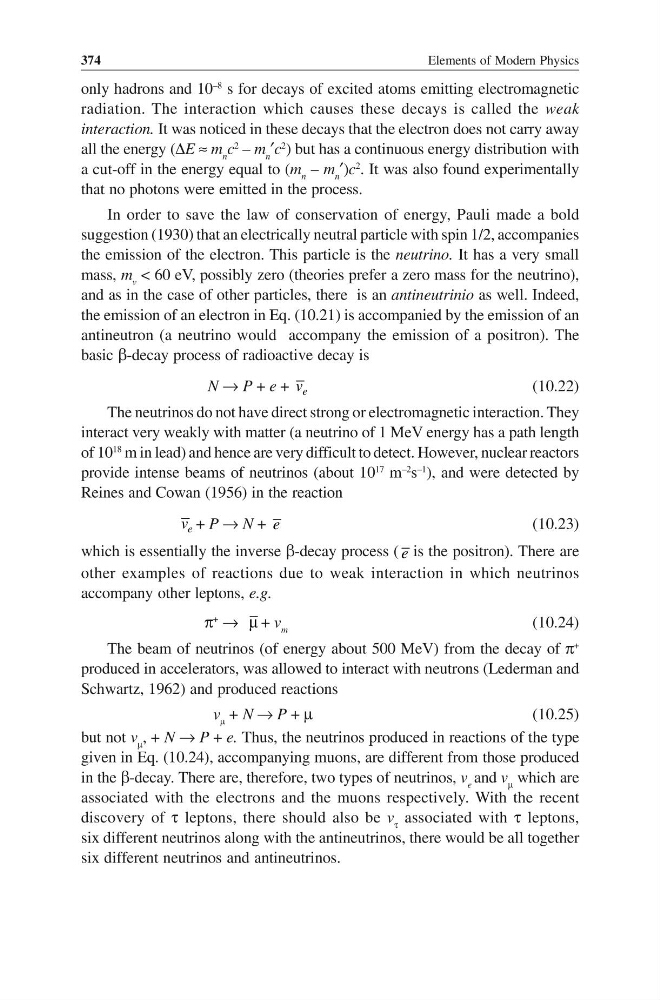
Elements of Modern Physics
374
only hadrons and 10
–8
s for decays of excited atoms emitting electromagnetic
radiation. The interaction which causes these decays is called the weak
interaction. It was noticed in these decays that the electron does not carry away
all the energy (∆E ≈ m n c
2
– m n ′c
2
) but has a continuous energy distribution with
a cut-off in the energy equal to (m n – m n ′)c
2
. It was also found experimentally
that no photons were emitted in the process.
In order to save the law of conservation of energy, Pauli made a bold
suggestion (1930) that an electrically neutral particle with spin 1/2, accompanies
the emission of the electron. This particle is the neutrino. It has a very small
mass, m v < 60 eV, possibly zero (theories prefer a zero mass for the neutrino),
and as in the case of other particles, there is an antineutrinio as well. Indeed,
the emission of an electron in Eq. (10.21) is accompanied by the emission of an
antineutron (a neutrino would accompany the emission of a positron). The
basic β-decay process of radioactive decay is
N → P + e + e
v
(10.22)
The neutrinos do not have direct strong or electromagnetic interaction. They
interact very weakly with matter (a neutrino of 1 MeV energy has a path length
of 10
18
m in lead) and hence are very difficult to detect. However, nuclear reactors
provide intense beams of neutrinos (about 10
17
m
–2
s
–1
), and were detected by
Reines and Cowan (1956) in the reaction
e
v + P → N + e
(10.23)
which is essentially the inverse β-decay process ( e is the positron). There are
other examples of reactions due to weak interaction in which neutrinos
accompany other leptons, e.g.
π
+
→ m + v m
(10.24)
The beam of neutrinos (of energy about 500 MeV) from the decay of π
+
produced in accelerators, was allowed to interact with neutrons (Lederman and
Schwartz, 1962) and produced reactions
v µ + N → P + µ
(10.25)
but not v µ , + N → P + e. Thus, the neutrinos produced in reactions of the type
given in Eq. (10.24), accompanying muons, are different from those produced
in the β-decay. There are, therefore, two types of neutrinos, v e and v µ which are
associated with the electrons and the muons respectively. With the recent
discovery of τ leptons, there should also be v τ associated with τ leptons,
six different neutrinos along with the antineutrinos, there would be all together
six different neutrinos and antineutrinos.
374
only hadrons and 10
–8
s for decays of excited atoms emitting electromagnetic
radiation. The interaction which causes these decays is called the weak
interaction. It was noticed in these decays that the electron does not carry away
all the energy (∆E ≈ m n c
2
– m n ′c
2
) but has a continuous energy distribution with
a cut-off in the energy equal to (m n – m n ′)c
2
. It was also found experimentally
that no photons were emitted in the process.
In order to save the law of conservation of energy, Pauli made a bold
suggestion (1930) that an electrically neutral particle with spin 1/2, accompanies
the emission of the electron. This particle is the neutrino. It has a very small
mass, m v < 60 eV, possibly zero (theories prefer a zero mass for the neutrino),
and as in the case of other particles, there is an antineutrinio as well. Indeed,
the emission of an electron in Eq. (10.21) is accompanied by the emission of an
antineutron (a neutrino would accompany the emission of a positron). The
basic β-decay process of radioactive decay is
N → P + e + e
v
(10.22)
The neutrinos do not have direct strong or electromagnetic interaction. They
interact very weakly with matter (a neutrino of 1 MeV energy has a path length
of 10
18
m in lead) and hence are very difficult to detect. However, nuclear reactors
provide intense beams of neutrinos (about 10
17
m
–2
s
–1
), and were detected by
Reines and Cowan (1956) in the reaction
e
v + P → N + e
(10.23)
which is essentially the inverse β-decay process ( e is the positron). There are
other examples of reactions due to weak interaction in which neutrinos
accompany other leptons, e.g.
π
+
→ m + v m
(10.24)
The beam of neutrinos (of energy about 500 MeV) from the decay of π
+
produced in accelerators, was allowed to interact with neutrons (Lederman and
Schwartz, 1962) and produced reactions
v µ + N → P + µ
(10.25)
but not v µ , + N → P + e. Thus, the neutrinos produced in reactions of the type
given in Eq. (10.24), accompanying muons, are different from those produced
in the β-decay. There are, therefore, two types of neutrinos, v e and v µ which are
associated with the electrons and the muons respectively. With the recent
discovery of τ leptons, there should also be v τ associated with τ leptons,
six different neutrinos along with the antineutrinos, there would be all together
six different neutrinos and antineutrinos.