

Elementary Particles
373
interactions, given by α in Eq. (10.16), is quite small, results can be obtained in
powers of α using perturbation theory.
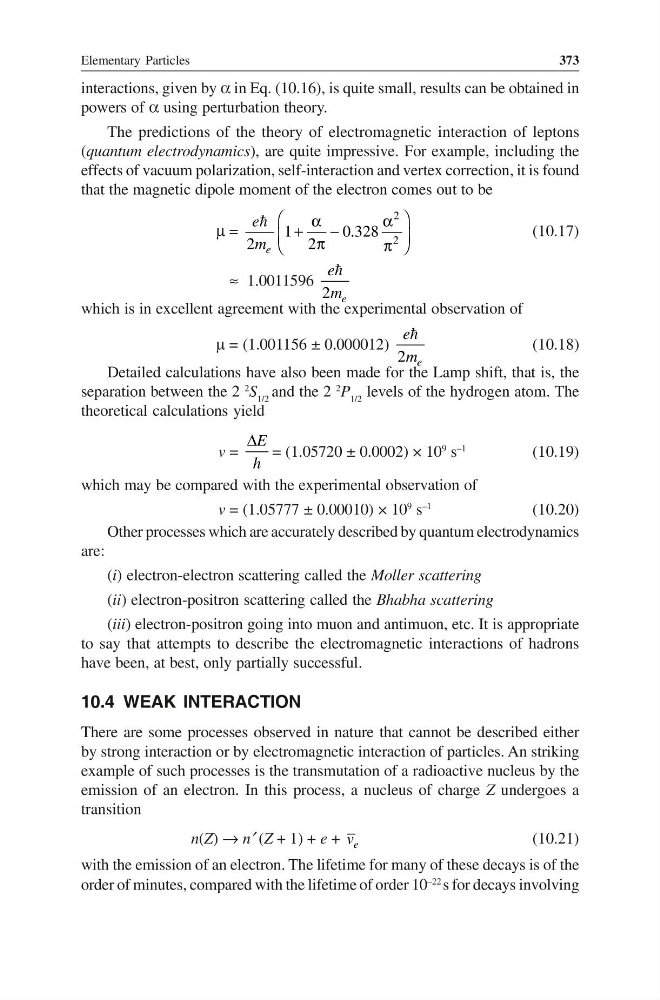
The predictions of the theory of electromagnetic interaction of leptons
(quantum electrodynamics), are quite impressive. For example, including the
effects of vacuum polarization, self-interaction and vertex correction, it is found
that the magnetic dipole moment of the electron comes out to be
µ =
2
2
1
0.328
2
2
e
e
m
Ê
ˆ
a
a
+
-
Á
˜
p
Ë
¯
p
(10.17)
≈ 1.0011596 2 e
e
m
which is in excellent agreement with the experimental observation of
µ = (1.001156 ± 0.000012) 2 e
e
m
(10.18)
Detailed calculations have also been made for the Lamp shift, that is, the
separation between the 2
2
S 1/2 and the 2
2
P 1/2 levels of the hydrogen atom. The
theoretical calculations yield
v =
E
h
D = (1.05720 ± 0.0002) × 10
9
s
–1
(10.19)
which may be compared with the experimental observation of
v = (1.05777 ± 0.00010) × 10
9
s
–1
(10.20)
Other processes which are accurately described by quantum electrodynamics
are:
(i) electron-electron scattering called the Moller scattering
(ii) electron-positron scattering called the Bhabha scattering
(iii) electron-positron going into muon and antimuon, etc. It is appropriate
to say that attempts to describe the electromagnetic interactions of hadrons
have been, at best, only partially successful.
10.4 WEAK INTERACTION
There are some processes observed in nature that cannot be described either
by strong interaction or by electromagnetic interaction of particles. An striking
example of such processes is the transmutation of a radioactive nucleus by the
emission of an electron. In this process, a nucleus of charge Z undergoes a
transition
n(Z) → n′ (Z + 1) + e + e
v
(10.21)
with the emission of an electron. The lifetime for many of these decays is of the
order of minutes, compared with the lifetime of order 10
–22
s for decays involving
373
interactions, given by α in Eq. (10.16), is quite small, results can be obtained in
powers of α using perturbation theory.
The predictions of the theory of electromagnetic interaction of leptons
(quantum electrodynamics), are quite impressive. For example, including the
effects of vacuum polarization, self-interaction and vertex correction, it is found
that the magnetic dipole moment of the electron comes out to be
µ =
2
2
1
0.328
2
2
e
e
m
Ê
ˆ
a
a
+
-
Á
˜
p
Ë
¯
p
(10.17)
≈ 1.0011596 2 e
e
m
which is in excellent agreement with the experimental observation of
µ = (1.001156 ± 0.000012) 2 e
e
m
(10.18)
Detailed calculations have also been made for the Lamp shift, that is, the
separation between the 2
2
S 1/2 and the 2
2
P 1/2 levels of the hydrogen atom. The
theoretical calculations yield
v =
E
h
D = (1.05720 ± 0.0002) × 10
9
s
–1
(10.19)
which may be compared with the experimental observation of
v = (1.05777 ± 0.00010) × 10
9
s
–1
(10.20)
Other processes which are accurately described by quantum electrodynamics
are:
(i) electron-electron scattering called the Moller scattering
(ii) electron-positron scattering called the Bhabha scattering
(iii) electron-positron going into muon and antimuon, etc. It is appropriate
to say that attempts to describe the electromagnetic interactions of hadrons
have been, at best, only partially successful.
10.4 WEAK INTERACTION
There are some processes observed in nature that cannot be described either
by strong interaction or by electromagnetic interaction of particles. An striking
example of such processes is the transmutation of a radioactive nucleus by the
emission of an electron. In this process, a nucleus of charge Z undergoes a
transition
n(Z) → n′ (Z + 1) + e + e
v
(10.21)
with the emission of an electron. The lifetime for many of these decays is of the
order of minutes, compared with the lifetime of order 10
–22
s for decays involving