

Elements of Modern Physics
348
for incident energies less than about 50 MeV, a nuclear reaction proceeds in
two stages. In the first stage, the projectile a is captured by the nucleus, forming
a compound nucleus c* which is usually an excited state of a nucleus. Such a
compound nucleus had a lifetime of about 10
–18
s, considerably longer than the
time taken by the projectile to cross the nucleus (t cross ~ R /v ≈ 10
–21
s). During
this time, the compound nucleus will have ‘forgotten’ the way it was formed. In
the second stage, this compound nucleus will decay independently of the mode
of its formation. The two stage process may be indicated by
X + a → C* → Y + b
(9.98)
The corresponding cross-section is factorizable, i.e.
σ [X (a,b) Y] = F (X, a) G (Y, b)
(9.99)
where F and G depend on the energy, spin, etc. of X, a and Y, b respectively. An
important result which follows immediately is that the ratio of the reaction
rates at a given energy, is independent of the initial state, i.e.
[ ( , ) ]
[ ( , ) ]
X a b Y
X a b Y
σ
σ
′
′
=
( , )
( , )
G Y b
G Y b
′ ′
(9.100)
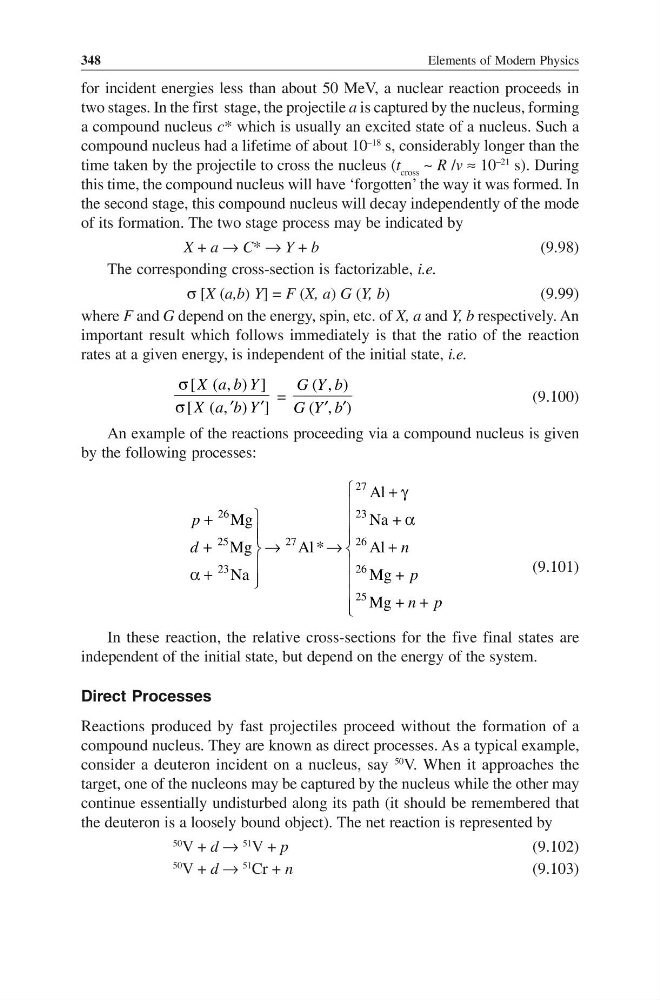
An example of the reactions proceeding via a compound nucleus is given
by the following processes:
27
26
23
25
27
26
23
26
25
Al
Mg
Na +
Mg
Al *
Al
Na
Mg +
Mg +
p
d
n
p
n p
+ γ
+
α
+
→
→
+
α +
+
(9.101)
In these reaction, the relative cross-sections for the five final states are
independent of the initial state, but depend on the energy of the system.
Direct Processes
Reactions produced by fast projectiles proceed without the formation of a
compound nucleus. They are known as direct processes. As a typical example,
consider a deuteron incident on a nucleus, say
50
V. When it approaches the
target, one of the nucleons may be captured by the nucleus while the other may
continue essentially undisturbed along its path (it should be remembered that
the deuteron is a loosely bound object). The net reaction is represented by
50
V + d →
51
V + p
(9.102)
50
V + d →
51
Cr + n
(9.103)
348
for incident energies less than about 50 MeV, a nuclear reaction proceeds in
two stages. In the first stage, the projectile a is captured by the nucleus, forming
a compound nucleus c* which is usually an excited state of a nucleus. Such a
compound nucleus had a lifetime of about 10
–18
s, considerably longer than the
time taken by the projectile to cross the nucleus (t cross ~ R /v ≈ 10
–21
s). During
this time, the compound nucleus will have ‘forgotten’ the way it was formed. In
the second stage, this compound nucleus will decay independently of the mode
of its formation. The two stage process may be indicated by
X + a → C* → Y + b
(9.98)
The corresponding cross-section is factorizable, i.e.
σ [X (a,b) Y] = F (X, a) G (Y, b)
(9.99)
where F and G depend on the energy, spin, etc. of X, a and Y, b respectively. An
important result which follows immediately is that the ratio of the reaction
rates at a given energy, is independent of the initial state, i.e.
[ ( , ) ]
[ ( , ) ]
X a b Y
X a b Y
σ
σ
′
′
=
( , )
( , )
G Y b
G Y b
′ ′
(9.100)
An example of the reactions proceeding via a compound nucleus is given
by the following processes:
27
26
23
25
27
26
23
26
25
Al
Mg
Na +
Mg
Al *
Al
Na
Mg +
Mg +
p
d
n
p
n p
+ γ
+
α
+
→
→
+
α +
+
(9.101)
In these reaction, the relative cross-sections for the five final states are
independent of the initial state, but depend on the energy of the system.
Direct Processes
Reactions produced by fast projectiles proceed without the formation of a
compound nucleus. They are known as direct processes. As a typical example,
consider a deuteron incident on a nucleus, say
50
V. When it approaches the
target, one of the nucleons may be captured by the nucleus while the other may
continue essentially undisturbed along its path (it should be remembered that
the deuteron is a loosely bound object). The net reaction is represented by
50
V + d →
51
V + p
(9.102)
50
V + d →
51
Cr + n
(9.103)