

The Nucleus
347
time spent by the neutron inside the nucleus is proportional to
1
v
,v being the
neutron velocity, it is expected that the effective cross-section increases as
1
v
at
low energies,
σ ~
1
v
~ E
–1/2
for small E
(9.97)
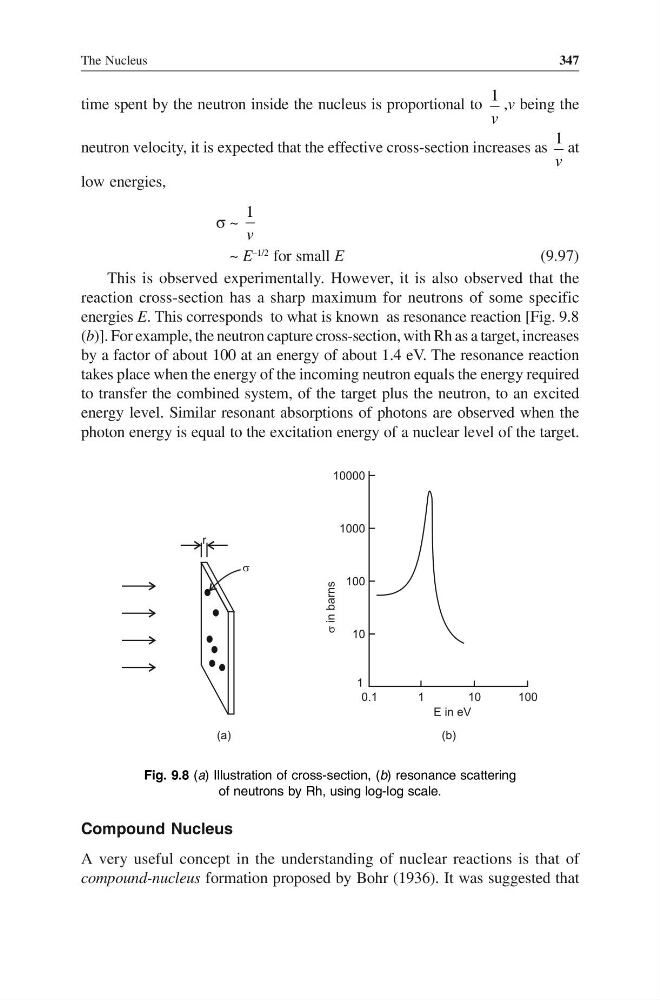
This is observed experimentally. However, it is also observed that the
reaction cross-section has a sharp maximum for neutrons of some specific
energies E. This corresponds to what is known as resonance reaction [Fig. 9.8
(b)]. For example, the neutron capture cross-section, with Rh as a target, increases
by a factor of about 100 at an energy of about 1.4 eV. The resonance reaction
takes place when the energy of the incoming neutron equals the energy required
to transfer the combined system, of the target plus the neutron, to an excited
energy level. Similar resonant absorptions of photons are observed when the
photon energy is equal to the excitation energy of a nuclear level of the target.
r
s
(a)
0.1
1
10
100
E in eV
(b)
10000
1000
100
10
1
s in barns
Fig. 9.8 (a) Illustration of cross-section, (b) resonance scattering
of neutrons by Rh, using log-log scale.
Compound Nucleus
A very useful concept in the understanding of nuclear reactions is that of
compound-nucleus formation proposed by Bohr (1936). It was suggested that
347
time spent by the neutron inside the nucleus is proportional to
1
v
,v being the
neutron velocity, it is expected that the effective cross-section increases as
1
v
at
low energies,
σ ~
1
v
~ E
–1/2
for small E
(9.97)
This is observed experimentally. However, it is also observed that the
reaction cross-section has a sharp maximum for neutrons of some specific
energies E. This corresponds to what is known as resonance reaction [Fig. 9.8
(b)]. For example, the neutron capture cross-section, with Rh as a target, increases
by a factor of about 100 at an energy of about 1.4 eV. The resonance reaction
takes place when the energy of the incoming neutron equals the energy required
to transfer the combined system, of the target plus the neutron, to an excited
energy level. Similar resonant absorptions of photons are observed when the
photon energy is equal to the excitation energy of a nuclear level of the target.
r
s
(a)
0.1
1
10
100
E in eV
(b)
10000
1000
100
10
1
s in barns
Fig. 9.8 (a) Illustration of cross-section, (b) resonance scattering
of neutrons by Rh, using log-log scale.
Compound Nucleus
A very useful concept in the understanding of nuclear reactions is that of
compound-nucleus formation proposed by Bohr (1936). It was suggested that