

The Nucleus
331
Angular momenta: The shell model allows us to predict the angular
momenta of the nuclei, for example, the angular momentum of a closed shell is
predicted by the Pauli exclusion principle, to be zero. If further, it is postulated
that like nucleons in a shell pair off in such a way that their total angular
momentum is zero, it follows that (i) all even A, even Z nuclei have zero angular
momentum, (ii) the angular momentum of odd A nuclei is due to the odd nucleon.
These results are generally observed to be true with a few exceptions. Some of
the exceptions are
2 3
1 1 Na with j = 3/2 instead of 5/2,
5 5
2 5 Mn with j = 5/2 instead
of 7/2, and
7 9
3 4 Se with j = 7/2 instead of j = 9/2. In all other cases the predictions
are consistent with experimental observations, e.g.
209
83 B has j = 9/2.
Magnetic moments: The magnetic moments of odd-A nuclei can be
estimated under the assumption that they are due to the odd nucleon (the magnetic
moments of even Z, even A nuclei are zero, while those of odd Z, even A nuclei
are difficult to analyse). The magnetic moment of the nucleon is both due to its
spin as well as its orbital angular momentum and is given by
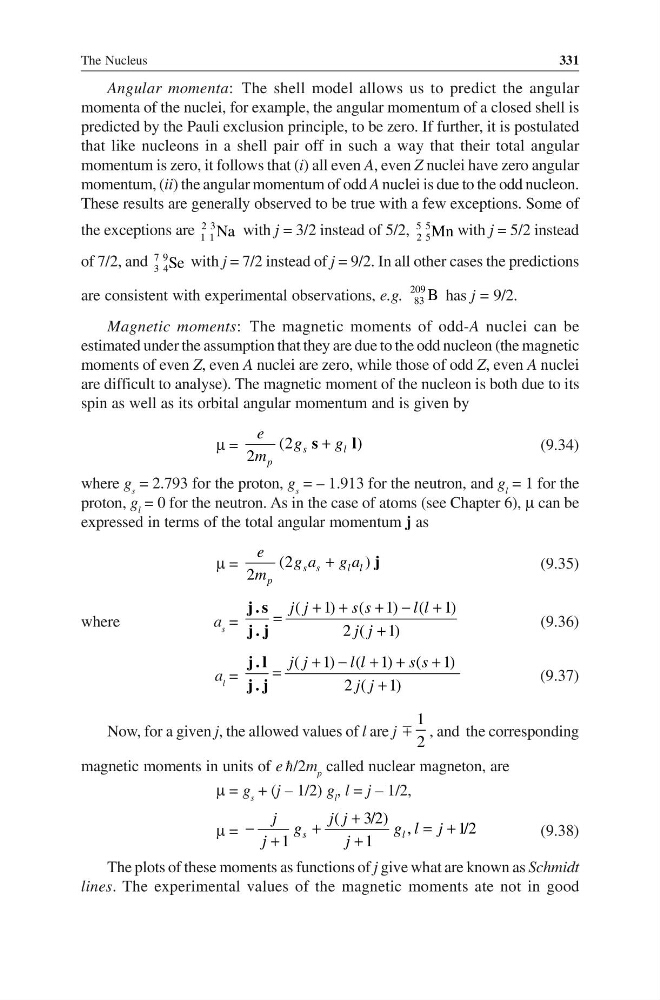
µ =
(2
)
2
s
l
p
e
g
g
m
+
s
l
(9.34)
where g s = 2.793 for the proton, g s = – 1.913 for the neutron, and g l = 1 for the
proton, g l = 0 for the neutron. As in the case of atoms (see Chapter 6), µ can be
expressed in terms of the total angular momentum j as
µ =
(2
)
2
s s
l l
p
e
g a g a
m
+
j
(9.35)
where
a s =
( 1) ( 1) ( 1)
2 ( 1)
j j
s s
l l
j j
+ +
+ − +
=
+
j . s
j . j
(9.36)
a l =
( 1) ( 1) ( 1)
2 ( 1)
j j
l l
s s
j j
+ − + +
+
=
+
j . l
j . j
(9.37)
Now, for a given j, the allowed values of l are j
1
2
∓ , and the corresponding
magnetic moments in units of e /2m p called nuclear magneton, are
µ = g s + (j – 1/2) g l , l = j – 1/2,
µ =
( 3/2) ,
1 /2
1
1
s
l
j
j j
g
g l j
j
j
+
−
+
= +
+
+
(9.38)
The plots of these moments as functions of j give what are known as Schmidt
lines. The experimental values of the magnetic moments ate not in good
331
Angular momenta: The shell model allows us to predict the angular
momenta of the nuclei, for example, the angular momentum of a closed shell is
predicted by the Pauli exclusion principle, to be zero. If further, it is postulated
that like nucleons in a shell pair off in such a way that their total angular
momentum is zero, it follows that (i) all even A, even Z nuclei have zero angular
momentum, (ii) the angular momentum of odd A nuclei is due to the odd nucleon.
These results are generally observed to be true with a few exceptions. Some of
the exceptions are
2 3
1 1 Na with j = 3/2 instead of 5/2,
5 5
2 5 Mn with j = 5/2 instead
of 7/2, and
7 9
3 4 Se with j = 7/2 instead of j = 9/2. In all other cases the predictions
are consistent with experimental observations, e.g.
209
83 B has j = 9/2.
Magnetic moments: The magnetic moments of odd-A nuclei can be
estimated under the assumption that they are due to the odd nucleon (the magnetic
moments of even Z, even A nuclei are zero, while those of odd Z, even A nuclei
are difficult to analyse). The magnetic moment of the nucleon is both due to its
spin as well as its orbital angular momentum and is given by
µ =
(2
)
2
s
l
p
e
g
g
m
+
s
l
(9.34)
where g s = 2.793 for the proton, g s = – 1.913 for the neutron, and g l = 1 for the
proton, g l = 0 for the neutron. As in the case of atoms (see Chapter 6), µ can be
expressed in terms of the total angular momentum j as
µ =
(2
)
2
s s
l l
p
e
g a g a
m
+
j
(9.35)
where
a s =
( 1) ( 1) ( 1)
2 ( 1)
j j
s s
l l
j j
+ +
+ − +
=
+
j . s
j . j
(9.36)
a l =
( 1) ( 1) ( 1)
2 ( 1)
j j
l l
s s
j j
+ − + +
+
=
+
j . l
j . j
(9.37)
Now, for a given j, the allowed values of l are j
1
2
∓ , and the corresponding
magnetic moments in units of e /2m p called nuclear magneton, are
µ = g s + (j – 1/2) g l , l = j – 1/2,
µ =
( 3/2) ,
1 /2
1
1
s
l
j
j j
g
g l j
j
j
+
−
+
= +
+
+
(9.38)
The plots of these moments as functions of j give what are known as Schmidt
lines. The experimental values of the magnetic moments ate not in good