

Elements of Modern Physics
330
n = 6
s
d
g
i
11/2
13/2
3/2
5/2
7/2
9/2
11/2
5/2
9/2
3/2
7/2
1/2 3/2
5/2
7/2
1/2
3/2
5/2
n = 5
n = 4
n = 3
n = 2
n = 1
n = 0
1/2
3/2
126
82
50
28
20
8
2
p
f
h
s
d
g
p
f
s
d
p
s
Oscillator levels
Perturbed
oscillator
levels
Spin-orbit
coupling
Shells
1/2
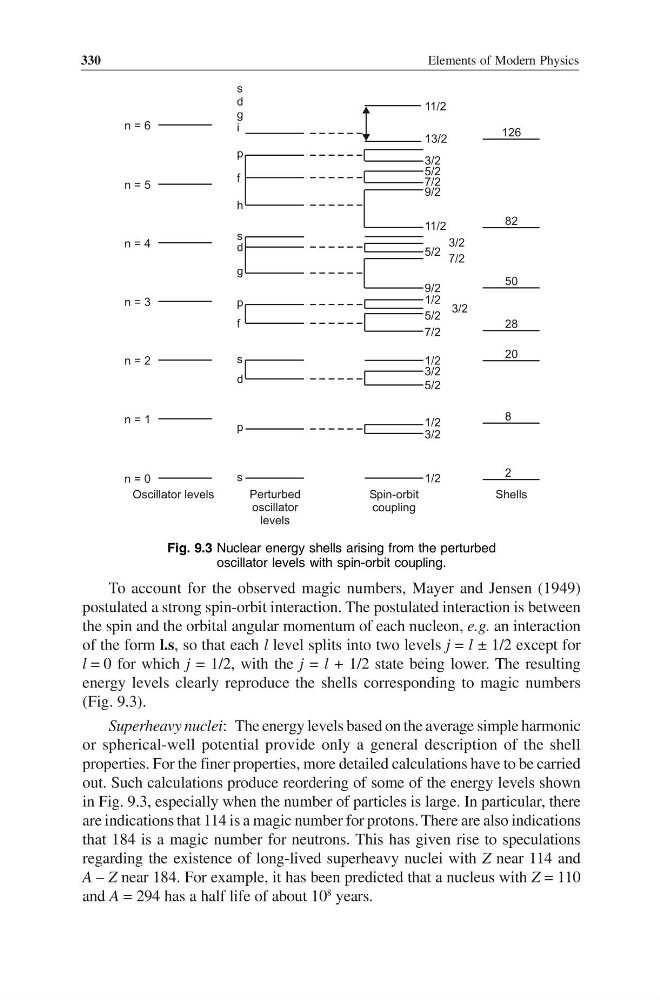
Fig. 9.3 Nuclear energy shells arising from the perturbed
oscillator levels with spin-orbit coupling.
To account for the observed magic numbers, Mayer and Jensen (1949)
postulated a strong spin-orbit interaction. The postulated interaction is between
the spin and the orbital angular momentum of each nucleon, e.g. an interaction
of the form l.s, so that each l level splits into two levels j = l ± 1/2 except for
l = 0 for which j = 1/2, with the j = l + 1/2 state being lower. The resulting
energy levels clearly reproduce the shells corresponding to magic numbers
(Fig. 9.3).
Superheavy nuclei: The energy levels based on the average simple harmonic
or spherical-well potential provide only a general description of the shell
properties. For the finer properties, more detailed calculations have to be carried
out. Such calculations produce reordering of some of the energy levels shown
in Fig. 9.3, especially when the number of particles is large. In particular, there
are indications that 114 is a magic number for protons. There are also indications
that 184 is a magic number for neutrons. This has given rise to speculations
regarding the existence of long-lived superheavy nuclei with Z near 114 and
A – Z near 184. For example, it has been predicted that a nucleus with Z = 110
and A = 294 has a half life of about 10
8
years.
330
n = 6
s
d
g
i
11/2
13/2
3/2
5/2
7/2
9/2
11/2
5/2
9/2
3/2
7/2
1/2 3/2
5/2
7/2
1/2
3/2
5/2
n = 5
n = 4
n = 3
n = 2
n = 1
n = 0
1/2
3/2
126
82
50
28
20
8
2
p
f
h
s
d
g
p
f
s
d
p
s
Oscillator levels
Perturbed
oscillator
levels
Spin-orbit
coupling
Shells
1/2
Fig. 9.3 Nuclear energy shells arising from the perturbed
oscillator levels with spin-orbit coupling.
To account for the observed magic numbers, Mayer and Jensen (1949)
postulated a strong spin-orbit interaction. The postulated interaction is between
the spin and the orbital angular momentum of each nucleon, e.g. an interaction
of the form l.s, so that each l level splits into two levels j = l ± 1/2 except for
l = 0 for which j = 1/2, with the j = l + 1/2 state being lower. The resulting
energy levels clearly reproduce the shells corresponding to magic numbers
(Fig. 9.3).
Superheavy nuclei: The energy levels based on the average simple harmonic
or spherical-well potential provide only a general description of the shell
properties. For the finer properties, more detailed calculations have to be carried
out. Such calculations produce reordering of some of the energy levels shown
in Fig. 9.3, especially when the number of particles is large. In particular, there
are indications that 114 is a magic number for protons. There are also indications
that 184 is a magic number for neutrons. This has given rise to speculations
regarding the existence of long-lived superheavy nuclei with Z near 114 and
A – Z near 184. For example, it has been predicted that a nucleus with Z = 110
and A = 294 has a half life of about 10
8
years.