

The Nucleus
327
Nucleon-Nucleon Interaction
The forces between two nucleons from the basis of nuclear interactions. An
important part of these forces is from the exchange of π-mesons.
A nucleon is continuously emitting and absorbing virtual π-mesons, and is
effectively surrounded by a cloud formed by them. These processes are regarded
as virtual since total energy and momentum conservation would forbid them,
but the uncertainty principle allows them to take place over short distances and
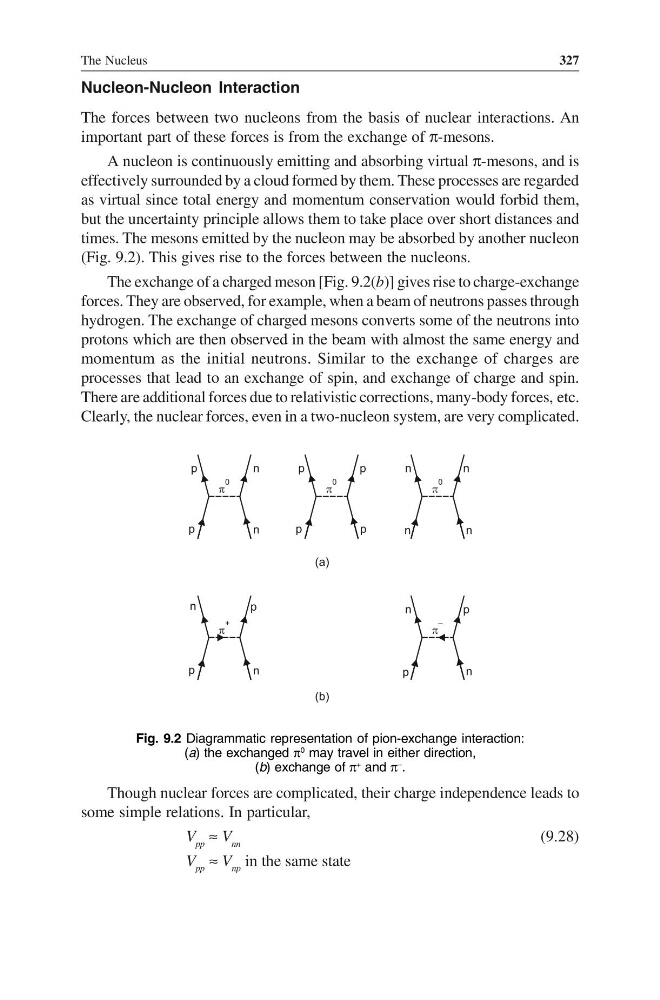
times. The mesons emitted by the nucleon may be absorbed by another nucleon
(Fig. 9.2). This gives rise to the forces between the nucleons.
The exchange of a charged meson [Fig. 9.2(b)] gives rise to charge-exchange
forces. They are observed, for example, when a beam of neutrons passes through
hydrogen. The exchange of charged mesons converts some of the neutrons into
protons which are then observed in the beam with almost the same energy and
momentum as the initial neutrons. Similar to the exchange of charges are
processes that lead to an exchange of spin, and exchange of charge and spin.
There are additional forces due to relativistic corrections, many-body forces, etc.
Clearly, the nuclear forces, even in a two-nucleon system, are very complicated.
p
n
p
n
p
0
p
p
p
0
n
p
0
(a)
p
p
n
n
n
n
p
p
n
p
+
n
p
–
p
p
n
(b)
Fig. 9.2 Diagrammatic representation of pion-exchange interaction:
(a) the exchanged π
0
may travel in either direction,
(b) exchange of π
+
and π
–
.
Though nuclear forces are complicated, their charge independence leads to
some simple relations. In particular,
V pp ≈ V nn
(9.28)
V pp ≈ V np in the same state
327
Nucleon-Nucleon Interaction
The forces between two nucleons from the basis of nuclear interactions. An
important part of these forces is from the exchange of π-mesons.
A nucleon is continuously emitting and absorbing virtual π-mesons, and is
effectively surrounded by a cloud formed by them. These processes are regarded
as virtual since total energy and momentum conservation would forbid them,
but the uncertainty principle allows them to take place over short distances and
times. The mesons emitted by the nucleon may be absorbed by another nucleon
(Fig. 9.2). This gives rise to the forces between the nucleons.
The exchange of a charged meson [Fig. 9.2(b)] gives rise to charge-exchange
forces. They are observed, for example, when a beam of neutrons passes through
hydrogen. The exchange of charged mesons converts some of the neutrons into
protons which are then observed in the beam with almost the same energy and
momentum as the initial neutrons. Similar to the exchange of charges are
processes that lead to an exchange of spin, and exchange of charge and spin.
There are additional forces due to relativistic corrections, many-body forces, etc.
Clearly, the nuclear forces, even in a two-nucleon system, are very complicated.
p
n
p
n
p
0
p
p
p
0
n
p
0
(a)
p
p
n
n
n
n
p
p
n
p
+
n
p
–
p
p
n
(b)
Fig. 9.2 Diagrammatic representation of pion-exchange interaction:
(a) the exchanged π
0
may travel in either direction,
(b) exchange of π
+
and π
–
.
Though nuclear forces are complicated, their charge independence leads to
some simple relations. In particular,
V pp ≈ V nn
(9.28)
V pp ≈ V np in the same state